
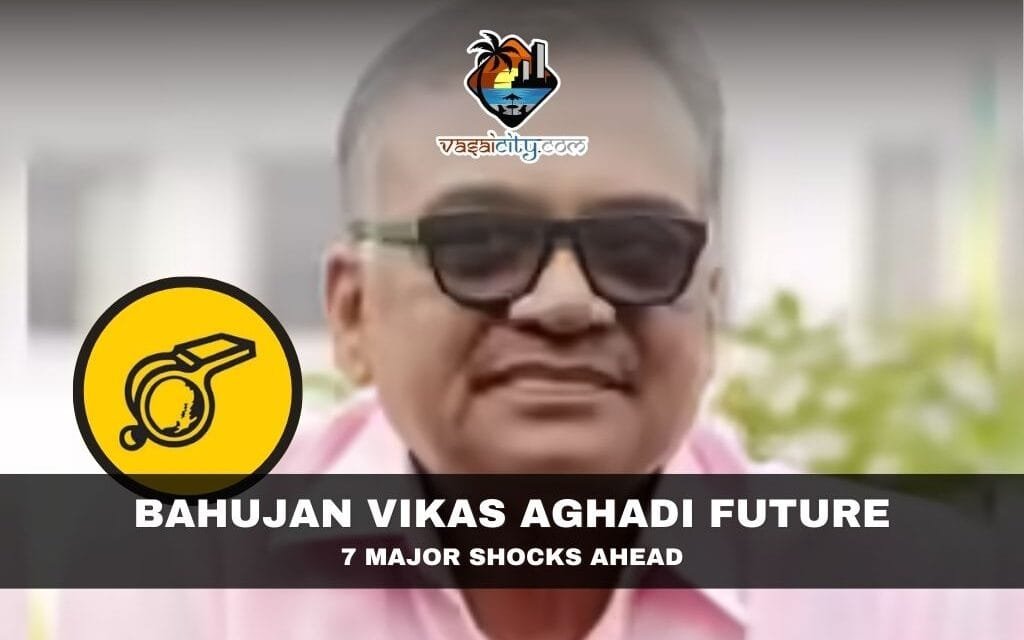
Bahujan Vikas Aghadi future has become a hot topic in Vasai-Virar’s political circles after a series of dramatic electoral setbacks. Once considered an unchallenged regional powerhouse, the Bahujan Vikas Aghadi (BVA) is now facing tough questions about its relevance, strategy, and survival in changing political times.
While the party continues to hold influence in parts of the Vasai-Virar subregion, recent defeats in both the Lok Sabha and Maharashtra Assembly elections have exposed deep cracks within its organisation. For local voters, political observers, and party workers alike, the Bahujan Vikas Aghadi future now appears uncertain and full of challenges.
Table of Contents
Bahujan Vikas Aghadi Future After Consecutive Election Losses
The biggest concern surrounding the Bahujan Vikas Aghadi future is its poor electoral performance at higher levels. In the recent Assembly elections, the BVA contested six seats but failed to win even one. This included three seats that the party had previously held, making the losses even more significant.
These defeats have made it clear that BVA has struggled to expand beyond its traditional stronghold. More importantly, it is now finding it difficult to even retain dominance within areas it once controlled comfortably.
For many voters in Vasai and Virar, this signals a shift in political loyalty towards larger state and national parties that appear better aligned with Maharashtra’s broader political mood.
Erosion of Grassroots Support Worries Party Leadership
Another major factor shaping the Bahujan Vikas Aghadi future is the steady erosion of its grassroots network. After the election defeats, several influential ward-level leaders and long-time party workers have reportedly left BVA.
Many of these leaders have shifted their allegiance to the Bharatiya Janata Party (BJP), which currently enjoys strong organisational backing and political momentum in the region.
This internal churn has weakened BVA’s booth-level machinery, once considered its biggest strength during municipal and local body elections.
Alliance Politics and the Maha Vikas Aghadi Question
Political experts believe that the Bahujan Vikas Aghadi future may depend heavily on alliances. One possible option is a strategic tie-up with the Maha Vikas Aghadi (MVA) coalition.
However, such an alliance will not be easy. Seat-sharing negotiations, ideological differences, and unresolved past rivalries could pose serious hurdles. Without careful planning and compromise, these challenges may outweigh the benefits of joining hands with a larger coalition.
Still, without broader support, reclaiming power in Vasai taluka may remain a distant dream for the party.
Bahujan Vikas Aghadi Future in VVCMC Elections
The upcoming Vasai Virar City Municipal Corporation (VVCMC) elections will be a critical test for the Bahujan Vikas Aghadi future.
In 2015, BVA created history by winning 106 seats and electing its first woman mayor, Pravina Hitendra Thakur. That landslide victory firmly established the party as the undisputed ruler of the civic body.
However, repeating that performance now appears next to impossible. Political equations have changed, voter expectations have evolved, and the BJP’s strong local presence has altered the balance of power.
Changing Political Formula No Longer Works
For years, the Bahujan Vikas Aghadi future was built on a unique and effective political formula. The party combined money power, organisational muscle, and a strong contractor–karyakarta network.
Party workers were rewarded with contracts, and contractors played a key role in managing local issues, voter mobilisation, and election strategies. This micro-management helped BVA dominate local elections for decades.
Today, that formula seems outdated. With the BJP controlling key levers of power at the state and central levels, BVA no longer enjoys the same administrative or financial advantages it once did.
Demographic Shifts Impacting Bahujan Vikas Aghadi Future
Demographic changes are another crucial factor influencing the Bahujan Vikas Aghadi future.
Party supremo Hitendra Thakur belongs to the Somvanshi Kshatriya Samaj, a community that once formed a significant vote base across Palghar district. In the past, this community played a decisive role in BVA’s electoral success.
However, continuous migration and changing population patterns have reduced the numerical strength of this group. As a result, it can no longer guarantee electoral victories on its own.
Voter Realignment and Rise of BJP
Earlier, communities such as Catholics, South Indians, Gujaratis, and Hindi-speaking voters supported BVA mainly to keep Shiv Sena out of power. That political motivation has weakened over time.
Today, a large section of North Indian voters in Vasai-Virar are backing the BJP, attracted by its national leadership, governance narrative, and strong organisational structure.
This voter realignment poses a serious challenge to the Bahujan Vikas Aghadi future, especially in urban and semi-urban pockets.
What BVA Must Do to Stay Relevant
To secure a stable Bahujan Vikas Aghadi future, the party must urgently address local governance issues. Backlogs in infrastructure development, water supply problems, road conditions, and housing concerns remain major voter priorities.
Additionally, providing genuine representation to deprived and marginalised communities could help BVA rebuild trust at the grassroots level.
Without a clear development agenda and organisational revival, competing against the BJP’s expanding influence will be extremely difficult.
The Road Ahead for Bahujan Vikas Aghadi
The Bahujan Vikas Aghadi future stands at a crossroads. The party still has local recognition, experienced leadership, and historical goodwill in parts of Vasai-Virar.
However, electoral defeats, internal desertions, demographic shifts, and changing voter behaviour mean that past success formulas can no longer guarantee future victories.
Whether BVA adapts to these new realities or fades into political irrelevance will largely depend on its strategy in the upcoming municipal elections.
Inputs by Biju Cherian
This article is based on the author’s research and perspectives. The publisher claims no responsibility for inaccuracies. Views expressed are the contributor’s alone. Institutions mentioned are not endorsed unless specified.