VVCMC Water Conservation Policy has become an urgent necessity as climate change continues to reshape weather patterns across the region. While Vasai-Virar receives heavy rainfall every year, increasing groundwater depletion and poor water storage infrastructure are raising concerns about the city’s long-term water security.
Experts believe that water scarcity does not happen overnight. It develops gradually through irregular rainfall, rising temperatures, excessive groundwater extraction, and inadequate conservation measures. Unless preventive action is taken today, the region could face severe water shortages in the coming years.
Table of Contents
Why the VVCMC Water Conservation Policy Is Needed Now
The VVCMC Water Conservation Policy should focus on preventing future crises instead of reacting after reservoirs and borewells begin drying up. Climate experts recommend adopting scientific and sustainable water management practices that improve groundwater recharge while conserving every possible drop of rainwater.
Despite receiving significant annual rainfall, many areas in Vasai-Virar continue to experience groundwater stress during the summer months. This happens because groundwater extraction through borewells often exceeds the natural recharge capacity of local aquifers.
A well-planned conservation policy can bridge this gap by increasing water storage capacity and restoring natural water bodies.
Scientific Planning Must Lead Every Project
One of the most important components of the VVCMC Water Conservation Policy should be scientific assessment before implementation.
The municipal corporation can begin by conducting detailed GIS mapping of watersheds, groundwater resources, and existing water infrastructure. Observation wells should be regularly monitored to understand seasonal groundwater fluctuations and identify areas under severe stress.
Accurate scientific data will help authorities prioritise projects that offer the greatest long-term benefits instead of adopting temporary solutions.
Watershed Development Can Improve Groundwater Recharge
Watershed-based planning remains one of the most effective methods for improving groundwater levels.
Experts recommend widening and deepening traditional bawkhals, restoring natural drainage channels, and improving rainwater storage systems. These interventions allow rainwater to seep into the ground instead of flowing directly into the sea.
Creating new ponds and rejuvenating existing ponds can significantly increase the city’s water storage capacity while supporting local biodiversity.
The VVCMC Water Conservation Policy should therefore include comprehensive watershed development across vulnerable locations in Vasai-Virar.
Rainwater Harvesting Should Become Mandatory
As urbanisation continues across Vasai-Virar, rainwater harvesting must become an essential requirement for all new residential, commercial, and institutional buildings.
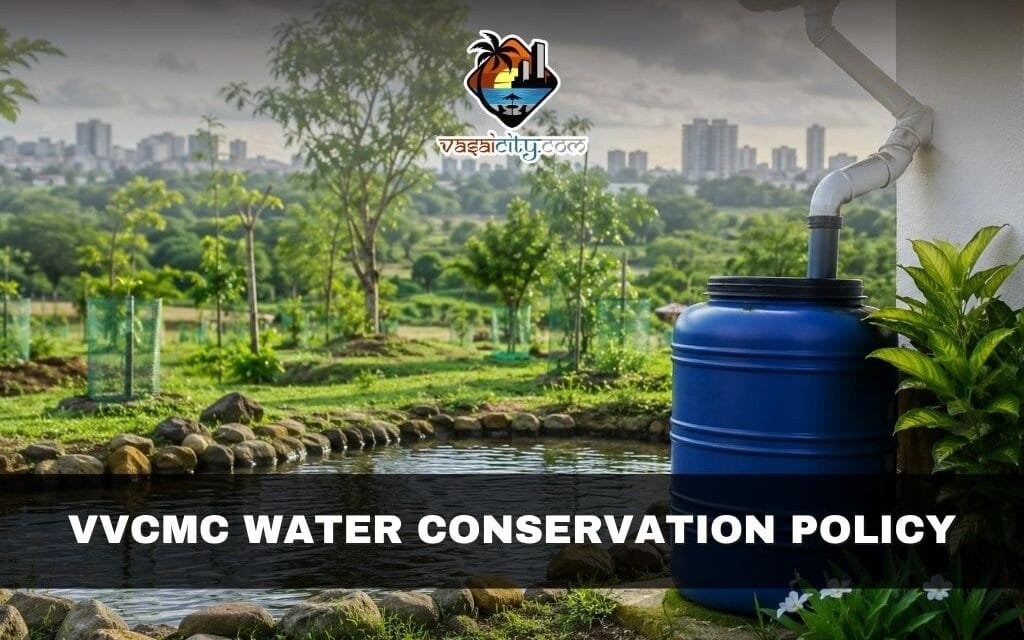
Mandatory rooftop rainwater harvesting systems can reduce dependence on groundwater while increasing natural recharge during the monsoon season.
The municipal corporation can also encourage existing housing societies to install rainwater harvesting structures through incentives and awareness programmes.
Such measures would strengthen the overall objectives of the VVCMC Water Conservation Policy while promoting responsible water use among citizens.
Recharge Structures Can Strengthen Water Security
Groundwater recharge structures play a critical role in replenishing depleted aquifers.
The municipal corporation should construct recharge shafts, recharge wells, and percolation pits in suitable locations identified through scientific surveys.
These structures allow excess rainwater to enter underground aquifers, improving water availability during dry months.
Combined with regular maintenance, these projects can substantially improve groundwater levels over time.
Forest Conservation and Plantation Are Equally Important
Water conservation is closely linked with environmental conservation.
Large-scale plantation drives should form an integral part of the VVCMC Water Conservation Policy. Native tree species improve soil moisture retention, reduce erosion, and support groundwater recharge.
However, planting trees alone is not enough.
The municipal corporation must ensure long-term maintenance, watering, and protection of saplings so they survive and contribute to ecological restoration.
Forest water conservation works should also be implemented in surrounding green zones to improve the natural water cycle.
Desilting of Dams and Water Bodies Must Be Prioritised
Many local dams and ponds gradually lose their storage capacity due to accumulated silt.
Regular desilting can restore water-holding capacity and improve water availability during summer.
The VVCMC Water Conservation Policy should include periodic inspection and desilting of all dams, lakes, ponds, and reservoirs under municipal jurisdiction.
These relatively low-cost interventions often produce long-term benefits for water storage.
Technology Can Improve Transparency and Accountability
Modern technology should become the backbone of every conservation initiative.
All water conservation assets should be geo-tagged using Geographic Information Systems (GIS). Public dashboards can display project progress, expenditure, and maintenance schedules, ensuring complete transparency.
Independent third-party audits can further strengthen accountability and verify the effectiveness of completed works.
Technology-driven governance will help ensure that every conservation project delivers measurable environmental benefits.
Community Participation Is Essential
No conservation policy can succeed without public involvement.
Residents, schools, housing societies, NGOs, and local businesses should actively participate in rainwater harvesting, tree plantation drives, and water awareness campaigns.
Educational programmes can encourage responsible water usage and inspire future generations to become environmental stewards.
Community participation transforms conservation from a government initiative into a shared civic responsibility.
A Long-Term Investment for Vasai-Virar
Climate change is expected to increase pressure on urban water resources across India. Cities that invest in water conservation today will be better prepared for tomorrow’s challenges.
The proposed VVCMC Water Conservation Policy offers an opportunity to build a climate-resilient Vasai-Virar through scientific planning, sustainable infrastructure, ecological restoration, and citizen participation.
Rather than waiting for severe water shortages, the municipal corporation can lead proactive action that safeguards groundwater, improves water availability, and protects the environment for future generations.
A comprehensive conservation strategy today will ensure that Vasai-Virar remains water-secure despite changing climate conditions.
For water conservation guidelines and rainwater harvesting resources, visit the Ministry of Jal Shakti: https://www.jalshakti-dowr.gov.in/
Inputs by Biju Cherian
This article is based on the author’s research and perspectives. The publisher claims no responsibility for inaccuracies. Views expressed are the contributor’s alone. Institutions mentioned are not endorsed unless specified.