
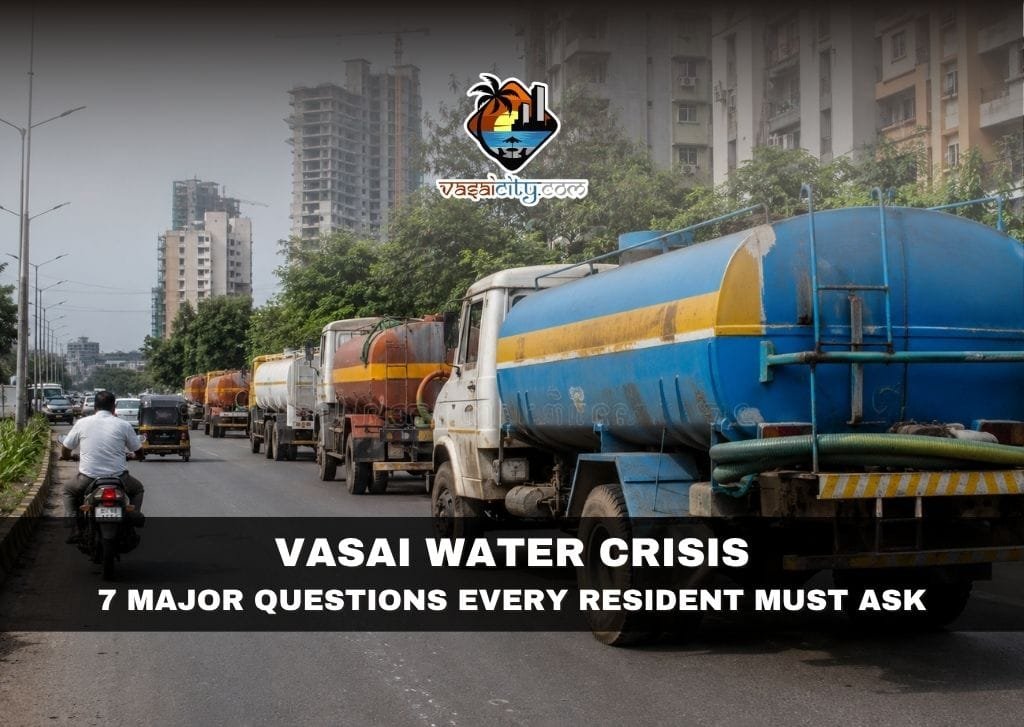
Vasai Water Crisis is becoming impossible to ignore. Every day, hundreds of water tankers travel through the roads of Vasai-Virar, supplying homes, restaurants, industries and construction sites. While these tankers help meet the growing demand for water, one important question remains unanswered - where does all this water actually come from?
For many residents, the sight has become so common that it barely attracts attention anymore. Yet behind every tanker lies a larger environmental concern that deserves serious discussion.
Table of Contents
The Growing Presence of Water Tankers in Vasai
Anyone travelling towards Vasai Road railway station is likely to notice a constant stream of water tankers moving across the city's busy roads. Some are fully loaded while others are on their way to refill.
Their destinations vary widely.
Hotels require water for daily operations. Restaurants depend on regular supply to serve customers. Housing societies rely on tankers whenever municipal water falls short. Industrial units consume large volumes every day, while massive residential and commercial construction projects need enormous quantities throughout the construction cycle.
The growing dependence on tanker water reflects one undeniable reality - the demand for water in Vasai-Virar is increasing faster than ever before.
Where Does the Water Come From?
The biggest question surrounding the Vasai Water Crisis is the origin of this water.
Is it extracted from traditional open wells?
Is it pumped from deep underground borewells?
Does it come from nearby lakes, rivers or reservoirs?
Or is it sourced from areas already facing water shortages?
Without transparency regarding water sources, residents remain unaware of how much pressure is being placed on the region's natural water reserves.
Groundwater is not an unlimited resource. Once depleted, it often takes years - or even decades - to recover naturally.
Development Needs Water - but Nature Has Limits
No one disputes the importance of development.
Construction projects create employment.
Hotels and restaurants support tourism and local businesses.
Housing societies accommodate the region's growing population.
Industrial growth generates economic opportunities.
However, development should never come at the cost of permanently damaging natural resources.
The real challenge lies in achieving a balance between economic growth and environmental sustainability. Extracting water continuously without replenishing natural reserves creates an imbalance that eventually affects everyone.
Delayed Monsoon Exposed a Bigger Problem
This year's delayed monsoon served as a reminder of how vulnerable the region has become.
Across many parts of Vasai-Virar, wells experienced declining water levels. Several borewells reportedly ran dry. Farmers waited anxiously for rainfall while many residents worried about future water availability.
Despite these warning signs, the demand for water continued to rise.
The Vasai Water Crisis is no longer only about seasonal shortages. It reflects a deeper issue involving groundwater management, urban expansion and environmental planning.
Water Cannot Be Manufactured
Modern technology has transformed many aspects of life, but one fact remains unchanged.
Water cannot simply be manufactured to meet increasing demand.
Freshwater depends entirely on nature's carefully balanced cycle.
Rainfall feeds rivers and lakes.
Forests capture and retain moisture.
Wetlands store excess water.
Healthy soil filters rainwater into underground aquifers.
Natural drainage systems help replenish groundwater that communities rely upon throughout the year.
When these ecosystems are damaged, the entire water cycle suffers.
Nature's Water Bank Is Being Depleted
Every environmental change has long-term consequences.
Flattening hills reduces natural rainwater absorption.
Destroying wetlands removes important water storage areas.
Cutting trees decreases groundwater recharge.
Blocking natural drains prevents rainwater from reaching underground aquifers.
Each of these actions represents another withdrawal from what can be described as nature's own water bank.
Unlike financial accounts, these withdrawals cannot easily be replaced.
The consequences may not be visible immediately, but over time they become increasingly difficult to reverse.
Vasai Once Had a Strong Water Heritage
Older residents often remember a very different Vasai.
Many homes had their own wells.
Community ponds, tanks, rivers and traditional bawkhals served as valuable water sources.
The arrival of the monsoon was welcomed with appreciation because people understood its importance.
Water was treated as a shared community resource rather than something that would always be available on demand.
As urbanisation accelerated, many traditional water bodies disappeared beneath roads, buildings and expanding infrastructure.
Transparency Is the Need of the Hour
The Vasai Water Crisis cannot be addressed without accurate information.
Residents deserve greater transparency regarding groundwater extraction and tanker water operations.
A public audit of water sources could help answer several important questions.
How many borewells are actively supplying tanker operators?
How much groundwater is extracted every day?
Which areas are experiencing declining water tables?
Are extraction limits being monitored effectively?
Making such information publicly available would help build trust while encouraging responsible water management.
Sustainable Solutions Cannot Wait
Experts across India increasingly recommend integrated water management rather than relying solely on groundwater extraction.
Several practical measures could significantly improve long-term water security in Vasai-Virar.
Strengthen Groundwater Monitoring
Authorities should regularly monitor groundwater levels and regulate commercial borewell extraction to prevent overuse.
Restore Lakes, Rivers and Ponds
Many traditional water bodies require urgent desilting and restoration so they can once again store monsoon rainfall effectively.
Protect Wetlands and Natural Drainage
Wetlands and natural drainage channels act as critical flood buffers while also helping recharge groundwater.
Preserving these ecosystems benefits both water conservation and flood prevention.
Make Rainwater Harvesting a Community Habit
Rainwater harvesting should become standard practice across residential societies, schools, industries and commercial buildings.
Capturing rain where it falls reduces dependence on groundwater while improving long-term sustainability.
The Government of India's Jal Shakti Ministry also promotes rainwater harvesting and groundwater conservation through various national initiatives. Residents can learn more through the official portal of the Ministry of Jal Shakti.
A Shared Responsibility for Future Generations
The Vasai Water Crisis is not merely an environmental issue—it is a question about the future of the region.
Population growth will continue.
Development will continue.
Water demand will continue to increase.
Whether future generations inherit healthy rivers, functioning wetlands and reliable groundwater depends on the decisions being made today.
Every resident, developer, business owner and policymaker has a role to play.
Protecting water is no longer simply an environmental concern. It has become one of the most important investments in Vasai-Virar's future.
Inputs by Biju Cherian
This article is based on the author’s research and perspectives. The publisher claims no responsibility for inaccuracies. Views expressed are the contributor’s alone. Institutions mentioned are not endorsed unless specified.