
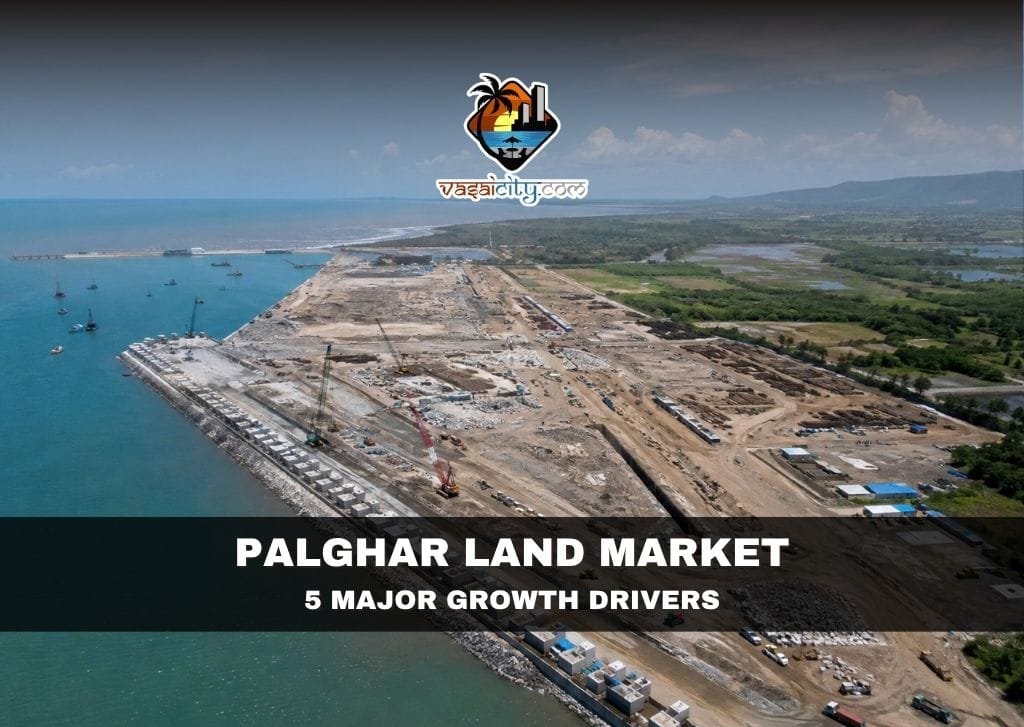
The Palghar land market is increasingly attracting attention as a combination of major transport, port, industrial, and connectivity projects takes shape across the district.
Unlike peripheral markets that depend heavily on one proposed project, Palghar's growth story is spread across several infrastructure initiatives at different stages of development. That gives the district a more diversified long-term investment narrative — although it does not eliminate the risks involved in buying land.
For property buyers and investors in Vasai-Virar, the developments are particularly relevant because several projects are designed to strengthen connections between Mumbai, Gujarat, Palghar's industrial belt and the wider Mumbai Metropolitan Region.
However, there is an important distinction between projects that are sanctioned or under construction and projects that are still proposals. Investors should not treat all infrastructure announcements as guaranteed drivers of immediate land appreciation.
Table of Contents
Palghar Land Market Gets 5 Major Infrastructure Drivers
The strongest part of the Palghar land market story comes from projects where government approval, funding, construction or implementation has already progressed significantly.
1. Virar-Dahanu Rail Quadrupling Strengthens Palghar Land Market
The ₹3,578-crore Virar-Dahanu Road railway quadrupling project is one of the most important transport upgrades for the northern suburban corridor.
The project involves adding two railway lines to the existing Virar-Dahanu section, creating four tracks and allowing suburban and long-distance services to operate more efficiently. MRVC's 2023-24 annual report puts the project length at about 64 km and identifies nine existing stations along the corridor.
The project is already showing visible progress.
In April 2026, the Railway Ministry announced that important capacity-augmentation works had been completed at Virar station, including platforms capable of handling 15-coach suburban trains.
The broader project is expected to improve suburban connectivity towards Palghar and Dahanu. For the Palghar land market, better rail capacity can potentially support residential growth, commercial activity and easier commuting over the longer term.
2. Mumbai-Ahmedabad Bullet Train Adds a High-Speed Connectivity Layer
The Mumbai-Ahmedabad High Speed Rail corridor is another major infrastructure project with direct relevance to Palghar.
The 508-km corridor includes Virar and Boisar stations in Maharashtra. The trains are designed for a maximum operating speed of 320 km/h. NHSRCL says the entire project has now achieved 100% land acquisition.
That matters because land acquisition is often one of the major sources of uncertainty for large infrastructure projects.
The corridor is being supported substantially through financing from the Japan International Cooperation Agency, while NHSRCL is responsible for implementation.
Boisar's position on the high-speed rail network could strengthen its long-term importance as an industrial and employment centre.
For the Palghar land market, however, the impact should be viewed as a long-term connectivity benefit rather than a promise of immediate price appreciation.
3. Vadhavan Port Could Transform the District's Economic Geography
Perhaps the biggest structural change facing the Palghar land market is the development of Vadhavan Port near Dahanu.
The Union Cabinet approved the greenfield deep-draft major port in June 2024 at an estimated project cost of ₹76,220 crore. The port is being developed through Vadhavan Port Project Limited, a joint venture involving the Jawaharlal Nehru Port Authority and Maharashtra Maritime Board.
The scale is substantial.
Government information says the port is designed for a cumulative capacity of around 298 million tonnes per annum, including 23.2 million TEUs of container-handling capacity.
The project is also expected to generate significant employment opportunities. The government has estimated approximately 10 lakh direct and indirect employment opportunities associated with the development.
More recently, authorities have moved beyond the port's core construction plans and into workforce development. In February 2026, VPPL and Maharashtra's Directorate of Vocational Education and Training signed an MoU to provide skill training to young people from 44 villages around the Vadhavan region.
That is significant for the Palghar land market because port-led development can create demand not only for industrial land, but also for housing, warehousing, transport, retail and supporting services.
4. Dedicated Freight Corridor Supports an Industrial Story
The Western Dedicated Freight Corridor adds another important layer to the Palghar land market.
The freight corridor passes through the Palghar industrial belt, with its alignment running through areas including Saphale, Palghar, Umroli and Boisar. Official DFCCIL documentation identifies the Saphale-Palghar-Boisar section as part of the alignment.
The importance of freight infrastructure goes beyond faster trains.
Dedicated freight connectivity can improve the economics of logistics, warehousing and manufacturing by providing more efficient movement of goods between industrial centres and ports.
The emerging connection between Vadhavan Port and the freight network could become particularly important. A Vadhavan Port rail-connectivity DPR proposes a rail connection from the New Palghar station of the Western Dedicated Freight Corridor towards the port.
This creates a potentially powerful combination: port + freight rail + industrial land.
For investors, that makes the industrial belt worth watching, although individual plots still require detailed title, zoning and development-potential checks.
5. NH48 Remains a Current, Not Merely Future, Driver
While new infrastructure projects receive most of the attention, National Highway 48 remains one of the established economic arteries of the district.
The highway connects the Mumbai region with Gujarat and northern India and already supports significant passenger, commercial and freight movement.
This gives properties with appropriate commercial zoning and good highway access a different investment profile from agricultural or interior land waiting for a future infrastructure announcement.
The distinction is important for anyone studying the Palghar land market: existing economic activity generally carries less execution risk than a project that exists only on a proposal map.
Seven More Projects Could Influence the Palghar Land Market
Beyond the five relatively stronger infrastructure drivers, several other proposals and projects could influence the district's future.
However, their status varies considerably and investors should not assign them the same value as sanctioned or actively implemented projects.
Uttan-Virar Sea Link and Virar-Alibaug Corridor
The proposed Uttan-Virar Sea Link and the Virar-Alibaug Multimodal Corridor could improve east-west and north-south connectivity across the wider MMR.
If implemented, these projects could alter travel patterns and potentially increase the attractiveness of currently less-connected areas.
But because proposals can change in alignment, scope, funding and timelines, their potential should be treated as future upside rather than current certainty.
Narangi Creek Bridge
The proposed Vasai-to-Palghar Narangi Creek Bridge is another connectivity project attracting attention in the region.
Importantly, MMRDA's latest available information says administrative approval has been granted, but a revised cost estimate is required following a change in the proposed lane configuration from 1+1 to 2+2 lanes. Construction will proceed after the required approval and funding are in place.
That makes it more advanced than a purely conceptual project, but it should still not be presented as an operational infrastructure link.
Proposed Offshore Airport
An offshore airport proposal near the Dahanu coast has been discussed as a much longer-term infrastructure possibility.
If eventually implemented, such a project could have a major impact on the region's accessibility and economic geography.
But for the Palghar land market, this belongs firmly in the high-risk, long-horizon category until construction, funding and statutory clearances move substantially forward.
Textile and Agro-Export Opportunities
Proposals involving textile manufacturing and agro-export infrastructure could complement the district's emerging port and logistics economy.
The potential connection is straightforward: manufacturing creates freight demand, freight creates logistics demand, and both can create employment and housing demand.
But land buyers should verify the actual status of individual projects rather than purchasing based solely on a proposed industrial park or export hub.
Satpati Fishing Port Modernisation
Satpati's fishing infrastructure is another part of the district's broader coastal-development picture.
Modernisation of fishing infrastructure can support local livelihoods and improve marine-sector facilities, although its impact on surrounding land values is likely to be much more localised than the impact expected from a major port or railway project.
What This Means for Investors
The central investment argument for the Palghar land market is not that every announced project will be completed on schedule.
It is that several independent infrastructure themes are developing across the same district: suburban rail expansion, high-speed rail, freight infrastructure, port development, highways and potential multimodal connectivity.
That diversification is what makes Palghar different from a land market dependent on a single speculative announcement.
At the same time, infrastructure-led investment requires patience.
Land close to a confirmed, funded and progressing project generally carries a different risk profile from land whose value depends on a proposed sea link, airport or industrial park.
The Palghar land market therefore needs to be evaluated village by village — and often plot by plot.
Buyers should verify the latest 7/12 extract, title chain, encumbrances, zoning, NA status where applicable, access road, reservation status and development restrictions before committing money.
Coastal and environmentally sensitive areas require additional caution because development potential can be affected by applicable CRZ, forest, agricultural and other statutory restrictions.
For readers following property trends closer to Vasai, our earlier coverage of Vasai real estate investment and its major growth drivers provides useful context on how infrastructure is influencing the wider region.
The Bigger Picture for Palghar
The Palghar land market is entering a phase where infrastructure, industry and connectivity are increasingly overlapping.
Vadhavan Port could strengthen the coastal economy. The freight corridor could support logistics and manufacturing. Bullet Train connectivity could raise the strategic importance of Boisar and Virar. Railway quadrupling could improve everyday suburban access.
But infrastructure does not automatically translate into land appreciation.
The strongest opportunities are likely to emerge where confirmed infrastructure, genuine employment generation, road access, existing development and legally developable land come together.
That is also why investors should separate confirmed projects from proposals and avoid paying today's premium for tomorrow's speculation.
Disclaimer: Infrastructure projects and proposed developments can change in scope, alignment, funding or completion timelines. Land investment decisions should be based on independently verified title and government records, not solely on projected infrastructure benefits.