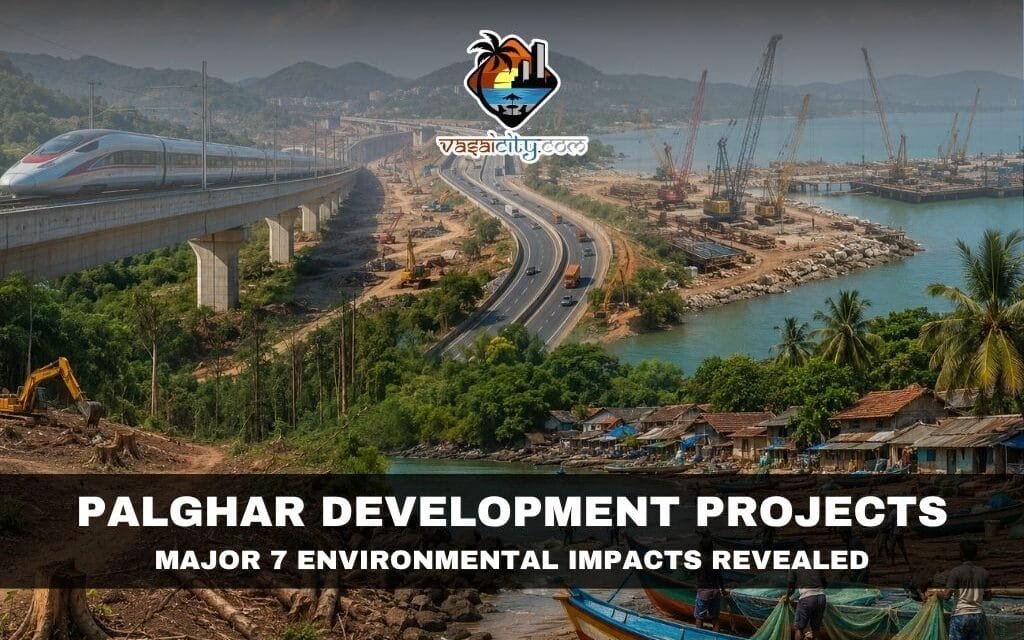
Palghar Development Projects are transforming the Vasai-Talasari belt at an unprecedented pace. Massive infrastructure investments promise economic growth and employment, but they also raise serious concerns about environmental degradation, climate change, and the future of local communities. Across Vasai, Dahanu, Talasari, Palghar, and Wada, the effects of these projects are becoming increasingly visible.
From dusty tribal hamlets and cracked homes to shrinking fish stocks and disappearing forests, residents are witnessing changes that go far beyond construction. While each project represents progress individually, their combined impact is reshaping the region’s landscape, economy, and ecology.
Table of Contents
The Vision Behind the Palghar Development Projects
The Maharashtra Government has identified Palghar district as a key region in its ambitious plan to develop the proposed “Fourth Mumbai.” As a result, the district has become the focus of several mega infrastructure initiatives worth an estimated ₹2.20 lakh crore to ₹2.40 lakh crore.
These Palghar Development Projects include:
- Mumbai–Ahmedabad High-Speed Rail
- Mumbai–Vadodara Expressway
- Murbe Commercial Port
- Vadhvan Mega Port
Together, these projects are expected to accelerate industrial development, improve transportation, and attract significant private investment. However, environmental experts and local communities warn that such rapid expansion must be balanced with sustainability.
Mumbai–Ahmedabad Bullet Train and Its Environmental Impact
One of the largest Palghar Development Projects is the Mumbai–Ahmedabad High-Speed Rail corridor.
The railway passes through several villages across Vasai, Palghar, Dahanu, and Talasari, requiring the acquisition of agricultural land, forest areas, and residential properties.
Environmental Concerns
Construction has already led to:
- Large-scale tree felling
- Reduction in green cover
- Increased dust and noise pollution
- Soil erosion
- Pressure on groundwater resources
- Disturbance of natural drainage systems
- Changes in local microclimate
- Loss of fertile agricultural land
Residents in affected villages fear that these long-term environmental changes may permanently alter the region’s ecological balance.
Mumbai–Vadodara Expressway Passing Through Tribal Villages
Another major component of the Palghar Development Projects is the Mumbai–Vadodara Expressway.
The highway crosses more than 70 villages, including several tribal settlements in Talasari, Dahanu, Palghar, Vasai, and Wada talukas.
Key Environmental Challenges
Construction activities involve extensive cutting of forests and excavation of hilly terrain.
Environmental concerns include:
- Destruction of forests
- Loss of biodiversity
- Fragmentation of wildlife habitats
- Disruption of animal migration routes
- Increased air and noise pollution
- Alteration of natural water channels
- Higher flood risk
- Soil erosion and landslide vulnerability
Environmentalists believe that these impacts could significantly affect the region’s natural resilience.
Murbe Commercial Port Raises Coastal Concerns
The proposed commercial port near Murbe in Palghar involves reclaiming approximately 594 acres of shallow rocky seabed between the Uchheli and Satpati creeks.
This coastal development forms another important part of the Palghar Development Projects.
Expected Environmental Effects
Experts have highlighted several possible consequences:
- Marine water pollution
- Damage to coastal biodiversity
- Decline in fish populations
- Increased industrial waste
- Greater demand on freshwater resources
- Waste management challenges
- Pressure from rapid population growth
For local fishing communities, declining fish stocks directly threaten their primary source of income.
Vadhvan Port Could Transform the Coastline
Perhaps the most debated among all Palghar Development Projects is the proposed Vadhvan Port.
The mega port will require reclaiming nearly 1,448 hectares (3,575 acres) of land from the Arabian Sea, fundamentally changing the coastline.
Environmental Risks
Scientists and environmental groups have expressed concerns about:
- Destruction of marine ecosystems
- Changes in ocean currents
- Disruption of fish breeding grounds
- Threat to commercially valuable fish species such as the Ghol fish
- Increased coastal erosion
- Greater vulnerability to cyclones
- Rising sea level risks
- Loss of marine biodiversity, including coral habitats
Traditional fishing routes may also be permanently affected, forcing many fishing families to alter or abandon their livelihoods.
Climate Change and Livelihoods
The cumulative impact of these Palghar Development Projects extends beyond infrastructure.
As forests disappear, hills are excavated, and coastlines are reclaimed, the district’s natural climate regulation systems are also changing.
Communities that depend directly on natural resources are among the most vulnerable.
Those Most Affected Include
- Fishermen
- Farmers
- Adivasi communities
- Coastal villagers
- Small landowners
Many residents already report declining agricultural productivity, unpredictable weather patterns, and reduced fish catches.
These environmental pressures combine with industrial expansion to create long-term socio-economic uncertainty.
Growing Migration and Pressure on Infrastructure
Large-scale investment under the Palghar Development Projects is expected to generate thousands of jobs.
This may also encourage migration into rapidly developing areas such as Vasai and Palghar.
While economic growth brings opportunities, increased population also places additional pressure on:
- Housing
- Water supply
- Waste management
- Healthcare
- Public transport
- Urban infrastructure
Without careful planning, rapid urbanisation could create new environmental and civic challenges.
Local Communities Seek Greater Participation
Many residents argue that development should not come at the cost of traditional livelihoods.
Farmers continue to raise concerns over land acquisition.
Fishing communities worry about shrinking marine resources.
Adivasi groups fear losing access to forests and ancestral lands.
Environmental activists believe stronger public consultation and transparent environmental assessments are essential before proceeding with large-scale infrastructure.
Lack of Unified Opposition
Observers note that local protests have often remained fragmented.
Movements led by fishermen, farmers, environmental activists, and tribal communities generally operate independently, limiting their collective influence.
Some analysts also believe that the absence of strong political leadership at the district level has allowed many decisions to progress without significant public scrutiny.
A coordinated approach, they argue, would better represent community concerns while encouraging sustainable development.
Balancing Growth with Sustainability
Economic development is undoubtedly important for Palghar’s future.
However, the Palghar Development Projects demonstrate that growth must be carefully balanced with environmental conservation.
Infrastructure, industry, and investment can coexist with ecological protection if projects incorporate robust environmental safeguards, scientific planning, community participation, and long-term sustainability measures.
The coming years will determine whether Palghar becomes a model of balanced development—or a cautionary example of growth achieved at the expense of its environment and traditional way of life.
Inputs by Biju Cherian
This article is based on the author’s research and perspectives. The publisher claims no responsibility for inaccuracies. Views expressed are the contributor’s alone. Institutions mentioned are not endorsed unless specified.