
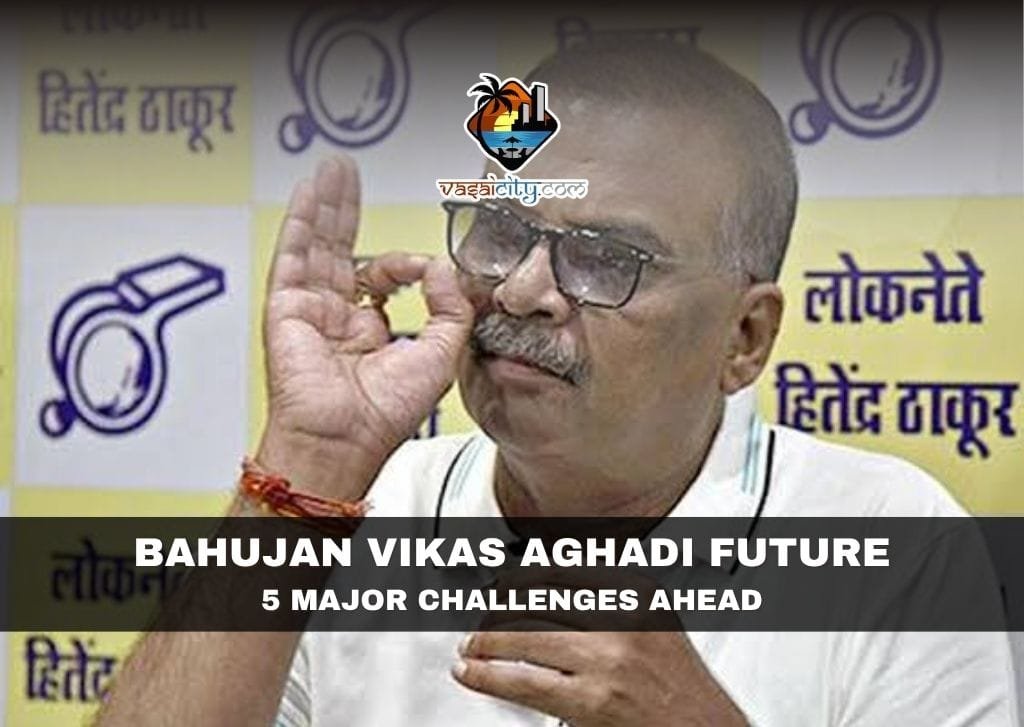
The Bahujan Vikas Aghadi Future has become one of the biggest political questions in Vasai-Virar after the party's mixed electoral performance over the past few years. While the regional outfit continues to enjoy considerable influence in local civic politics, recent defeats in state and national elections have raised questions about its long-term political strategy and ability to remain dominant.
For nearly two decades, the Bahujan Vikas Aghadi (BVA) has played a defining role in shaping the political landscape of Vasai-Virar and parts of Palghar district. However, changing voter demographics, shifting political alliances, and the growing influence of national parties are creating new challenges that could redefine local politics in the years ahead.
Table of Contents
Bahujan Vikas Aghadi Future After Mixed Electoral Results
Although the BVA secured control of the Vasai Virar City Municipal Corporation (VVCMC) and also performed well in the Thane District Central Cooperative Bank elections, its performance in larger elections has been far less encouraging.
The party has suffered repeated setbacks in Lok Sabha and Maharashtra Assembly elections, losing multiple contests that it once considered safe. Several constituencies that were previously represented by BVA candidates have shifted to rival political parties, highlighting a changing political environment.
Political observers believe these defeats indicate that the party's influence remains largely confined to its traditional local base and has struggled to expand beyond regional politics.
Declining Influence Beyond Local Politics
One of the biggest concerns surrounding the Bahujan Vikas Aghadi Future is its inability to convert local popularity into success at the state and national level.
While civic elections often revolve around local development, municipal services and grassroots networks, Assembly and Lok Sabha elections usually involve broader political narratives, state leadership and national issues.
As Maharashtra politics increasingly revolves around larger alliances and national parties, regional organisations like the BVA face greater competition than ever before.
Internal Challenges After Electoral Defeats
Recent electoral losses have reportedly resulted in organisational challenges for the party.
Several ward-level leaders and local workers have shifted their political allegiance to the Bharatiya Janata Party (BJP), reducing the organisational strength that once gave BVA a significant advantage during local elections.
Political analysts believe retaining experienced grassroots workers will be essential if the party hopes to strengthen its position before the next civic elections.
Can Strategic Alliances Shape the Bahujan Vikas Aghadi Future?
Another question being discussed in political circles is whether the BVA should explore alliances with larger opposition groups.
Some observers believe closer coordination with the Maha Vikas Aghadi (MVA) could strengthen the party's electoral prospects. However, alliance negotiations often involve complex seat-sharing arrangements, leadership issues and political differences.
Whether such an alliance is politically practical remains uncertain, particularly considering the changing dynamics of Maharashtra politics.
Governance Will Matter More Than Election Strategy
Winning elections is only one part of political success.
With the party continuing to play a significant role in the Vasai Virar City Municipal Corporation, residents are likely to judge its performance based on governance, infrastructure development and public services.
Road connectivity, drainage, water supply, traffic management, environmental protection and urban planning remain among the biggest concerns across Vasai-Virar.
Delivering visible improvements in these areas could strengthen public confidence and help the party maintain its local support base.
Changing Political Formula in Vasai-Virar
For many years, the BVA built a strong organisational structure through close coordination between party workers and local development projects.
Political commentators have often noted that contractors, local leaders and grassroots workers played an important role in election management and voter mobilisation.
However, with political power increasingly shifting towards larger state-level parties, this traditional model may no longer provide the same electoral advantage it once did.
Changing governance systems, increased political competition and evolving voter expectations have altered the political landscape considerably.
Demographic Changes Are Reshaping Local Politics
The Bahujan Vikas Aghadi Future is also closely linked to changing demographics across Palghar district.
Historically, the leadership of Hitendra Thakur drew substantial support from sections of the Somvanshi Kshatriya community, which has long been influential in the region.
However, rapid urbanisation and migration into Vasai-Virar have significantly changed the area's population profile.
As thousands of new residents continue to settle in the region each year, political parties must increasingly appeal to a more diverse electorate representing different languages, communities and economic backgrounds.
Voting Patterns Continue to Evolve
Over the years, voting preferences among several communities have also undergone noticeable changes.
Earlier elections often witnessed support for the BVA from sections of the Catholic community, South Indian voters and various Gujarati-speaking residents.
Today, political competition has intensified, with national parties making significant inroads among Hindi-speaking and Gujarati-speaking voters.
At the same time, analysts observed that many Catholic voters continued to support the BVA during the recent municipal elections, contributing to the election of several corporators from the community.
These changing voting patterns suggest that no political party can rely solely on traditional support bases.
Can History Repeat Itself?
The BVA's performance in the 2015 VVCMC elections remains one of the most dominant victories in local political history.
The party won 106 seats and formed a powerful municipal administration, with Pravina Hitendra Thakur becoming the corporation's first woman Mayor.
Replicating such an overwhelming victory in today's highly competitive political environment may prove considerably more difficult.
Growing competition from national parties, increased voter awareness and changing political expectations have made elections more unpredictable than ever before.
The Road Ahead for Bahujan Vikas Aghadi
The future of the BVA will likely depend on several critical factors.
The party must strengthen its grassroots organisation, retain experienced local leadership and demonstrate effective governance in areas under its administration.
It may also need to build broader political partnerships while adapting to changing demographic trends and evolving voter expectations.
Most importantly, residents will increasingly evaluate political parties based on development, transparency and delivery of civic services rather than historical dominance alone.
As Vasai-Virar continues to grow into one of the fastest-developing urban regions in the Mumbai Metropolitan Region, the coming years will determine whether the Bahujan Vikas Aghadi can successfully reinvent itself or whether new political forces will reshape the region's electoral landscape.
Inputs by Biju Cherian
This article is based on the author’s research and perspectives. The publisher claims no responsibility for inaccuracies. Views expressed are the contributor’s alone. Institutions mentioned are not endorsed unless specified.