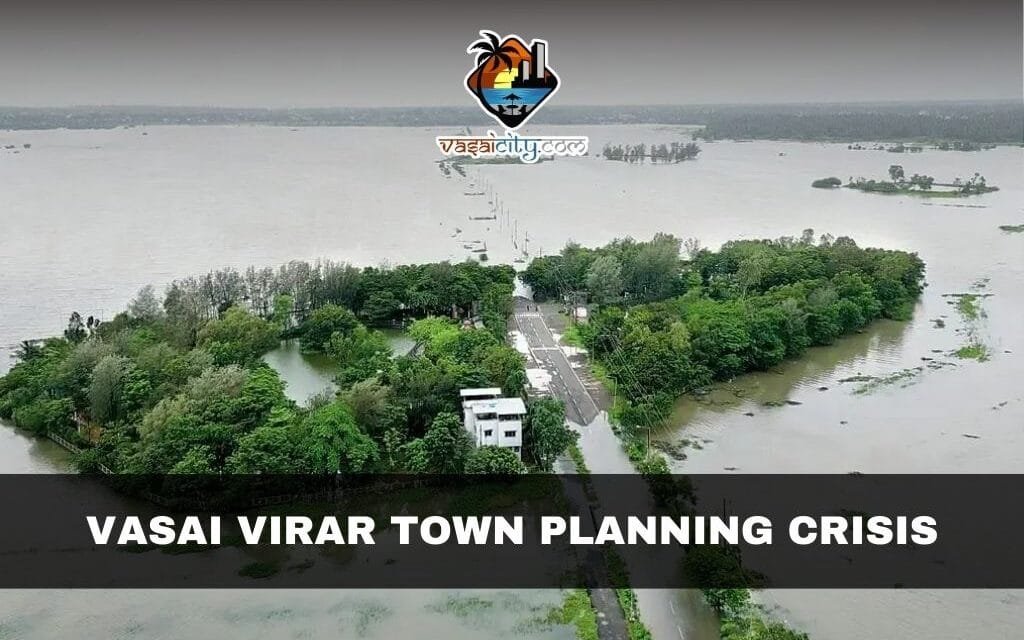
The Vasai Virar Town Planning Crisis has become one of the most serious challenges affecting the fast-growing suburb north of Mumbai. Although town planning for Vasai-Virar officially began as early as 1972, residents today experience the consequences of decades of weak execution. On paper, the region always had a development blueprint—yet on the ground, little was implemented in reality.
Table of Contents
A Plan That Existed Only on Paper
The Vasai Virar Town Planning Crisis began decades ago. In 1972, just 12 years after the formation of Maharashtra and the creation of Vasai taluka, the state government introduced the first official town plan. Later, in 1990, the City and Industrial Development Corporation (CIDCO) was appointed as the planning authority for the subregion. CIDCO built on the existing plan and introduced its own framework. After the establishment of Vasai Virar City Municipal Corporation (VVCMC), a third layer of town planning emerged.
However, despite multiple versions of plans, none were implemented effectively. Development remained limited to official discussions inside conference halls and government offices instead of being executed on the ground. As a result, the Vasai Virar Town Planning Crisis has left the subregion struggling with waterlogging, outdated infrastructure, and insufficient employment opportunities.
Infrastructure That Could Not Keep Up With Population Growth
Vasai Virar’s population exploded within a few decades, but planning decisions failed to keep pace. The focus remained almost entirely on large-scale housing construction, while industries, tourism, and local employment generation were ignored. Rather than becoming an economic hub, the city turned into a dormitory suburb, forcing lakhs of residents to travel daily to Mumbai for work.
Local industrial estates—such as Navghar East, Gokhivare, Valiv and Sativali—have not been able to produce significant employment, especially for blue-collar workers. Jobs that do exist tend to be low-paying. Meanwhile, traditional sectors like agriculture and fisheries are shrinking year after year. Even flourishing retail business pockets and the growing banking zone along Ambadi Road offer limited scale and cannot absorb the rising workforce.
Poor Infrastructure and Public Services
The Vasai Virar Town Planning Crisis is clearly visible in everyday struggles faced by residents:
- Severe waterlogging during the monsoon, caused by inadequate drains and the absence of a planned stormwater management system.
- Unreliable electricity supply, with frequent interruptions impacting homes and businesses.
- Poorly maintained roads, congested bridges, and weak public transport networks, which contribute to long commute times.
- Lack of proper drainage, increasing the impact of climate change and making several areas flood-prone.
Many taxes and local revenue collections were not effectively used to improve essential public services. Instead, decades of weak governance and inconsistent priorities contributed to the widening infrastructure gap.
Uncontrolled Urbanisation and Illegal Construction
Over time, the subregion witnessed uncontrolled urban development driven by what many critics describe as a builder–politician–bureaucrat nexus. This led to:
- Rapid increase in slums and unauthorised structures
- Poor quality constructions
- Provision of services to illegal buildings, such as water and electricity connections
Building approval loopholes and poor structural audits have put many residents at risk, especially during floods and heatwaves. Continuous inward migration into already burdened neighborhoods has put tremendous pressure on shrinking natural buffers like wetlands, mangroves, and agricultural land.
No Long-term Economic Strategy
One major reason behind the Vasai Virar Town Planning Crisis is the lack of a clear roadmap for economic growth. Unlike other parts of Maharashtra that successfully developed industrial corridors and IT parks, Vasai Virar did not focus on:
- Attracting major corporations
- Establishing technology or knowledge parks
- Developing coastal tourism
- Supporting agro-based industries
As a result, local revenue remained extremely limited compared to the massive expansion in population. Without sufficient funds, large-scale development projects could not be executed.
Residents Forced to Depend on Mumbai
Due to limited local job opportunities, tens of thousands of residents travel daily to Mumbai by train and road. Long-distance commuting affects both quality of life and family well-being. If the region had implemented a strong long-term planning and economic strategy, local prosperity and employment could have flourished.
The Way Forward
Urban experts and civic activists believe that Vasai Virar needs:
- A unified updated development plan backed by strict implementation
- Strong focus on infrastructure and climate-resilient projects
- Better public transport connectivity and new bridges
- Local job creation through industries, IT parks, and tourism
- Transparent governance and regular audits of construction quality
Inputs by Biju Cherian
This article is based on the author’s research and perspectives. The publisher claims no responsibility for inaccuracies. Views expressed are the contributor’s alone. Institutions mentioned are not endorsed unless specified.