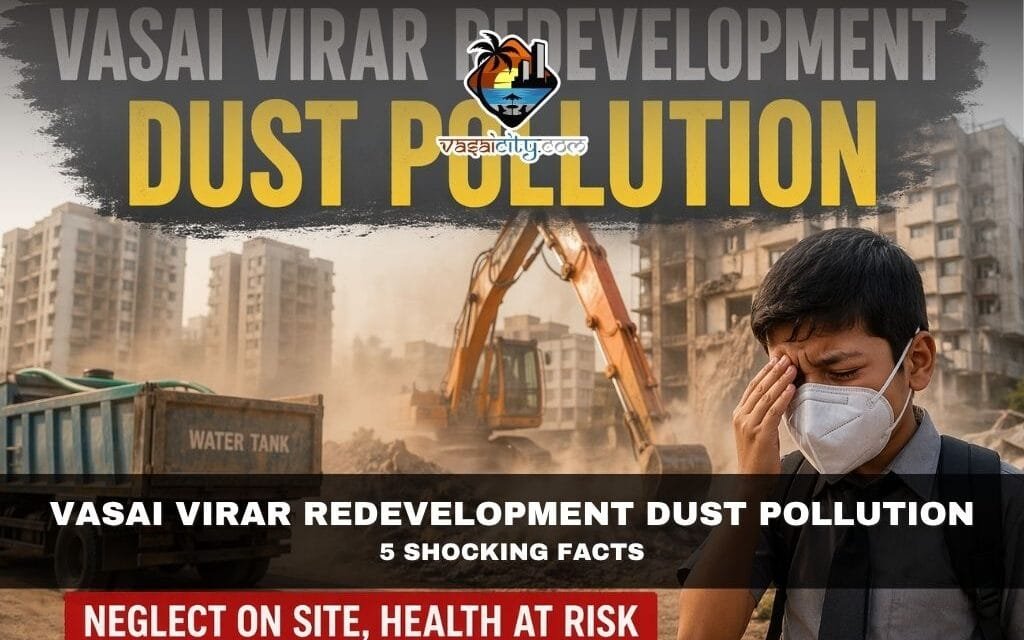
Vasai Virar redevelopment dust pollution is rapidly becoming a serious concern, as large-scale construction projects across the region continue without proper environmental safeguards.
Once appreciated for its relatively cleaner air and calm surroundings, Vasai Virar is now witnessing a sharp decline in air quality. Several ongoing redevelopment projects, instead of improving living standards, are creating hazardous conditions for thousands of residents.
Table of Contents
Rising Dust Levels Across Vasai Virar
The growing issue of Vasai Virar redevelopment dust pollution is visible across multiple neighborhoods where redevelopment work is underway. From demolition of old buildings to excavation and heavy construction, large amounts of dust are being released into the air daily.
Residents report that fine dust particles settle everywhere — on parked vehicles, inside homes, on school premises, and even on clothing. This continuous exposure is not just inconvenient but poses serious health risks.
Children, elderly individuals, and those suffering from respiratory illnesses are particularly vulnerable. Many families have started noticing an increase in breathing problems, allergies, and eye irritation.
Lack of Dust Control Measures
One of the main reasons behind Vasai Virar redevelopment dust pollution is the complete absence of basic dust control practices at construction sites.
As per government norms, contractors must use water tankers and fogging systems regularly to suppress dust. However, in most redevelopment locations, these essential measures are missing.
Instead of following guidelines, many contractors appear to be cutting costs and accelerating work timelines. This negligence is leading to uncontrolled dust emissions, directly affecting nearby residential areas.
Violation of Environmental Guidelines
The issue of Vasai Virar redevelopment dust pollution is not merely a result of poor planning—it is a clear violation of environmental regulations.
Construction companies are legally required to implement dust mitigation strategies, including:
- Regular water sprinkling
- Covering construction materials
- Using dust barriers
- Monitoring air quality levels
Failure to comply with these rules not only harms public health but also undermines environmental protection efforts.
For official construction and environmental norms, refer to the Central Pollution Control Board guidelines:
https://cpcb.nic.in
Absence of Civic Supervision
Equally alarming is the lack of on-ground monitoring by municipal authorities. The ongoing Vasai Virar redevelopment dust pollution crisis highlights a major gap in governance.
Civic engineers and officials responsible for supervising these projects are rarely seen at construction sites. Residents claim there are no routine inspections, no enforcement actions, and no accountability.
This absence of oversight allows contractors to operate without fear of penalties, leading to widespread non-compliance with safety and environmental standards.
Impact on Public Health
The consequences of Vasai Virar redevelopment dust pollution extend beyond visible dust layers. Poor air quality directly impacts lung health and overall well-being.
Some common health issues reported by residents include:
- Persistent coughing and throat irritation
- Increased asthma attacks
- Eye and skin irritation
- Fatigue and headaches
With the Air Quality Index (AQI) reportedly rising in affected zones, the situation demands urgent attention.
What Authorities Must Do
To control Vasai Virar redevelopment dust pollution, immediate action from local authorities is essential.
Key steps that should be taken include:
- Imposing strict fines on violating contractors
- Conducting surprise inspections at construction sites
- Making dust control measures mandatory and monitored
- Ensuring transparency and accountability in redevelopment projects
Without strict enforcement, the situation is likely to worsen in the coming months.
Development vs Public Health
While redevelopment is necessary for urban growth, it cannot come at the cost of citizens’ health. The ongoing Vasai Virar redevelopment dust pollution crisis raises serious questions about the balance between development and environmental responsibility.
Residents deserve projects that improve infrastructure without compromising air quality and safety.
The Way Forward
Addressing Vasai Virar redevelopment dust pollution requires a collective effort from authorities, contractors, and citizens.
Strict implementation of rules, active monitoring, and public awareness can help restore cleaner air in the region. Without immediate corrective measures, the long-term impact on public health could be severe.
Vasai Virar’s future depends not just on development, but on responsible and sustainable development.
Inputs by Biju Cherian
This article is based on the author’s research and perspectives. The publisher claims no responsibility for inaccuracies. Views expressed are the contributor’s alone. Institutions mentioned are not endorsed unless specified.