Vasai Virar Flood Recovery has entered a crucial phase as normal life gradually resumes across the city following one of the worst spells of monsoon rainfall in recent years. After nearly a week of severe flooding, receding waters, restored electricity, and the reopening of transport services have brought much-needed relief to thousands of residents.
However, despite visible improvements, the impact of the floods continues to be felt across several neighbourhoods, where families are cleaning damaged homes, repairing vehicles, and rebuilding their daily lives.
Table of Contents
Vasai Virar Flood Recovery Begins After Seven Days of Heavy Rain
The unprecedented rainfall left Vasai-Virar battling widespread flooding, bringing normal life to a standstill. Over 1,400 mm of rainfall was recorded within seven days, causing rivers and drainage systems to overflow while roads, residential societies, markets, and public infrastructure remained submerged.
Many families found themselves trapped inside their homes as floodwaters entered ground-floor apartments and commercial establishments. Several businesses suffered major financial losses after water damaged inventory, furniture, electrical equipment, and essential goods.
With floodwaters now receding in most parts of the city, residents have begun the difficult task of cleaning their homes and restoring normalcy.
Six Lives Lost During the Flood Crisis
While Vasai Virar Flood Recovery offers hope, the city continues to mourn the tragic loss of six people who reportedly drowned during rain-related incidents.
Authorities also recovered the body of an unidentified woman near the Suruchi Baug coastline in Vasai. Officials suspect she may have been swept away during the peak of the flooding.
The incidents have once again highlighted the dangers posed by rapidly rising floodwaters during extreme weather events and the importance of avoiding flooded areas during heavy rainfall.
Electricity Restored Across Most Areas
One of the biggest milestones in the Vasai Virar Flood Recovery has been the restoration of electricity.
According to the Maharashtra State Electricity Distribution Company Limited (MSEDCL), power supply has been restored in most affected localities after engineers worked continuously to repair extensive damage caused by floodwaters.
The heavy rainfall severely affected the city’s electricity network.
The damage included:
- 91 electricity poles damaged
- 62 transformers developing technical faults
- Flooding at the Suncity substation
- Multiple Distribution Panel (DP) boxes submerged
- Large sections of the power distribution network disrupted
Several residents in Nalasopara (West) remained without electricity for nearly 120 hours, making it one of the longest power outages experienced during the crisis.
Residents from Chheda Nagar recalled living without electricity for almost five days after supply was disconnected as a safety precaution during severe flooding.
MSEDCL, which serves over 10.5 lakh consumers across Vasai-Virar, has estimated infrastructure losses exceeding ₹1 crore.
Civic Body Deploys 58 Pumps to Remove Water
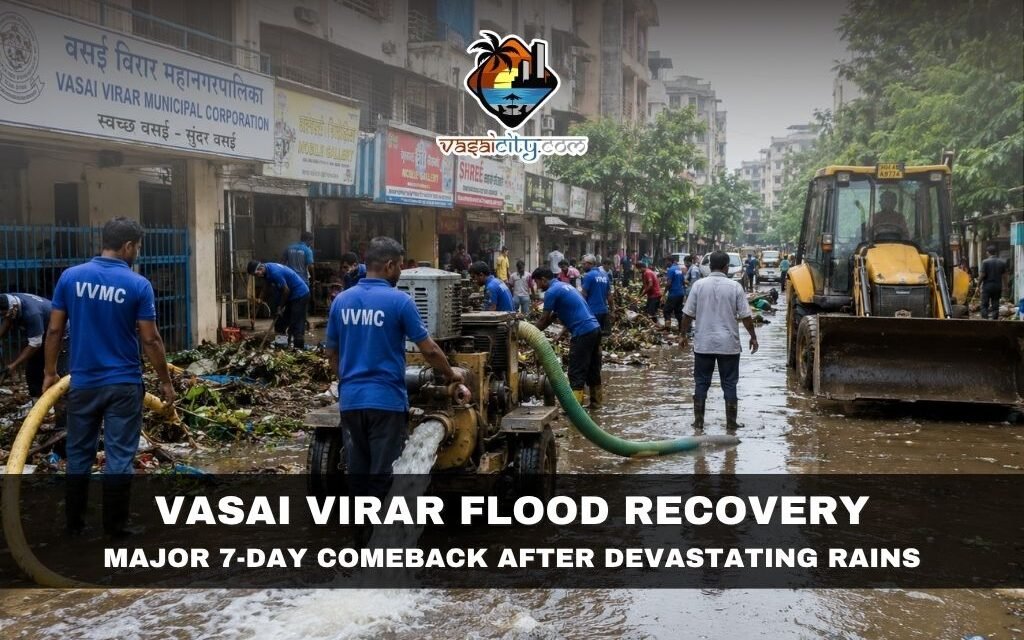
Although floodwaters have largely withdrawn, Vasai Virar Flood Recovery is still underway in several low-lying areas where stagnant water remains.
The Vasai-Virar Municipal Corporation (VVMC) has deployed 58 high-capacity water pumps to drain water from affected neighbourhoods.
According to civic officials, pumping operations continue in vulnerable pockets where waterlogging persists despite improving weather conditions.
Executive Engineer (Water Supply) Surendra Thakare confirmed that the pumps have been strategically installed to speed up drainage and reduce health risks associated with stagnant water.
Slush and Debris Continue to Trouble Residents
Even after the floodwaters disappeared, another challenge emerged.
Roads across several parts of Vasai-Virar remain covered with thick layers of mud, debris, garbage, and silt deposited by floodwaters.
Residents have spent several days cleaning homes, removing damaged furniture, disinfecting living spaces, and salvaging whatever belongings they can.
Commercial establishments have also begun reopening, although many continue to assess financial losses caused by water damage.
Hundreds of Flood-Damaged Vehicles Await Repairs
The Vasai Virar Flood Recovery has also created an enormous workload for local automobile garages.
Hundreds of cars and two-wheelers parked inside residential complexes and open parking lots were submerged during the floods.
Garage owners reported receiving over 200 flood-damaged vehicles from areas including:
- Madhuban
- Evershine
- Vasant Nagri
- Vasai East
Mechanics say many vehicles suffered engine damage, electrical failures, and corrosion after remaining underwater for several hours.
Owners may have to spend substantial amounts on repairs before their vehicles become roadworthy again.
Families Count Their Losses
Residents across flood-affected neighbourhoods continue to deal with extensive household damage.
In Kargil Nagar, Virar East, waist-deep water entered homes and destroyed valuable household items including televisions, refrigerators, furniture, clothing, and educational materials.
One resident shared that everything from household appliances to children’s school books was ruined during the flooding.
Many affected families are now depending on support from relatives, community organisations, and civic authorities as they begin rebuilding their homes.
NDRF and Civic Teams Rescue Hundreds
The coordinated emergency response played a major role in saving lives during the crisis.
According to the Vasai-Virar Municipal Corporation:
- 738 residents were rescued from flooded locations.
- VVMC Fire Brigade teams worked alongside the National Disaster Response Force (NDRF).
- 208 tree-fall incidents were attended.
- 10 fire-related emergencies were handled.
- Three wall-collapse incidents were managed safely.
The administration also confirmed that 11 pregnant women received emergency medical assistance and safely delivered their babies despite the challenging conditions.
Public Transport Services Resume
As part of the ongoing Vasai Virar Flood Recovery, transport services have gradually resumed.
The Ro-Ro ferry service restarted operations after being suspended during the heavy rainfall.
Meanwhile, municipal bus services are also returning in phases as road conditions improve and damaged routes become operational once again.
This restoration is expected to help thousands of daily commuters who depend on public transport for work, education, and essential travel.
Health Measures Intensified After Floods
Flood recovery extends beyond restoring roads and electricity.
Recognising the increased risk of diseases after flooding, the civic administration has launched preventive public health measures across affected areas.
Municipal teams have started distributing medicines, conducting sanitation drives, and implementing mosquito-control measures to reduce the spread of water-borne and vector-borne illnesses.
Health officials have advised residents to drink clean water, maintain hygiene, avoid contaminated food, and seek medical attention if symptoms such as fever, diarrhoea, or skin infections develop.
Long Road Ahead for Vasai Virar Flood Recovery
Although the worst phase of the flooding appears to be over, Vasai Virar Flood Recovery is far from complete.
Thousands of residents continue cleaning homes, repairing damaged property, replacing household essentials, and recovering from financial losses caused by one of the most severe monsoon events the city has witnessed in recent years.
The combined efforts of civic authorities, emergency responders, utility workers, volunteers, and local communities have helped restore essential services faster than expected. However, the disaster has once again highlighted the urgent need for stronger urban drainage systems, improved flood preparedness, and resilient infrastructure capable of handling increasingly intense monsoon rainfall.
As the city rebuilds, residents remain hopeful that lessons learned from this crisis will lead to better planning and improved disaster management in the years ahead.
Frequently Asked Questions (FAQs)
What caused the flooding in Vasai-Virar?
The flooding was caused by more than 1,400 mm of rainfall received over seven days, overwhelming drainage systems and inundating several residential and commercial areas across Vasai-Virar.
How many people lost their lives during the Vasai-Virar floods?
According to civic officials, six people lost their lives in rain-related drowning incidents during the flooding.
Has electricity been restored in Vasai-Virar?
Yes. MSEDCL has restored power supply in most affected areas after repairing damaged electricity poles, transformers, substations, and distribution infrastructure.
What is VVMC doing after the floods?
The Vasai-Virar Municipal Corporation (VVMC) has deployed 58 water pumps, cleared debris, restored public services, distributed medicines, and started preventive measures against water-borne diseases.
How many people were rescued during the floods?
VVMC and the National Disaster Response Force (NDRF) rescued 738 people from flood-affected areas during the emergency.
Are public transport services operating again?
Yes. Municipal bus services have resumed in phases, and the Ro-Ro ferry service has restarted operations after the weather improved.
What precautions should residents take after flooding?
Residents should drink clean water, maintain hygiene, avoid contaminated food, disinfect their homes, and seek medical attention if they experience symptoms of water-borne diseases.