
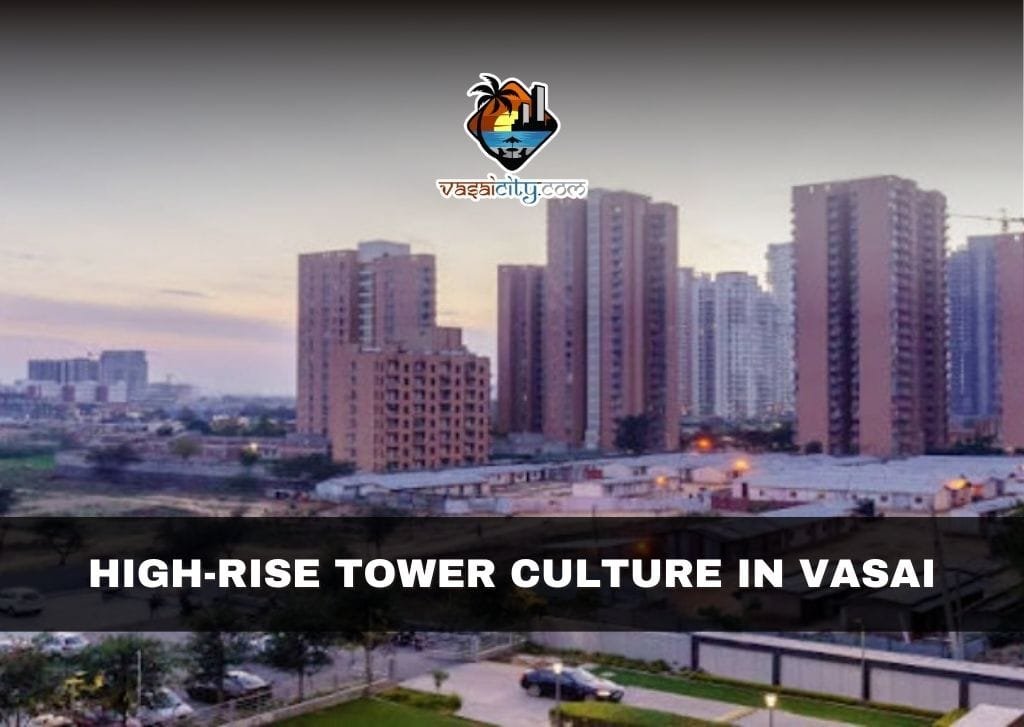
High-Rise Tower Culture in Vasai has emerged as one of the most contentious civic and planning issues in the region, as towering residential projects steadily replace bungalows, villages, and low-rise neighbourhoods that once defined Vasai’s identity.
From the serene lanes of Giriz–Nirmal to the old settlements of Navghar–Chulne, a dramatic new skyline is taking shape. Across Pachubunder, Vaitarna, and surrounding villages, land is being reshaped to accommodate taller and denser buildings. Redevelopers appear locked in a silent race to build higher than one another, often prioritising scale and speed over planning sensibility.
While sections of the urban population welcome redevelopment for larger homes and modern facilities, Vasai’s original communities — Kolis, Agris, Panmalis, Adivasis, and East Indian Catholics — are openly opposing this High-Rise Tower Culture in Vasai, warning that it threatens the region’s social, environmental, and economic balance.
Table of Contents
What Does High-Rise Tower Culture in Vasai Mean?
The term High-Rise Tower Culture in Vasai is increasingly used by residents and civic observers to describe a development model driven by vertical growth, speculative real estate investment, and luxury housing, often with limited regard for heritage, infrastructure capacity, or ecological sustainability.
Community representatives argue that Vasai is witnessing Mumbai-style densification without Mumbai-level infrastructure or planning discipline. They stress that development should be guided by long-term town planning principles, not short-term profit motives.
1. Erosion of Traditional Community Networks
One of the most visible impacts of High-Rise Tower Culture in Vasai is the breakdown of close-knit community life.
Traditional Vasai villages were built around social interaction, shared spaces, and strong neighbourly bonds. In contrast, high-rise living promotes vertical segregation. Residents living several floors apart often remain strangers, weakening the sense of collective identity.
Many locals say this shift makes indigenous communities feel displaced psychologically, even when they continue to live in the same geographical area.
2. Decline of Street Life and Local Economy
Street life has historically been central to Vasai’s villages, serving as a hub for commerce, socialising, and informal services.
However, High-Rise Tower Culture in Vasai replaces active streets with gated compounds, parking ramps, and controlled access points. Daily needs are increasingly met through delivery platforms, reducing dependence on local kirana stores and small businesses.
Urban planners warn that such inactive streetscapes reduce safety, weaken local economies, and erode cultural vibrancy.
3. Disconnection From Nature and Open Spaces
For generations, Vasai’s communities lived in close harmony with nature — surrounded by farmlands, creeks, forests, rivers, hills, and the sea.
Critics argue that High-Rise Tower Culture in Vasai forces residents into elevated, enclosed living environments that limit daily contact with nature. Access to green spaces becomes restricted, and the traditional relationship between people and their surroundings weakens.
Mental health experts have long highlighted the importance of ground-level social and natural interaction, something that high-density vertical living often lacks.
4. Environmental and Climatic Impact
Environmental degradation is a major concern linked to High-Rise Tower Culture in Vasai.
High-rise buildings typically consume more energy per capita for elevators, water pumping, cooling, and lighting. They also contribute to higher carbon emissions and urban heat island effects. In Vasai, residents report that tall towers cast long shadows over neighbouring homes and alter local wind patterns, sometimes creating uncomfortable wind tunnels.
Such changes, locals argue, were never adequately assessed through transparent environmental impact studies.
5. Severe Pressure on Local Infrastructure
Perhaps the most immediate challenge posed by High-Rise Tower Culture in Vasai is the strain on existing infrastructure.
Water supply, sewage systems, electricity networks, roads, and public transport were designed for low- to medium-density settlements. Rapid vertical densification has resulted in frequent water shortages, traffic congestion, power fluctuations, and waste management issues.
According to official urban planning norms issued by government authorities, infrastructure capacity must precede high-density development - a principle residents feel is being ignored.
6. Rising Costs and Social Displacement
Many projects under High-Rise Tower Culture in Vasai cater primarily to luxury buyers and real estate investors rather than addressing affordable housing needs.
As a result, property prices, rents, and everyday living costs have increased sharply. Long-time residents, lower-income families, and small businesses are finding it difficult to sustain themselves in areas they have inhabited for decades.
Community leaders caution that this trend could permanently alter Vasai’s demographic and economic structure.
7. Threat to Heritage and Village Identity
Vasai’s villages possess distinct cultural, architectural, and historical identities shaped over centuries.
Opponents of High-Rise Tower Culture in Vasai argue that current redevelopment models treat land as a commodity rather than a cultural asset. Uniform towers replace unique village layouts, erasing architectural diversity and heritage value.
Residents emphasise that they are not anti-development, but firmly against development that disregards identity, history, and local consent.
Growing Voices of Dissent
Local organisations and Bhumiputra groups are increasingly demanding stricter planning controls, transparent approvals, and community consultation. They insist that development must balance growth with sustainability, as outlined in Maharashtra’s town planning and environmental regulations.
The Road Ahead for Vasai
The debate around High-Rise Tower Culture in Vasai highlights a larger question facing rapidly urbanising regions across India: how to grow without losing identity.
As redevelopment accelerates, the choices made today will shape Vasai’s social fabric, environment, and quality of life for decades. Whether policymakers prioritise inclusive, well-planned growth over unchecked vertical expansion remains to be seen.
Inputs by Biju Cherian
This article is based on the author’s research and perspectives. The publisher claims no responsibility for inaccuracies. Views expressed are the contributor’s alone. Institutions mentioned are not endorsed unless specified.
