
The Mumbai-Vadhavan Expressway connectivity plan is set to bring together three major road infrastructure projects linking Mumbai’s coastal network with the upcoming deep-draft Vadhavan Port in Palghar district. For residents, commuters, and businesses across Vasai, Virar, Nalasopara, and the wider Mumbai Metropolitan Region (MMR), the network represents a significant shift in how both passenger and freight traffic could move along the western coast.
Rather than a single continuous highway already under construction, this connectivity framework consists of three distinct corridors currently at different stages of approval and execution. Together, they are designed to connect Mumbai’s coastal road system, National Highway 48 (NH-48), the Delhi–Mumbai Expressway, and the Samruddhi Mahamarg directly to Vadhavan Port.
In This Article
Key Facts at a Glance
- Uttan–Virar Sea Link: A 55.12-km corridor featuring a 24.35-km sea bridge and 30.77 km of connecting roads through Uttan, Vasai, and Virar. It has received state approval with a revised estimated cost of around ₹58,755 crore.
- Vadhavan Port to NH-48 Expressway: A 32.1-km access-controlled expressway linking the port to Tawa village on NH-48. The National Highways Authority of India (NHAI) awarded the ₹2,360-crore construction contract in April 2026.
- Samruddhi–Vadhavan Freight Corridor: An approximately 105-km corridor connecting Vadhavan Port with Bharvir on the Samruddhi Mahamarg. The project was approved by the Maharashtra Cabinet in 2025.
- Current Status: These are separate projects progressing on independent timelines, not a single unified expressway currently being built end-to-end.
Breaking Down the Mumbai-Vadhavan Expressway Network
To understand how the region’s road-based logistics map is changing, it helps to look at each of the three components individually. Each corridor serves a specific geographical role—one along the coast, one tying into the national north-south highway grid, and one reaching deep into Maharashtra’s hinterland.
1. The 55.12-km Uttan–Virar Sea Link
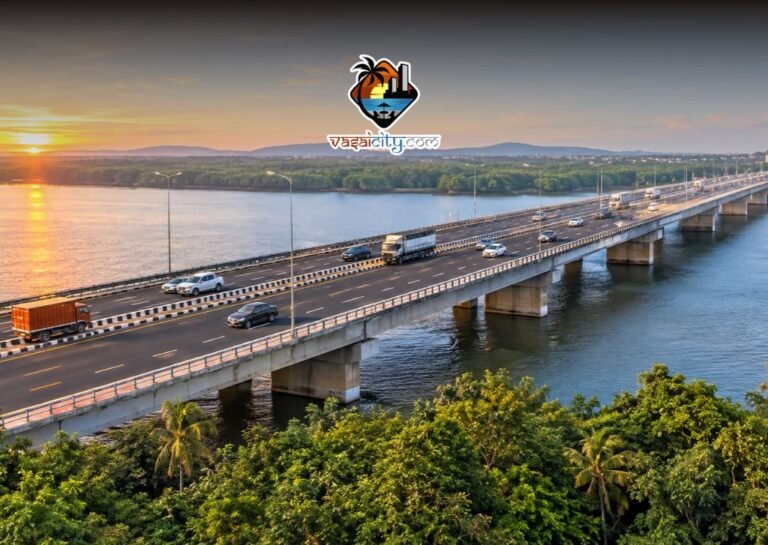
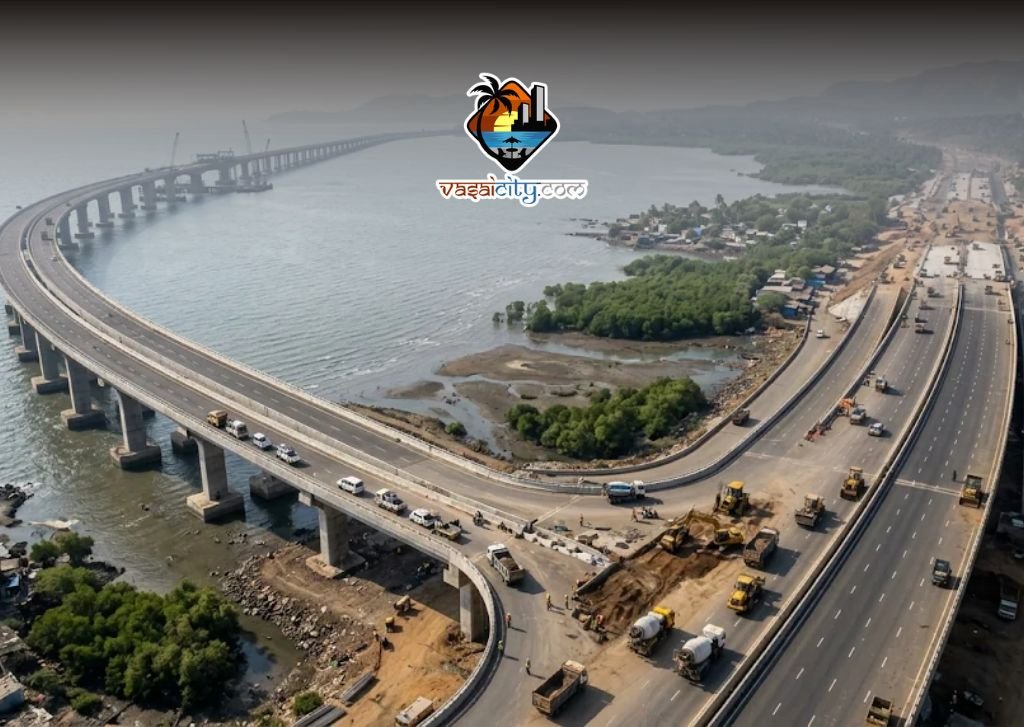
For readers in Vasai-Virar, the Uttan–Virar Sea Link is the most directly relevant piece of the puzzle. Spanning a total length of 55.12 km, the project comprises a 24.35-km sea bridge paired with 30.77 km of land-based connecting roads passing through Uttan, Vasai, and Virar.
The project has secured state approval with a revised estimated cost of roughly ₹58,755 crore. By extending Mumbai’s coastal road network northward across the sea and into the Vasai-Virar belt, this link is intended to provide a high-speed coastal alternative to the heavily congested Western Express Highway and NH-48 corridors.
2. The 32.1-km Vadhavan Port–Tawa (NH-48) Access-Controlled Expressway
Further north in Palghar district, the second major component focuses on giving the upcoming port immediate access to the national highway grid. This 32.1-km access-controlled expressway will connect Vadhavan Port directly to Tawa village on NH-48.
In plain terms, an access-controlled expressway restricts entry and exit to designated interchanges, preventing local cross-traffic and allowing commercial vehicles to maintain steady speeds. According to the project details, the National Highways Authority of India (NHAI) awarded the ₹2,360-crore construction contract in April 2026 (Editor’s note: link directly to the specific NHAI tender/press release URL upon editorial verification).
Initially designed as a four-lane corridor, the road is engineered to be expandable to eight lanes as port traffic grows. Crucially, it will also integrate with the Delhi–Mumbai Expressway network, giving cargo moving out of Vadhavan a direct high-speed route toward Gujarat and northern India.
3. The 105-km Samruddhi–Vadhavan Freight Corridor
The third leg of the network looks eastward. Approved by the Maharashtra Cabinet in 2025, the approximately 105-km Samruddhi–Vadhavan freight corridor is planned to connect Vadhavan Port to Bharvir on the Samruddhi Mahamarg (the Mumbai–Nagpur Expressway).
This corridor is specifically aimed at linking the western coastline with Maharashtra’s inland logistics and industrial network. By creating a dedicated freight spine between the port and the Samruddhi Mahamarg, agricultural produce, manufactured goods, and bulk cargo from central and eastern Maharashtra could reach the coast without having to pass through Mumbai’s urban road bottlenecks.
Why the Mumbai-Vadhavan Expressway Matters for Vasai, Virar, and Nalasopara
While Vadhavan Port is located in Palghar district to the north, the ripple effects of this multi-project road network will be felt acutely across Vasai, Virar, and Nalasopara.
Relief from Freight and Commuter Bottlenecks
Currently, NH-48 serves as the primary artery for both heavy commercial trucks heading to and from Gujarat and daily commuters travelling between Vasai-Virar and Mumbai. Frequent traffic snarls along the highway—especially near Vasai Phata, Ghodbunder, and Virar—have long been a major pain point for local residents.
By introducing a coastal sea link through Uttan, Vasai, and Virar alongside dedicated port-connectivity corridors further north, the long-term plan aims to segregate coastal passenger movement and heavy port-bound freight. However, commuters should note that tangible relief will depend on how quickly each individual project moves from approval to completed construction.
Economic and Logistics Growth in the Vasai-Virar Belt
Vasai and Nalasopara already host a dense ecosystem of small and medium-scale industrial estates, warehouses, and logistics operators. Improved connectivity to a major deep-draft international port—one capable of handling large container vessels that require deeper water—could strengthen the region’s appeal for warehousing, cold storage, and supply-chain businesses.
At the same time, major infrastructure projects of this scale often bring transitional challenges during construction, including land acquisition, traffic diversions, and environmental scrutiny. Local residents and businesses will need to watch official project notifications closely as work progresses on the ground.
Understanding the Bigger Picture: Vadhavan as an International Trade Gateway
The broader ambition behind linking Mumbai’s coastal road system, NH-48, the Delhi–Mumbai Expressway, and the Samruddhi Mahamarg is to position Vadhavan Port as a major gateway for international trade.
Ports rely heavily on “hinterland connectivity”—the road and rail networks that move containers between ships and inland markets. Without high-capacity roads, even a modern deep-draft port can face severe cargo backlogs. By planning three separate corridors that radiate south toward Mumbai, north toward Delhi, and east toward Nagpur, state and central agencies are attempting to build a multi-directional logistics web before port operations scale up.
Important Context: Separate Timelines, Not One Completed Highway
It is important for readers to keep expectations grounded. Although the phrase Mumbai-Vadhavan Expressway is often used to describe this emerging network, it is not a single continuous expressway currently under construction.
Each component sits at a different milestone:
- The Vadhavan–Tawa (NH-48) expressway has reached the contract-award stage as of April 2026.
- The Samruddhi–Vadhavan freight corridor secured Maharashtra Cabinet approval in 2025.
- The Uttan–Virar Sea Link has received state approval with a revised cost estimate of around ₹58,755 crore.
Because these projects involve different executing agencies, funding structures, and engineering complexities—ranging from a 24.35-km open-sea bridge to inland freight highways—their completion dates will vary.
What Local Residents Should Watch Next
For people living in Vasai, Virar, Nalasopara, and Palghar, the next phase to monitor will be ground-level execution milestones. These include detailed alignment maps for the connecting roads in Uttan, Vasai, and Virar, construction timelines for the NHAI-awarded Tawa expressway, and official tendering updates for the Samruddhi–Vadhavan freight corridor.
As these three corridors advance independently, their eventual integration could fundamentally reshape travel times, commercial freight movement, and economic activity across the northern Mumbai Metropolitan Region.
Frequently Asked Questions (FAQs)
Is the Mumbai-Vadhavan Expressway a single continuous highway under construction?
No. These are three separate infrastructure projects at different stages of approval and implementation, rather than one continuous expressway currently being built end-to-end. Each project has its own scope, budget, and timeline, though they are designed to work together as a unified connectivity network.
How will the Uttan–Virar Sea Link affect Vasai and Virar?
The 55.12-km Uttan–Virar Sea Link includes a 24.35-km sea bridge and 30.77 km of connecting roads passing through Uttan, Vasai, and Virar. Once built, it is intended to connect Mumbai’s coastal road network directly to the Vasai-Virar belt, offering a faster coastal alternative to congested inland highways.
What is the estimated cost of the Uttan–Virar Sea Link?
The Uttan–Virar Sea Link has received state approval with a revised estimated cost of approximately ₹58,755 crore. This covers both the 24.35-km sea bridge and the 30.77 km of land-based connecting roads across Uttan, Vasai, and Virar.
What is the status of the Vadhavan Port to NH-48 expressway?
The 32.1-km access-controlled expressway connecting Vadhavan Port to Tawa village on NH-48 moved forward in April 2026, when the National Highways Authority of India (NHAI) awarded the ₹2,360-crore construction contract. It will be built as a four-lane road that can be expanded to eight lanes.
Will Vadhavan Port connect to the Delhi–Mumbai Expressway?
Yes. The 32.1-km access-controlled expressway between Vadhavan Port and Tawa village on NH-48 is designed to connect with the Delhi–Mumbai Expressway network. This will allow commercial cargo from the port to access high-speed routes toward Gujarat and northern India.
What is the Samruddhi–Vadhavan freight corridor?
The Samruddhi–Vadhavan freight corridor is an approximately 105-km road project approved by the Maharashtra Cabinet in 2025. It will link Vadhavan Port directly to Bharvir on the Samruddhi Mahamarg, connecting Maharashtra’s western coastline with the state’s inland logistics and industrial network.
When will all three Mumbai-Vadhavan connectivity projects be completed?
Exact completion dates for all three projects have not been confirmed in the available project details. Because the Uttan–Virar Sea Link, the NH-48 link, and the Samruddhi–Vadhavan freight corridor are separate projects at different stages of approval and contracting, they will be completed on different timelines.