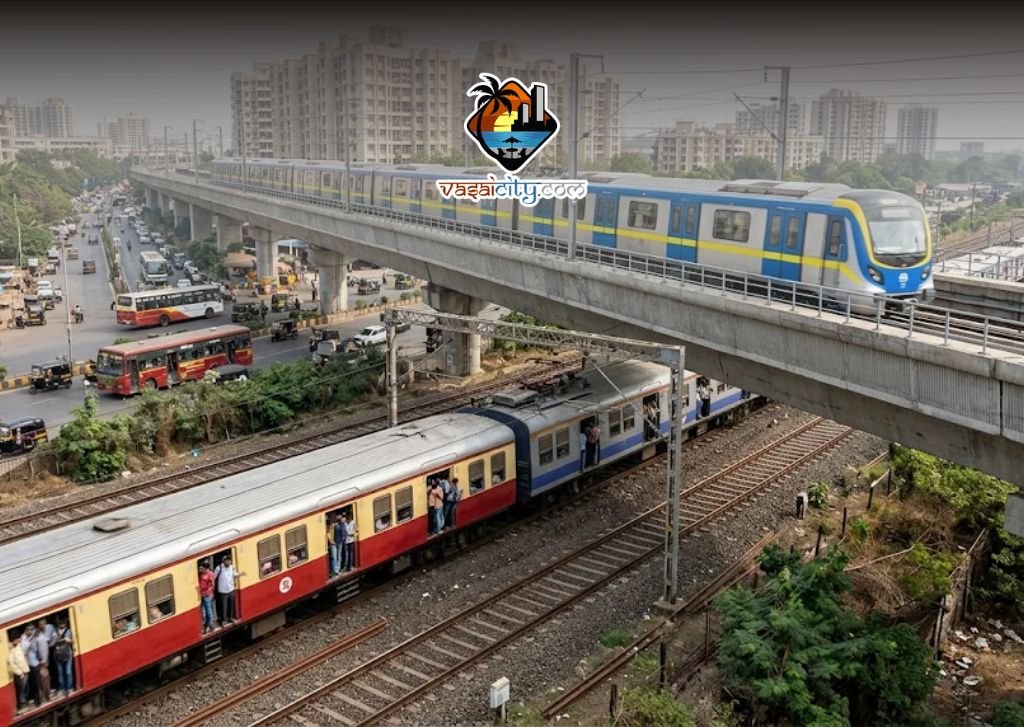

The planned Vasai Virar Metro has sparked a familiar debate across Vasai, Virar and Nalasopara: once metro trains reach the far northern suburbs, will Mumbai’s iconic local trains finally empty out? While many residents hope the metro will replace overcrowded suburban compartments, recent railway ridership figures tell a much more grounded story.
Data recorded after the expansion of the metro network into neighbouring Mira-Bhayandar shows that metro corridors are indeed taking some pressure off local stations. However, the numbers also make one thing clear: Mumbai’s suburban railway network is not going anywhere anytime soon, and it will remain the primary lifeline for commuters for many years to come.
In This Article
What Happened After Metro Line 9 Reached Mira Road
A clear preview of what the Vasai Virar Metro could do to local train crowds emerged after Metro Line 9 reached Mira Road on 8 April 2026. According to railway data, daily passenger footfall at Mira Road railway station dropped by roughly 10% following the launch.
The impact was even more visible one station further north. At Bhayander railway station, daily footfall fell by about 16%. For daily commuters who have long dealt with packed platforms and heavy peak-hour boarding along the Western Railway line, a double-digit drop in station footfall is a welcome sign of relief.
Yet, a 10% to 16% reduction does not mean local trains are running empty. Instead, it indicates that a specific segment of passengers has shifted to the metro, while the vast majority of commuters continue to rely on suburban rail.
Why First-Class Tickets and Short Trips Are Shifting
The sharpest shift away from local trains has been among first-class ticket holders and short-distance travellers. Railway figures show that first-class ticket sales fell by 15% at Andheri and by 13% at Mira Road.
Much of this change is linked to Metro Lines 2A and 7, which have absorbed a significant share of short-distance journeys across the western suburbs. For commuters who previously paid extra for a first-class local train pass just to avoid general-compartment crowding on shorter stretches, the metro offers air-conditioned coaches, predictable boarding and a more comfortable ride.
In practical terms, this means the metro is proving highly effective at handling intra-suburban travel. Commuters travelling between nearby western suburban hubs no longer need to squeeze into a fast or slow local train for a few stops.
The Surprising Surge in AC Local Train Ridership
While first-class and short-distance local train numbers dipped at select stations, another category of suburban rail travel saw a dramatic jump. Air-conditioned (AC) local train ridership climbed by nearly 30%.
Even more striking is the demand for long-distance commutes into Mumbai’s major commercial centres. AC local journeys to Lower Parel rose by more than 175%.
This trend highlights a crucial reality of Mumbai’s geography and commuter habits. For office-goers travelling long distances from the extended northern suburbs to business districts in Central and South Mumbai, direct rail connectivity remains hard to beat. Taking a single, fast AC local train is often faster and more convenient than making multiple interchanges across different metro lines.
The Capacity Gap: Metro Network vs Suburban Local Trains
To understand why the Vasai Virar Metro will complement rather than replace local trains, it helps to look at the sheer scale of daily passenger volume.
- Mumbai Metro Network: Carries approximately 9 lakh passengers per day across its operational network.
- Mumbai Suburban Local Trains: Carry approximately 68 lakh passengers per day.
The difference in carrying capacity is just as stark at the individual train level. A standard 12-car suburban local train is designed to carry about 2,400 passengers comfortably. During peak morning and evening rush hours, however, these trains routinely carry more than 6,000 passengers at a time.
Because suburban railways move such massive volumes of people over long distances at high frequency, no single metro corridor can absorb that entire load overnight. Even as new metro lines open and ridership grows, the heavy-haul capacity of the suburban railway remains irreplaceable.
What This Means for Vasai, Virar and Nalasopara Commuters
For residents of Vasai, Virar, Nalasopara and Naigaon, the Mira-Bhayandar experience offers a realistic glimpse into the future. When the Vasai Virar Metro becomes operational, it is likely to bring meaningful everyday benefits:
- Easier short-distance travel: Commuters heading to Mira Road, Bhayander, Dahisar or Andheri will have a reliable, air-conditioned alternative to road traffic and crowded slow locals.
- Marginal peak-hour relief: Stations along the Vasai-Virar belt could see a noticeable dip in short-trip footfall, similar to the 10%–16% drop seen at Mira Road and Bhayander.
- Continued reliance on local trains for South Mumbai: Commuters working in areas like Lower Parel, Dadar or Churchgate will likely continue using Western Railway fast locals and AC locals as their primary mode of transport.
Frequently Asked Questions (FAQs)
Will the Vasai Virar Metro make Mumbai local trains irrelevant?
No. Railway ridership data indicates that while metro lines reduce some crowding on local trains, they do not replace them. The entire Mumbai Metro network carries about 9 lakh passengers daily, compared to roughly 68 lakh passengers on suburban local trains. Both systems are needed to handle the region’s commuter volume.
How did Metro Line 9 affect local train footfall at Mira Road and Bhayander?
After Metro Line 9 reached Mira Road on 8 April 2026, daily passenger footfall fell by about 10% at Mira Road railway station and by roughly 16% at Bhayander railway station. This shows that metro connectivity does draw a noticeable share of commuters away from nearby suburban stations.
Why did first-class local train ticket sales drop at Andheri and Mira Road?
First-class ticket sales dropped by 15% at Andheri and 13% at Mira Road largely because Metro Lines 2A and 7 absorbed many short-distance trips. Commuters who previously paid extra for first-class local train travel on shorter routes have shifted to the air-conditioned comfort of the metro.
What happened to AC local train ridership after the metro expanded?
Despite the metro’s growth, AC local train ridership increased by nearly 30%. In particular, AC local journeys to Lower Parel rose by over 175%, showing strong demand for direct, air-conditioned long-distance train travel into Mumbai’s central business hubs.
How many passengers does a 12-car local train carry during peak hours?
A 12-car Mumbai suburban local train is built to carry about 2,400 passengers. However, during peak morning and evening rush hours, a single 12-car train routinely carries more than 6,000 passengers, highlighting the unmatched carrying capacity of the suburban railway network.
How does total daily ridership compare between Mumbai Metro and local trains?
Across the full operational network, Mumbai Metro carries approximately 9 lakh passengers per day. In contrast, Mumbai’s suburban local train network carries around 68 lakh passengers daily, making it more than seven times larger in terms of daily commuter volume.
How will the Vasai Virar Metro benefit daily commuters in Vasai and Virar?
Once operational, the Vasai Virar Metro is expected to offer a comfortable, air-conditioned option for short- and medium-distance trips toward Mira-Bhayandar, Dahisar and the western suburbs. It may also slightly ease platform crowding at local stations, though long-distance commuters heading to South and Central Mumbai will still rely heavily on local trains.
When will the Vasai Virar Metro open to the public?
The supplied railway data does not specify an official opening date for the Vasai Virar Metro. Commuters should await formal timelines and project updates from the Mumbai Metropolitan Region Development Authority (MMRDA) and the state government.