
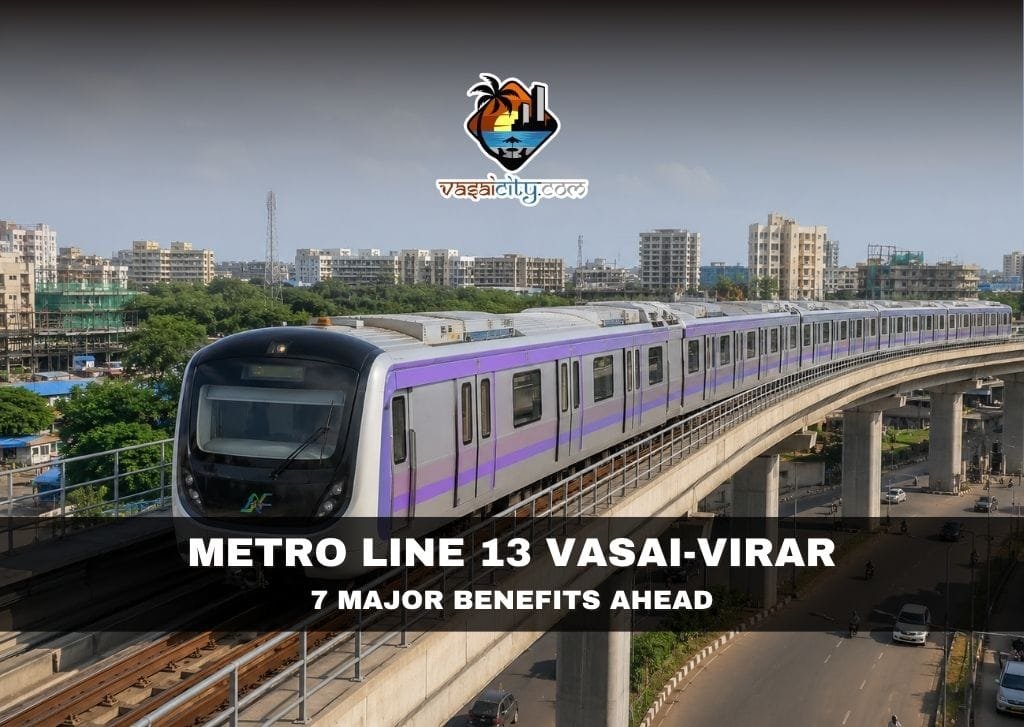
Metro Line 13 Vasai-Virar has moved from a long-discussed proposal to a major approved infrastructure project, with the Maharashtra government clearing the ₹17,724.99-crore corridor on August 18, 2026.
The project will create a new metro connection between Mira-Bhayandar and Vasai-Virar, linking important residential and commercial areas across the northern part of the Mumbai Metropolitan Region.
According to the latest project details reported after the approval, the corridor will be about 25.03 km long, with 21.78 km elevated and 3.25 km underground. MMRDA will implement the project.
For residents of Vasai, Naigaon, Nalasopara and Virar, the significance of Metro Line 13 Vasai-Virar goes beyond simply adding another mode of transport. The corridor could influence commuting patterns, business activity, redevelopment and the long-term growth of several neighbourhoods.
Table of Contents
1. Metro Line 13 Vasai-Virar Will Open a New Travel Corridor
One of the biggest advantages of Metro Line 13 Vasai-Virar will be the creation of a direct public transport corridor between Mira-Bhayandar and the Vasai-Virar region.
At present, commuters travelling across this belt often depend heavily on Western Railway services, buses, private vehicles and increasingly congested roads.
The metro could provide an additional option for people travelling between residential areas, railway stations, educational institutions, workplaces and commercial centres.
The project will also strengthen connections with the wider Mumbai Metro network. A proposed interchange with Metro Line 9 at Netaji Subhash Chandra Bose Stadium will further expand the potential reach of the corridor.
2. Naigaon Could Become an Important Connectivity Hub
Naigaon is one of the areas that could see significant benefits from Metro Line 13 Vasai-Virar.
The proposed corridor will connect with the suburban railway network at Naigaon, creating an important interchange between metro and local trains.
For residents of Naigaon East and surrounding areas, improved access to the metro could make the railway station and nearby transport corridors more valuable as mobility hubs.
Better public transport integration could also encourage commercial activity around station areas, although the actual scale of development will depend on station access, roads, parking, pedestrian facilities and implementation.
3. Vasai Could See Stronger East-West Connectivity
Metro Line 13 Vasai-Virar is particularly significant for Vasai because the corridor introduces a new high-capacity transport link through an area where road connectivity can be affected by congestion.
The planned underground section is expected to run through the densely developed Vasai-Nalasopara portion of the alignment. The 3.25-km underground component was added as part of the revised project plan.
Vasai could therefore benefit from improved access towards Mira-Bhayandar while also gaining stronger links towards Nalasopara and Virar.
The project also includes a major integrated road-and-metro bridge over Vasai Creek. Recent reports put the bridge length at about 4.92 km, with road and metro infrastructure incorporated into the same structure.
This could be particularly important for residents who currently face difficulties travelling between the two sides of the creek.
4. Nalasopara Could Become a Major Beneficiary
Among all the locations along the route, Nalasopara could be one of the most closely watched areas after Metro Line 13 Vasai-Virar becomes a reality.
The proposed corridor will connect with the Nalasopara railway network, giving commuters another way to travel beyond the existing local train system.
Both Nalasopara East and Nalasopara West have featured in the proposed station plans, although the final station configuration should be followed through official project updates as implementation progresses.
The metro could also encourage more organised development around major transport nodes.
However, it is important to distinguish between potential development and guaranteed development. A metro station does not automatically mean that every nearby property will appreciate at the same rate.
Road access, station walking distance, existing infrastructure, development permissions, drainage, water supply and the quality of surrounding neighbourhoods will all influence the actual impact.
5. Virar's Eastern Areas Could Gain a New Growth Driver
Metro Line 13 Vasai-Virar could also have a major impact on Virar, particularly areas located closer to the proposed northern end of the corridor.
The project is planned to extend towards Dongarpada, while a metro depot is also proposed in the Virar area.
Locations such as Yashwant Nagar, Viva College, Yazoo Park and Dongarpada have appeared in the proposed alignment and station planning.
For residents in Virar East, an additional mass-transit option could reduce dependence on road transport for certain journeys.
It could also make developing areas more attractive to businesses and residential developers if supporting infrastructure keeps pace with population growth.
6. Will Metro Line 13 Increase Property Prices?
This is likely to be one of the biggest questions among property owners and homebuyers.
Metro Line 13 Vasai-Virar could create upward pressure on property demand, especially in locations within convenient walking or feeder-transport distance of stations.
Better connectivity generally makes residential locations more attractive because commuters place a premium on accessibility.
However, claims that property prices will automatically rise by a fixed percentage should be treated cautiously. There is currently no official basis to state that every location along the corridor will see a 10%, 20% or 25% increase.
Instead, the likely impact will vary from one micro-market to another.
Properties closest to stations, areas with good roads and pedestrian access, and neighbourhoods with established civic infrastructure could potentially benefit more than properties that are technically close to the metro but difficult to reach.
For Vasai-Virar's property market, Metro Line 13 Vasai-Virar could therefore become an important factor in future buyer and investor decisions, but it should not be the only factor considered.
7. Development Could Shift Towards Metro-Connected Locations
Large transport projects often influence the geography of urban growth.
With Metro Line 13 Vasai-Virar, areas that currently depend heavily on local roads could become more attractive if they receive reliable station access and feeder services.
Commercial establishments may also look at locations near stations because of the potential for increased pedestrian movement.
Over time, this could encourage a mix of residential, retail, office and service-sector development around selected stations.
There could also be pressure for redevelopment in older and densely populated neighbourhoods.
However, redevelopment of chawls, slums or industrial properties is not an automatic consequence of the metro project. Such changes would depend on land ownership, development regulations, rehabilitation requirements, planning approvals and the economics of individual sites.
Metro Line 13 Vasai-Virar and the Railway Network
One of the strongest features of Metro Line 13 Vasai-Virar is its multimodal connectivity.
The corridor is expected to connect with Western Railway stations at Naigaon, Nalasopara and Virar. This means commuters could potentially use local trains for one part of their journey and the metro for another.
This type of integration is particularly important in Vasai-Virar, where the suburban railway remains the backbone of daily commuting.
The metro would therefore not simply compete with local trains. If properly integrated, it could complement the railway system and distribute passenger loads across multiple transport options.
What Could Change Around the Stations?
The biggest long-term changes may happen within the station influence areas rather than across the entire Vasai-Virar region.
Neighbourhoods with direct access to stations could see increased demand for shops, restaurants, offices, rental housing and other services.
Property developers may also increasingly market projects based on metro accessibility.
For existing residents, the benefits could include shorter connections to major transport hubs and employment areas.
For businesses, improved connectivity could expand the potential customer and employee catchment area.
For local authorities, however, the challenge will be ensuring that roads, footpaths, drainage, parking, public spaces and other civic infrastructure grow alongside the transport network.
A Wider Transformation for Vasai-Virar
The arrival of Metro Line 13 Vasai-Virar should also be viewed as part of a much larger infrastructure transformation taking place across the region.
Other metro corridors, road projects, railway improvements and regional connectivity projects are gradually changing the relationship between Vasai-Virar and the rest of the Mumbai Metropolitan Region.
VasaiCity has previously examined how multiple infrastructure projects could influence the region's future growth in Vasai Virar Connectivity Growth: 5 Major Changes Ahead.
The official Mumbai Metropolitan Region Development Authority (MMRDA) continues to list the Mira-Bhayander-to-Virar corridor among its Metro Line 13 project work.
What Residents Should Watch Next
The government approval is a major milestone, but residents should remember that approval is not the same as completion.
The next stages will involve detailed implementation, land-related work, tendering, construction and supporting infrastructure.
Station-level access will also be crucial.
A metro line can dramatically improve connectivity, but its practical value depends on how easily residents can reach the station from their homes and workplaces.
For Vasai-Virar, the success of Metro Line 13 Vasai-Virar will therefore depend not only on constructing the viaduct and stations but also on creating efficient last-mile connectivity.
The Bottom Line
Metro Line 13 Vasai-Virar could become one of the most important transport projects for the region's next phase of growth.
Naigaon, Vasai, Nalasopara and Virar are likely to be among the major beneficiaries, while Mira-Bhayandar will gain a new connection towards the rapidly expanding Vasai-Virar belt.
The project could improve commuting options, strengthen railway integration, encourage commercial activity and increase the attractiveness of selected station areas.
But the real impact will become clearer only as construction progresses and station locations, access roads and surrounding development take shape.
For residents and property owners, the key message is simple: the metro could create opportunities, but the biggest gains are likely to be location-specific rather than uniform across the entire Vasai-Virar region.