
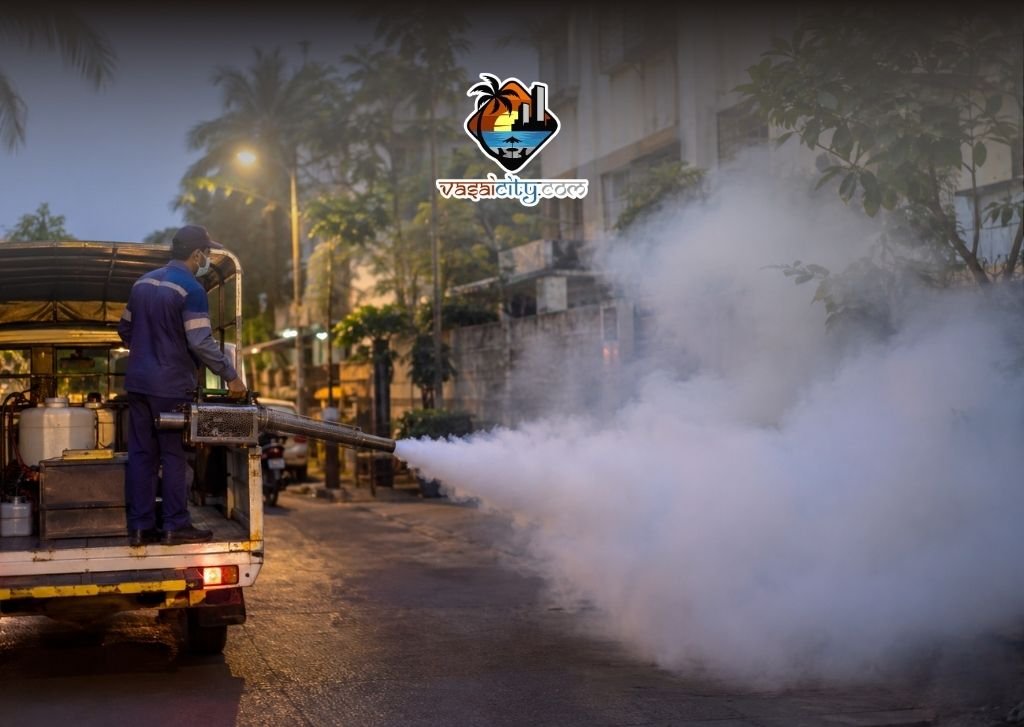
Evening mosquito fogging could become an important addition to mosquito-control efforts in Vasai-Virar, particularly in neighbourhoods where residents continue to face heavy mosquito activity after sunset.
The suggestion comes amid renewed civic action against dengue, malaria and other mosquito-borne diseases in the city. The Vasai-Virar City Municipal Corporation (VVCMC) has been carrying out fogging, insecticide spraying, larval surveys and inspections of potential mosquito-breeding sites as part of its preventive programme.
However, residents and civic observers may now want the corporation to examine whether evening mosquito fogging can be expanded in areas experiencing persistent mosquito nuisance.
The idea is not to replace existing morning operations. Instead, evening mosquito fogging could be used as a targeted supplementary measure in locations where mosquito activity is particularly high around dusk and during the early evening.
Table of Contents
Why Evening Mosquito Fogging Could Help Vasai-Virar
Mosquito activity is not the same throughout the day.
Different mosquito species have different biting and resting patterns. WHO guidance notes that space spraying should be timed according to the flight activity of the target mosquito species. For some dengue vectors, spraying may be appropriate in the early morning or early evening, while other mosquitoes can be more active around dusk or during the night.
This makes timing an important part of any mosquito-control programme.
For Vasai-Virar, where residential areas, open plots, drains, construction sites, waterlogged locations and densely populated neighbourhoods exist alongside one another, a targeted evening mosquito fogging programme could potentially improve coverage in mosquito hotspots.
1. Evening Mosquito Fogging Targets Adult Mosquitoes When They Are Active
One of the biggest arguments for evening mosquito fogging is timing.
Fogging or space spraying is primarily designed to reduce flying adult mosquitoes. It does not eliminate mosquito eggs, larvae or pupae breeding in stagnant water.
WHO's vector-control guidance specifically states that space treatments affect flying adult insects and should be timed to coincide with the flight activity of mosquitoes. For dengue vectors, early evening can be an appropriate treatment period.
This means a properly planned evening operation could potentially expose more active adult mosquitoes to the insecticide mist.
For residents, this could be especially useful in areas where mosquito nuisance increases sharply around sunset.
Parks, open grounds, internal roads, vacant plots, roadside drains and areas surrounding housing societies could be assessed for mosquito activity before deciding where additional spraying is necessary.
The emphasis should therefore be on targeted evening mosquito fogging, rather than simply sending fogging vehicles everywhere every evening.
2. Cooler Evening Conditions May Improve Fog Persistence
Weather conditions can influence how a mosquito-control spray behaves after it is released.
During very hot parts of the day, atmospheric conditions and air movement can affect the behaviour and dispersal of insecticide droplets.
WHO guidance notes that space spraying is generally carried out when the aerosol can remain airborne for as long as possible, commonly around dawn, dusk or night-time, depending on the target mosquito and local conditions.
This is one reason evening mosquito fogging deserves consideration as part of a scientifically planned programme.
However, local weather conditions must still be monitored.
Strong winds, rainfall or other atmospheric conditions can reduce the effectiveness of outdoor spraying. Therefore, VVCMC should ideally use local surveillance and weather conditions to determine when and where fogging should be undertaken.
3. Evening Mosquito Fogging Could Address the After-Sunset Nuisance
For many residents, the mosquito problem becomes most noticeable after sunset.
People return from work, children play outdoors, families sit in gardens or balconies, and residents move through streets and common areas.
If mosquito activity increases during this period, morning-only operations may not address the entire daily cycle of mosquito activity.
A well-planned evening mosquito fogging schedule could therefore provide an additional window for controlling adult mosquitoes.
This is particularly worth examining in neighbourhoods where residents have repeatedly reported mosquito swarms after sunset.
The concern is not merely about inconvenience.
Mosquitoes can transmit diseases such as dengue and malaria, making sustained vector-control efforts an important public-health measure.
Recent VVCMC action already includes fogging and chemical spraying, larval surveys and identification of breeding locations.
The next step could be to assess whether the timing and frequency of those operations are matching actual mosquito activity across different parts of the city.
4. Evening Fogging Should Be Targeted, Not Simply Daily Everywhere
There is an important distinction between requesting more evening mosquito fogging and demanding indiscriminate daily fogging across the entire municipal area.
The latter may not be the most effective use of manpower, fuel or insecticides.
Instead, VVCMC could consider a surveillance-based model.
Health teams could identify mosquito hotspots through complaints, field inspections, larval surveys, disease surveillance and repeated observations.
Areas with persistent adult mosquito activity could then receive additional evening mosquito fogging according to an operational schedule.
This approach would allow the corporation to concentrate resources where they are most needed.
It would also make it easier to evaluate whether additional fogging is actually reducing mosquito numbers.
WHO recommends integrated vector management rather than relying on a single intervention. Mosquito control can include adult-mosquito control, larval control, environmental management, surveillance and community participation.
5. Evening Mosquito Fogging Must Be Combined With Breeding-Site Control
Perhaps the most important point is that fogging alone cannot solve the city's mosquito problem.
Evening mosquito fogging primarily targets adult mosquitoes.
It does not remove stagnant water where mosquitoes breed.
This is why VVCMC's current focus on larval surveys and breeding-site inspections remains important.
In September 2026, the civic body's public-health campaign included inspections and action against mosquito breeding locations, including construction sites, scrap shops, tyre shops, nurseries, housing societies and other potential breeding areas.
Residents have also been advised to remove stagnant water from containers, flowerpot trays, tyres, bottles and other objects around homes.
A weekly "dry day" has been recommended to help eliminate potential breeding sites.
This combined approach is much more important than simply increasing the number of fogging rounds.
Vasai-Virar Needs a Ward-Wise Strategy
VVCMC currently has nine administrative wards, from A to I, covering the large Vasai-Virar municipal area.
Because the city's geography and development patterns vary considerably, mosquito-control requirements are unlikely to be identical everywhere.
An area surrounded by open land may face different mosquito conditions from a densely populated residential neighbourhood.
Similarly, locations near drains, construction sites, water bodies or poorly drained areas may require different interventions.
A ward-wise evening mosquito fogging programme could therefore be more practical than a blanket city-wide schedule.
Each ward could maintain a list of mosquito-sensitive locations and update it based on complaints, field inspections and health surveillance.
The corporation could then publish or communicate the planned fogging schedule so residents know when municipal teams are expected in their neighbourhood.
Residents Should Also Know When Fogging Is Planned
Communication is another important part of an effective evening mosquito fogging programme.
Residents should receive advance information whenever possible.
Housing societies, schools, markets and other institutions could be notified about the expected timing of spraying.
This would allow residents to take reasonable precautions and avoid unnecessary exposure to the fogging operation.
WHO guidance also stresses the importance of protecting spray workers and informing communities about space-spraying operations and relevant precautions.
VVCMC could use its website, social-media channels, WhatsApp communication, ward offices and local public announcements to share schedules.
Such communication would also allow residents to report mosquito hotspots more efficiently.
Could Evening Fogging Reduce Dengue and Malaria Risk?
The answer requires some caution.
Fogging can reduce adult mosquito populations in the treated area, but it is not a standalone guarantee against dengue, malaria or other mosquito-borne diseases.
WHO recommends integrated vector-control strategies that address mosquitoes at different stages of their life cycle and reduce breeding opportunities.
For dengue in particular, eliminating containers and other places where Aedes mosquitoes can breed remains critical.
This means the ideal strategy for Vasai-Virar should combine evening mosquito fogging, larval control, removal of stagnant water, environmental sanitation, surveillance and public participation.
The goal should be sustained mosquito reduction rather than temporary relief from visible swarms.
Vasai's Mosquito Problem Requires Continuous Monitoring
Vasai-Virar's rapidly changing urban environment makes mosquito surveillance increasingly important.
Construction activity, open plots, water accumulation, clogged drainage channels, discarded containers and other environmental conditions can create new breeding locations.
The municipal corporation's current campaign already recognises the importance of finding and eliminating breeding sites.
However, the situation can change quickly.
A location that is relatively free of mosquitoes one week can become a breeding hotspot after rainfall or water accumulation.
That is why evening mosquito fogging should ideally be linked to regular field surveillance rather than being treated as a fixed routine disconnected from local conditions.
A Practical Proposal for VVCMC
Instead of immediately introducing city-wide daily evening mosquito fogging, VVCMC could consider a pilot programme.
The corporation could select mosquito-sensitive areas from each administrative ward and conduct targeted evening operations for a defined period.
Before and after the programme, health teams could record mosquito activity and complaints.
The results could then be compared with areas receiving only the existing schedule.
If the data shows a meaningful reduction in adult mosquito activity, the programme could be expanded.
Such a pilot would also allow the civic body to determine the appropriate equipment, manpower, frequency, timing and insecticide application method for local conditions.
Residents Also Have a Role
Municipal action alone cannot eliminate mosquitoes from a city as large and diverse as Vasai-Virar.
Residents must also ensure that their homes, societies and surrounding areas do not provide breeding opportunities.
Water tanks, buckets, plant trays, tyres, discarded containers and other objects capable of holding water should be checked regularly.
Housing societies should pay particular attention to basements, terraces, gardens, construction areas and other locations where water can collect.
VVCMC's September 2026 campaign specifically called on residents to cooperate with health teams during breeding-site inspections and follow preventive instructions.
This community participation is essential because even a highly effective evening mosquito fogging operation will have limited long-term value if new mosquitoes continue emerging from nearby breeding sites.
The Demand: More Strategic Fogging, Not Just More Fog
Residents are not necessarily asking the civic body to simply increase the amount of chemical spraying.
The bigger demand is for smarter mosquito control.
That means identifying where mosquito populations are highest, understanding when different mosquito species are most active, treating breeding sites, monitoring disease trends and deploying evening mosquito fogging where it can provide additional benefit.
This approach could make mosquito-control operations more targeted and measurable.
It could also help VVCMC determine whether additional evening rounds are actually producing better results.
For a city stretching from the Vasai side to Virar and containing nine administrative wards, such a data-driven approach may be more practical than following a uniform schedule everywhere.
What Vasai-Virar Residents Can Expect
The mosquito problem is unlikely to disappear overnight.
But better coordination between municipal teams and residents can significantly strengthen prevention.
For residents, the immediate priorities are simple: report persistent mosquito hotspots, eliminate stagnant water, cooperate with municipal health inspections and follow local fogging advisories.
For VVCMC, the priority should be to continue breeding-site control while evaluating whether evening mosquito fogging can strengthen adult-mosquito control in identified hotspots.
The city already has an ongoing mosquito-control programme. Recent municipal action includes fogging, spraying, larval surveys, breeding-site inspections and public awareness activities.
Adding a carefully monitored evening component could therefore be considered as an extension of the existing system rather than an entirely new approach.
The Bottom Line
Evening mosquito fogging deserves consideration as a targeted mosquito-control measure in Vasai-Virar, particularly in locations where mosquito activity is high around dusk and after sunset.
Scientific guidance supports timing space spraying around mosquito activity and favourable atmospheric conditions, but it also makes clear that fogging is only one part of effective vector control.
For Vasai-Virar, the strongest strategy would combine evening mosquito fogging, larval control, stagnant-water removal, surveillance, sanitation and resident participation.
The question for VVCMC is therefore not simply whether it should fog the city every evening.
The more useful question is: Can evening mosquito fogging, deployed at the right locations and the right time, make the city's existing mosquito-control programme more effective?
A ward-wise pilot, backed by mosquito surveillance and measurable results, could provide the answer.
Disclaimer: This article presents a civic-policy suggestion based on public-health guidance and local reporting. Fogging schedules, insecticides, application methods and frequency should be determined by qualified public-health authorities based on local surveillance, regulations and safety protocols.