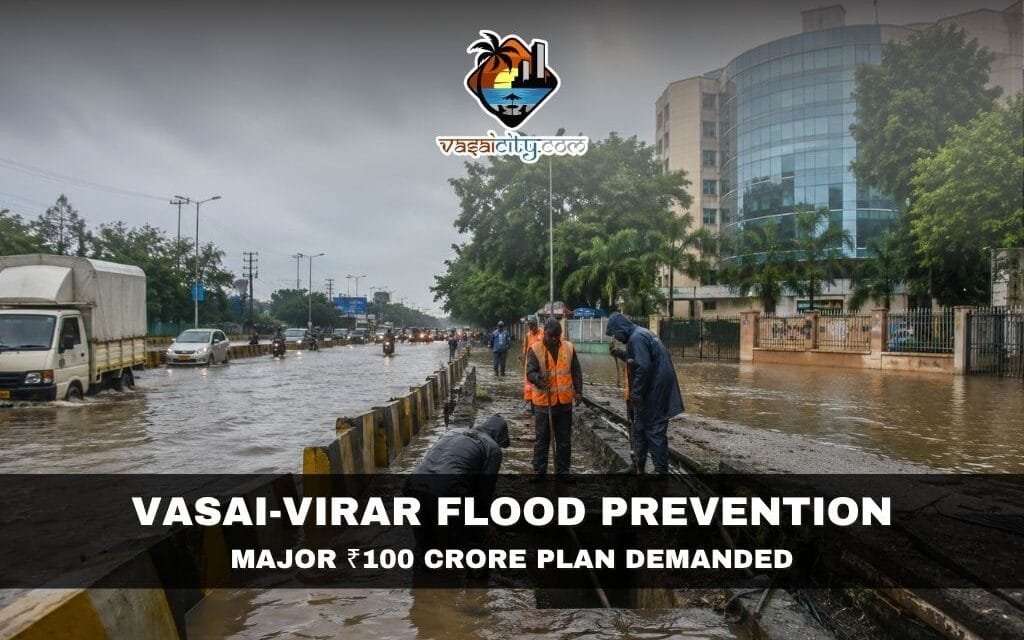
VASAI:Vasai-Virar Flood Prevention has once again become a major concern after Mayor Ajiv Patil urged the Vasai Virar City Municipal Corporation (VVCMC) to allocate a special fund of ₹100 crore for permanent flood mitigation projects across the city. The demand was raised during a joint meeting between municipal officials and railway authorities held at the VVCMC headquarters on Tuesday.
With the city experiencing severe flooding almost every monsoon, civic authorities are now looking beyond temporary measures and focusing on long-term infrastructure improvements that can significantly reduce flood risks.
Table of Contents
Why Vasai-Virar Flood Prevention Needs Immediate Attention
The issue of Vasai-Virar Flood Prevention has been growing more serious since 2017. Every year, heavy rainfall leaves several residential areas submerged, affecting thousands of residents, disrupting transport, damaging property, and causing economic losses.
Mayor Ajiv Patil highlighted that the record-breaking rainfall between July 4 and July 8 this year once again exposed the city’s weak drainage infrastructure. Large parts of Vasai and Virar remained waterlogged for hours, with residents struggling to commute and businesses suffering major disruptions.
According to the Mayor, while the municipal corporation spends crores of rupees every year on desilting drains before the monsoon, these efforts alone have not solved the flooding problem.
He stressed that simply cleaning drains is no longer sufficient and that scientific planning and permanent drainage improvements are essential for effective Vasai-Virar Flood Prevention.
₹100 Crore Special Allocation Proposed
During the meeting, Mayor Patil proposed a dedicated ₹100 crore budget exclusively for flood prevention projects.
The proposed fund would support:
- Construction of new drainage channels
- Expansion of existing stormwater drains
- Restoration of natural water flow paths
- Land acquisition wherever necessary
- Modern flood management infrastructure
- Improved coordination between civic and railway authorities
According to the Mayor, such an investment would significantly improve the city’s ability to handle heavy rainfall in the coming years.
Natural Water Channels Must Be Restored
One of the major suggestions discussed for Vasai-Virar Flood Prevention was the restoration of natural drainage routes that have disappeared due to rapid urban development.
Mayor Patil recommended that civic officials consult senior citizens who possess valuable knowledge of the city’s historical water flow patterns. Their local knowledge could help identify blocked streams and natural drainage channels that once carried rainwater safely towards creeks.
He also suggested reopening closed natural waterways after coordinating with local residents.
Experts believe restoring natural drainage systems can considerably reduce flooding during intense rainfall.
Removal of Obstructions Along Waterways
The Mayor also pointed out that mangrove growth and other obstructions are restricting water flow in certain locations.
He proposed removing such blockages wherever legally permissible after obtaining approvals from the Forest Department.
At the same time, he emphasized that environmental regulations should be respected while ensuring that critical drainage routes remain functional.
Balancing ecological conservation with urban flood management was identified as an important aspect of future planning.
Land Acquisition May Be Required
As urbanisation has expanded rapidly across Vasai-Virar, many traditional drainage channels have narrowed or disappeared altogether.
To address this challenge, the Mayor suggested that the municipal corporation consider acquiring land wherever necessary to construct wider and more efficient stormwater drains.
Such projects would require long-term planning but could provide a permanent solution to recurring flooding.
Railway Infrastructure Also Under Scrutiny
A significant portion of the discussion focused on drainage problems within railway limits.
Mayor Patil stated that incomplete cleaning of railway drains and culverts has reduced water flow during heavy rainfall.
He also observed that ongoing railway expansion projects have affected several natural drainage routes, increasing water accumulation in nearby residential areas.
The Mayor urged railway authorities to take immediate corrective measures by improving drainage systems under their jurisdiction.
Demand to Widen Major Drains
Another important proposal was to widen major drainage channels from the creek right up to their source.
Mayor Patil suggested that the primary drains should be expanded to at least 150 metres wherever technically feasible.
He explained that wider channels would enable rainwater to reach creeks more quickly, reducing the chances of flooding in densely populated neighbourhoods.
Experts attending the meeting agreed that improving drainage capacity is critical as rainfall intensity continues to increase.
Better Coordination Between Agencies
The meeting highlighted the importance of stronger coordination between the municipal corporation and railway authorities.
Flood management often involves multiple agencies, and delays in one department can reduce the effectiveness of the overall system.
Officials discussed ways to improve communication, jointly monitor drainage works, and complete infrastructure projects before future monsoon seasons.
The Mayor appealed to railway officials to begin construction of additional drains and gutters within railway limits without delay.
Senior Civic and Railway Officials Attend Meeting
The meeting was attended by several senior officials and elected representatives, including:
- Municipal Commissioner Prithviraj B. P.
- Additional Commissioners Deepak Sawant and Sanjay Herwade
- City Engineer Pradeep Pachange
- Senior railway officials
- Standing Committee Chairman Pravin Shetty
- House Leader Praful Sane
- Deputy Mayor Marshal Lopies
- Other elected representatives
The presence of officials from both civic and railway departments underscored the seriousness of the city’s flooding concerns.
Long-Term Vision for Vasai-Virar Flood Prevention
The repeated flooding witnessed over the past several years has demonstrated that temporary monsoon preparations alone cannot protect the growing city.
Experts increasingly advocate integrated urban planning that combines modern stormwater infrastructure with restoration of natural waterways.
If implemented effectively, the proposed ₹100 crore investment could significantly strengthen Vasai-Virar Flood Prevention, reduce property damage, improve public safety, and make the city more resilient against increasingly unpredictable rainfall.
Residents now await concrete action from both the municipal corporation and railway authorities to ensure that future monsoons do not bring the same annual hardships.