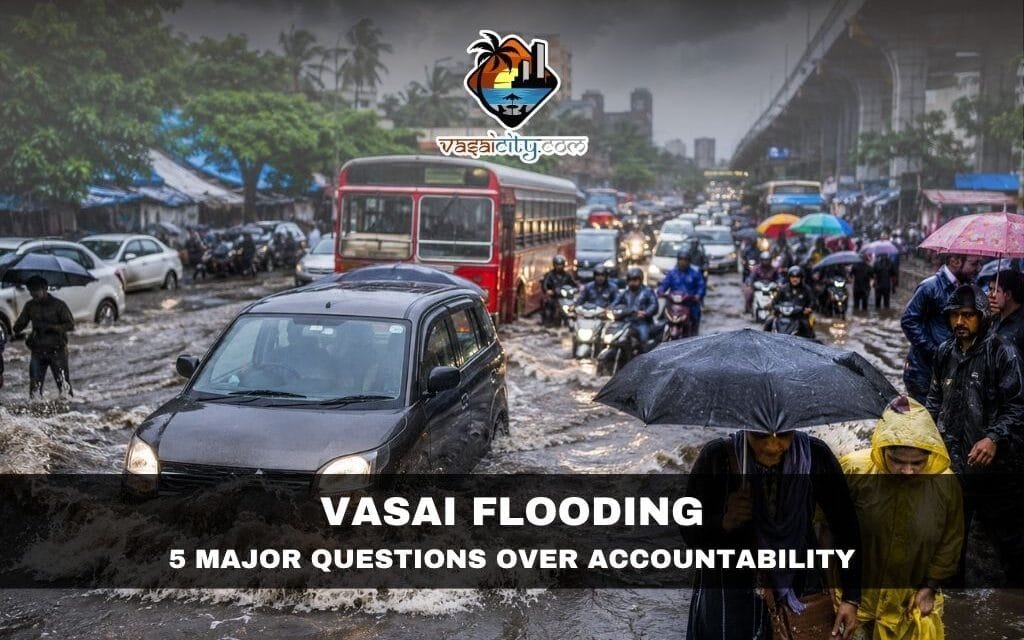
Vasai Flooding has once again brought daily life to a standstill, leaving thousands of residents struggling with waterlogged roads, damaged homes, disrupted transport, and interrupted essential services. As another spell of heavy monsoon rain submerged several parts of the city, public attention has shifted beyond the rainfall itself to a larger question – who should be held accountable for Vasai’s recurring flood crisis?
For decades, residents have witnessed a familiar pattern every monsoon. Roads disappear under water, railway services are affected, electricity supply becomes unreliable in some areas, drinking water shortages emerge, and communication networks face disruptions. Despite continuous urban growth and repeated assurances of infrastructure development, the city continues to battle the same civic challenges year after year.
Table of Contents
Why Vasai Flooding Continues to Trouble Residents
The latest episode of Vasai Flooding once again exposed the city’s vulnerability during periods of intense rainfall.
Videos and photographs shared across social media showed submerged vehicles, flooded residential areas, overflowing drains, and commuters stranded across various parts of Vasai. Many citizens expressed frustration that despite years of development, the situation appears to repeat itself every monsoon season.
While unusually heavy rainfall undoubtedly plays a significant role, many residents and political observers argue that rainfall alone cannot explain why flooding has become such a predictable annual event.
Political Debate Intensifies Over Vasai Flooding
The renewed Vasai Flooding has also reignited political debate.
Supporters of the Bahujan Vikas Aghadi (BVA) argue that the city has experienced exceptionally heavy rainfall and that managing such weather events remains a challenge for any urban administration. According to them, increasing climate variability and rapid urban expansion have made flood management more difficult.
However, opposition leaders maintain that the recurring flooding reflects deeper civic and planning failures. They argue that repeated promises of better drainage infrastructure and improved urban planning have yet to produce lasting results.
Critics have frequently pointed to issues such as:
- Clogged and poorly maintained drainage systems
- Rapid and unplanned urbanisation
- Encroachments on natural water channels
- Reduced open spaces for rainwater absorption
- Increasing pressure on ageing civic infrastructure
- Insufficient long-term flood management planning
According to the opposition, these structural issues continue to make Vasai Flooding worse every monsoon.
More Than Three Decades of Political Leadership
Hitendra Vishnu Thakur first won the Maharashtra Assembly election in 1990 and has remained one of the most influential political figures in Vasai Taluka ever since.
Over the past three and a half decades, Vasai has undergone significant transformation. New residential townships, commercial developments, educational institutions, hospitals, and transport infrastructure have reshaped the region, making it one of the fastest-growing urban centres within the Mumbai Metropolitan Region (MMR).
Yet despite this rapid growth, residents continue to face many of the same monsoon-related problems that existed decades ago.
For many citizens, Vasai Flooding has become an annual reminder that development alone does not necessarily guarantee resilient civic infrastructure.
Residents Continue to Face the Same Monsoon Challenges
Every year, heavy rainfall brings a similar list of hardships.
Floodwater enters homes and shops, causing property damage and financial losses. Roads become difficult or impossible to navigate. Local train services experience delays or suspensions whenever tracks become submerged.
Power outages affect households and businesses. Drinking water supply can become irregular in some localities. Mobile connectivity also suffers during severe weather conditions, making communication difficult.
For families, daily wage earners, students, and business owners, these disruptions create significant economic and emotional stress.
Many residents now question why these recurring issues have not been permanently addressed despite years of civic investment.
Urban Growth Has Increased Flood Risks
Urban planners have often highlighted how rapid development can increase flood vulnerability if supporting infrastructure does not expand at the same pace.
As cities grow, natural drainage channels are frequently altered, wetlands disappear, and large concrete surfaces prevent rainwater from naturally soaking into the ground. During intense rainfall, water has fewer places to drain, increasing the likelihood of urban flooding.
Experts have also noted that climate change has contributed to more frequent episodes of extreme rainfall across many parts of Maharashtra, placing additional pressure on ageing drainage systems.
These broader environmental challenges make long-term planning even more important for rapidly growing cities like Vasai.
Is Rainfall the Only Reason Behind Vasai Flooding?
The central question emerging from this year’s Vasai Flooding is whether nature alone should bear the blame.
While no city can completely eliminate flooding during extreme weather events, urban planning experts often emphasise that effective stormwater drainage, regular maintenance of water channels, scientific land-use planning, and disaster preparedness can significantly reduce flood impacts.
The debate now extends beyond politics to governance and accountability.
Many citizens believe that annual flooding should not simply be accepted as an unavoidable consequence of the monsoon.
Public Demands Greater Accountability
As discussions continue across social media and public forums, residents are increasingly demanding transparency regarding flood mitigation measures.
Questions frequently raised include:
- Are existing drainage projects sufficient?
- How regularly are drains cleaned before the monsoon?
- Have natural water channels been adequately protected?
- Is infrastructure keeping pace with population growth?
- What long-term flood management plans are currently being implemented?
These are questions many residents believe deserve clear and detailed answers.
Can Vasai Finally Break the Annual Flood Cycle?
The recurring Vasai Flooding has once again highlighted the urgent need for sustainable urban planning and resilient infrastructure.
With Vasai continuing to expand rapidly, experts suggest that future development must be accompanied by modern drainage systems, improved stormwater management, environmental conservation, and stronger civic planning.
Residents across the city hope that future monsoons will no longer bring the same cycle of flooded roads, disrupted transport, damaged homes, and public inconvenience.
Whether the current debate leads to meaningful policy changes remains to be seen, but one thing is clear—the people of Vasai continue to expect lasting solutions rather than temporary responses.
As political discussions intensify, the broader question remains at the centre of public discourse: after decades of recurring monsoon flooding, who ultimately bears responsibility for ensuring that Vasai becomes a city better prepared for the future?
Inputs by Biju Cherian
This article is based on the author’s research and perspectives. The publisher claims no responsibility for inaccuracies. Views expressed are the contributor’s alone. Institutions mentioned are not endorsed unless specified.