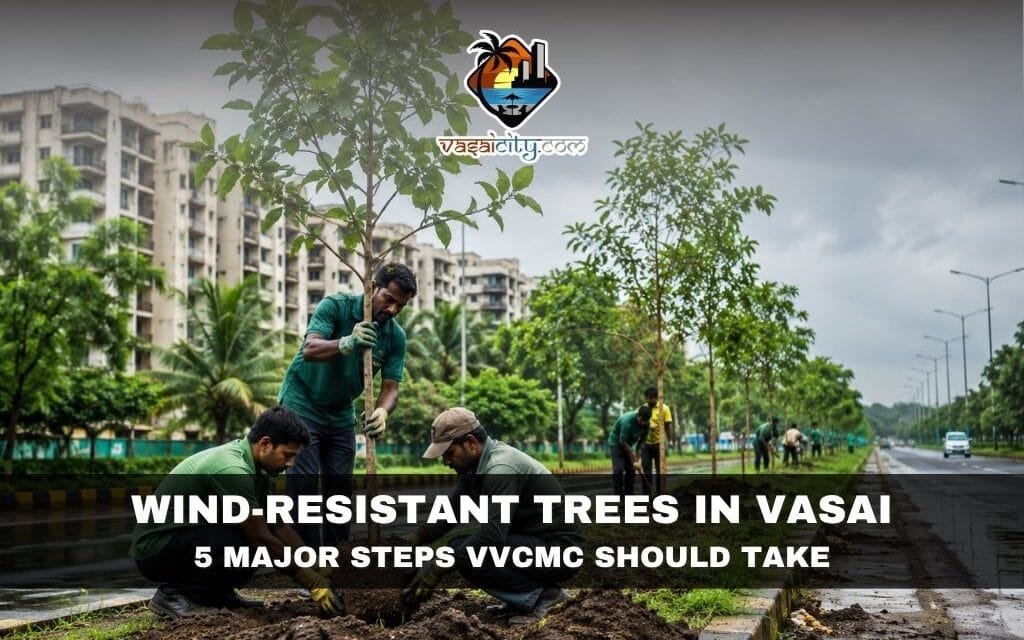
As heavy monsoon rains and powerful winds become more frequent every year, Wind-Resistant Trees in Vasai are emerging as an important solution to improve public safety and strengthen the city’s green infrastructure. Experts and residents believe the Vasai Virar City Municipal Corporation (VVCMC) should adopt a scientific approach to future plantation drives by selecting tree species that are better equipped to withstand extreme weather conditions.
Over the past few monsoon seasons, several incidents of uprooted trees have been reported across Vasai-Virar and other parts of the Mumbai Metropolitan Region. Many of these incidents have resulted in blocked roads, damaged vehicles, disrupted electricity supply, and, in some cases, injuries to commuters and pedestrians.
These recurring incidents have sparked discussions on whether future plantation efforts should focus not only on increasing the number of trees but also on improving their resilience.
Table of Contents
Why Wind-Resistant Trees in Vasai Are Becoming Essential
Maintaining the city’s green cover remains vital for improving air quality, reducing urban heat, supporting biodiversity, and enhancing the overall quality of life. However, climate patterns are changing rapidly, bringing stronger winds, heavier rainfall, and more frequent storms.
This changing climate highlights the importance of planting Wind-Resistant Trees in Vasai that possess deep and strong root systems capable of remaining stable during severe weather events.
Urban planners increasingly recommend selecting native tree species that naturally adapt to local soil conditions and seasonal weather patterns. Native trees generally require less maintenance while offering better long-term survival rates.
Understanding Why Trees Fall During Heavy Storms
Tree failures during the monsoon are often caused by multiple factors rather than wind alone.
Some common reasons include:
- Shallow root systems
- Poor soil conditions
- Waterlogged ground
- Structural weakness caused by disease
- Improper pruning practices
- Aging trees with internal decay
- Limited space for root development in urban areas
When heavy rain softens the soil and strong winds strike simultaneously, trees with weak anchorage become vulnerable to uprooting.
Scientific planning can significantly reduce these risks without compromising the city’s green cover.
Steps VVCMC Can Take for a Safer Urban Forest
A modern urban forestry strategy involves much more than planting saplings. Experts recommend that VVCMC adopt a comprehensive tree management programme focused on sustainability and public safety.
Some of the key measures include:
1. Plant Wind-Resistant Trees in Vasai
Future plantation drives should prioritise native species known for developing stronger root systems and better wind tolerance.
2. Conduct Regular Tree Health Audits
Periodic inspections can identify diseased, hollow, leaning, or structurally weak trees before they become dangerous during storms.
3. Scientific Pre-Monsoon Pruning
Proper pruning removes dead and unstable branches while maintaining the tree’s natural balance. Unscientific cutting should be avoided as it may weaken trees further.
4. Replace Unsafe Trees Responsibly
Trees that are beyond recovery should be replaced with healthier, climate-resilient species instead of leaving empty spaces.
5. Develop a Long-Term Urban Forestry Policy
A city-wide urban forestry policy can establish clear guidelines for tree selection, planting techniques, maintenance schedules, monitoring systems, and public awareness programmes.
Climate Change Demands Better Urban Planning
Climate experts continue to warn that extreme weather events are becoming more common due to changing global climate conditions.
Cities like Vasai-Virar need to prepare for these changing conditions by investing in resilient infrastructure, sustainable drainage systems, and scientifically planned green spaces.
Planting Wind-Resistant Trees in Vasai should therefore be viewed as part of a broader climate adaptation strategy rather than simply an environmental initiative.
Healthy urban forests can reduce flooding, lower temperatures, absorb carbon dioxide, improve air quality, and provide habitat for birds and other wildlife.
Benefits for Residents and Infrastructure
Implementing a scientific plantation programme offers multiple long-term benefits for the city.
These include:
- Improved public safety during storms
- Reduced road blockages
- Lower damage to vehicles and buildings
- Better protection of power and communication lines
- Stronger environmental sustainability
- Increased resilience against climate change
- Enhanced biodiversity across urban areas
A carefully planned approach allows the city to preserve its green identity while reducing risks associated with severe weather.
Public Participation Can Strengthen the Initiative
Residents also have an important role to play in protecting Vasai’s urban forest.
Citizens can report damaged or dangerously leaning trees to civic authorities, participate in plantation drives, discourage illegal tree cutting, and support awareness campaigns promoting sustainable tree care.
Community participation, combined with scientific planning, can significantly improve the success of future plantation programmes.
Looking Ahead
The increasing number of tree-fall incidents during every monsoon presents an opportunity for the Vasai Virar City Municipal Corporation to rethink its urban forestry strategy.
By prioritising Wind-Resistant Trees in Vasai, conducting regular inspections, adopting scientific pruning practices, and implementing a comprehensive tree management policy, the city can reduce risks while preserving its valuable green cover.
A balanced approach that protects both nature and public safety will help Vasai-Virar become more resilient in the face of changing climate conditions. With careful planning and sustained implementation, the city can continue to grow greener while ensuring safer roads, neighbourhoods, and public spaces for future generations.
Inputs by Biju Cherian
This article is based on the author’s research and perspectives. The publisher claims no responsibility for inaccuracies. Views expressed are the contributor’s alone. Institutions mentioned are not endorsed unless specified.