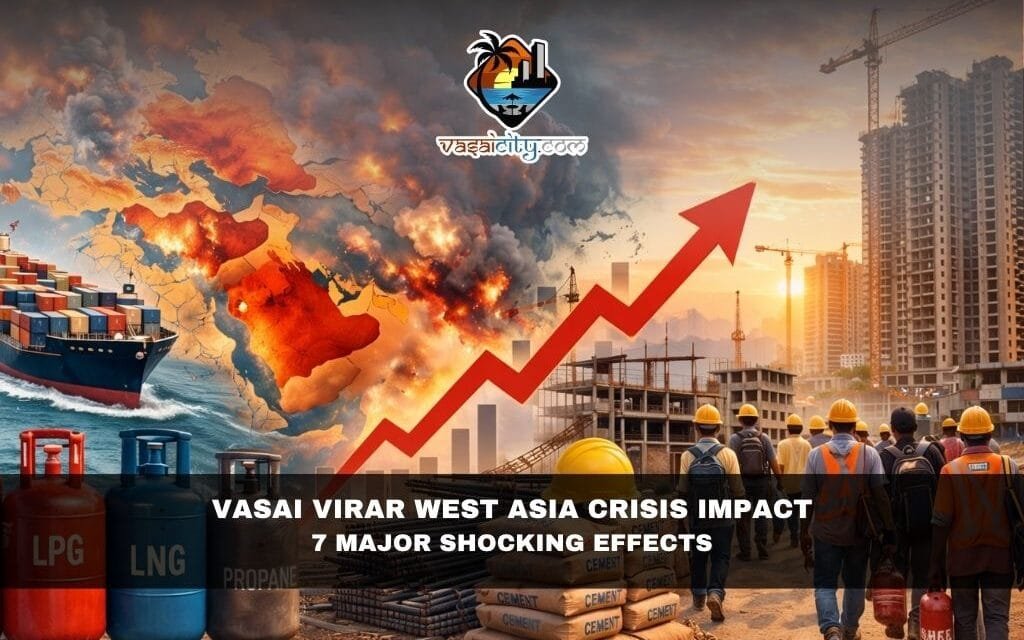
Vasai Virar West Asia Crisis Impact is becoming increasingly visible across the region as global tensions in West Asia continue to disrupt daily life, infrastructure, and local businesses in early 2026.
From rising construction costs to fuel shortages and declining industrial activity, the ripple effects are being felt across Vasai-Virar’s economy.
Table of Contents
Supply Chain Disruptions Hit Vasai Virar West Asia Crisis Impact
One of the most immediate consequences of the Vasai Virar West Asia Crisis Impact is the disruption in global supply chains. The ongoing blockade of the Strait of Hormuz has forced cargo ships to take longer routes via the Cape of Good Hope.
This detour has increased transit times by 10 to 20 days, significantly raising freight costs. Shipping companies are now imposing war surcharges ranging between $1,500 and $4,000 per container.
As a result, essential imported materials, including construction supplies and industrial gases, are facing shortages in the Vasai-Virar region.
Construction Sector Faces Rising Costs
The Vasai Virar West Asia Crisis Impact has placed immense pressure on the construction sector. Developers are struggling with increased costs of raw materials like steel, which has surged by nearly 20%, along with aluminum and logistics expenses.
These rising costs have added approximately ₹50 to ₹150 per square foot to high-rise construction projects, particularly in premium housing segments.
Additionally, shortages of critical materials such as tar are delaying road construction and public infrastructure projects. Several projects are now at risk of missing their deadlines.
Energy Shortages Disrupt Industries
Energy scarcity is another major aspect of the Vasai Virar West Asia Crisis Impact. The shortage of LPG, LNG, and propane has severely affected manufacturing units.
Many factories have reduced production by up to 50%, while some have temporarily shut down operations altogether. Small and medium enterprises (SMEs) are especially vulnerable, facing rising input costs and irregular payment cycles.
The crisis has also triggered a sharp increase in black-market prices, with commercial gas cylinders reportedly reaching as high as ₹8,000.
Workers and Small Businesses Under Pressure
The human cost of the Vasai Virar West Asia Crisis Impact is becoming increasingly evident. Factory workers and migrant labourers are experiencing reduced employment opportunities.
Due to high living costs and lack of cooking gas availability, many workers are returning to their hometowns. This reverse migration is further impacting local productivity and business continuity.
Small catering units and related service businesses have also been forced to shut down due to rising operational expenses.
Logistics and Manufacturing Sectors Slow Down
The logistics sector has witnessed a noticeable decline in activity due to reduced industrial output. Vehicle movement has dropped by nearly 50%, reflecting the slowdown in manufacturing and trade.
The Vasai Virar West Asia Crisis Impact has created a difficult situation for manufacturers, who are dealing with increasing production costs while facing reduced export competitiveness.
Packaging costs, particularly for plastic materials, have doubled, putting additional pressure on businesses involved in exports and ancillary services.
Real Estate Buyers Adopt Wait-and-Watch Approach
With uncertainty surrounding the global situation, the real estate market is also feeling the Vasai Virar West Asia Crisis Impact.
While developers are passing on the increased costs to buyers, many homebuyers are choosing to delay their purchasing decisions. This cautious approach is slowing down demand, especially in premium housing markets.
What Lies Ahead for Vasai Virar?
Experts suggest that even if the conflict is resolved immediately, it may take 1 to 3 months for global shipping routes and supply chains to normalize.
However, if the crisis continues, the Vasai Virar West Asia Crisis Impact could deepen further, leading to prolonged inflation in construction materials and additional strain on infrastructure projects.
Local Perspective: A Region in Transition
The ongoing situation highlights how global geopolitical conflicts can directly influence local economies like Vasai-Virar.
Inputs by Biju Cherian
This article is based on the author’s research and perspectives. The publisher claims no responsibility for inaccuracies. Views expressed are the contributor’s alone. Institutions mentioned are not endorsed unless specified.