
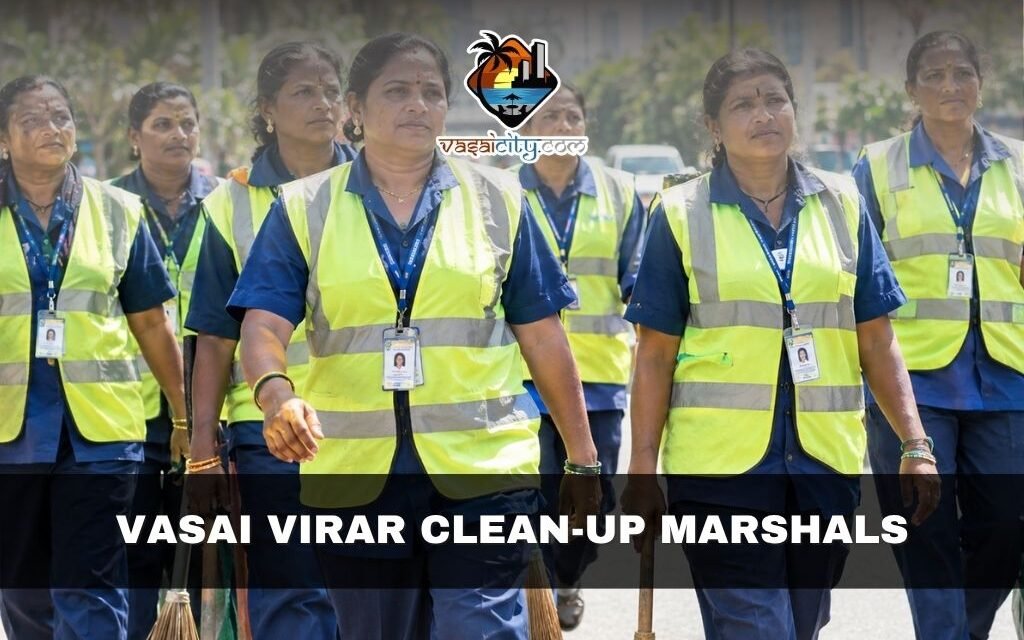
Vasai Virar Clean-Up Marshals are set to become part of a new civic initiative aimed at tackling littering, public spitting and other sanitation violations across the city. The Vasai-Virar City Municipal Corporation (VVCMC) has decided to move away from the traditional contractor-led approach and involve transgender people and women’s self-help groups in the programme.
The decision is significant not only from a sanitation perspective but also because it creates an opportunity for members of the transgender community to access dignified employment through municipal work.
The initiative is expected to cover all nine ward committees of Vasai-Virar. According to reports, the broader programme is planned for three years, while the participation of transgender workers will initially be tested for one year on a pilot basis.
Table of Contents
Why Vasai Virar Clean-Up Marshals Are Being Introduced
Despite regular municipal cleaning, littering remains a persistent problem in several parts of Vasai-Virar.
Residents and civic officials continue to encounter cases of people throwing waste on roads, spitting after consuming tobacco products, releasing dirty water onto public roads and burning waste near residential areas.
Such practices can quickly undermine regular sanitation work. A road may be cleaned in the morning, but irresponsible disposal of waste can leave the same location dirty again within hours.
The VVCMC’s Solid Waste Management Department is responsible for scientific waste disposal as well as activities including street cleaning, drain cleaning and related sanitation work.
The new Vasai Virar Clean-Up Marshals initiative is therefore intended to add an enforcement and awareness layer to the city’s existing sanitation system.
5 Major Changes Under the New Initiative
The proposed programme brings several changes to the way clean-up marshal duties will be handled in Vasai-Virar.
1. Greater municipal involvement
Instead of relying entirely on contractors to provide clean-up marshals, the civic body plans to implement the appointments through its own system.
2. Opportunities for transgender workers
Transgender people will receive a defined share of the opportunities under the programme, giving them access to municipal employment connected with sanitation and public awareness.
3. Participation of women’s self-help groups
Women associated with eligible self-help groups will also be able to participate, widening the employment opportunities created through the initiative.
4. Training and safety equipment
Selected personnel will receive special training from the municipal corporation. Uniforms, identity cards and safety equipment will also be provided, according to the reported plan.
5. Awareness alongside enforcement
The role will not simply be about issuing penalties. The programme is also expected to focus on educating citizens about responsible waste disposal and maintaining public cleanliness.
Nine Ward Committees to Be Covered
The Vasai Virar Clean-Up Marshals programme is expected to operate across all nine ward committees of the municipal corporation.
This is important because Vasai-Virar is a large and rapidly developing urban region, with residential neighbourhoods, commercial areas, transport corridors, markets and public spaces spread across a wide geographical area.
A city-wide approach could allow the civic administration to identify recurring littering locations and focus enforcement and awareness efforts where they are most needed.
However, the effectiveness of the programme will ultimately depend on how consistently the marshals are deployed and how clearly their powers and responsibilities are defined.
The VVCMC has also published information on the Solid Waste Management Rules 2026, including citizen notifications related to waste segregation and bulk waste generators.
Transgender Community to Get Employment Opportunity
One of the most notable aspects of the decision is the emphasis on employment for transgender people.
The reported proposal provides 33% preference for transgender participants, while the remaining opportunities are expected to be available to women’s self-help groups and other eligible categories.
Registered organisations representing transgender people will also reportedly be able to participate in the process.
For the transgender community, the initiative could provide more than a temporary source of income. It could create a pathway into formal civic work and provide greater visibility within public institutions.
The broader objective is to support social and economic empowerment while giving participants a defined role in improving the city.
Training, Uniforms and Identity Cards Planned
The role of a clean-up marshal can involve interaction with members of the public, particularly when citizens are found violating sanitation rules.
For that reason, training will be an important part of the programme.
According to the reported plan, selected personnel will receive municipal training before beginning their duties. Uniforms and identity cards will help citizens identify authorised marshals, while safety equipment is expected to provide protection during field operations.
This distinction will be important.
The public should be able to clearly differentiate between authorised Vasai Virar Clean-Up Marshals and individuals who may attempt to collect money or impose penalties without proper authority.
Clear identification, written procedures and appropriate supervision could therefore become critical to the success of the initiative.
Enforcement Is Only One Part of the Job
The programme is not being presented simply as a penalty-collection mechanism.
The reported responsibilities also include public awareness.
That means marshals could play a role in explaining why citizens should avoid throwing garbage on roads, spitting in public places or disposing of waste in unauthorised locations.
This approach could prove useful in areas where repeated cleaning has failed to solve the underlying behavioural problem.
A sustainable cleanliness system requires both enforcement and public cooperation. Even an expanded municipal workforce cannot keep every street clean if residents continue to dispose of waste irresponsibly.
Why the Decision Matters for Vasai-Virar
Waste management is one of the most visible indicators of urban governance.
Residents experience the impact directly through overflowing bins, roadside litter, unpleasant odours, blocked drains and unhygienic public spaces.
The municipality’s own solid-waste information highlights the importance of organised waste disposal, street cleaning and related sanitation activities.
The new Vasai Virar Clean-Up Marshals system could therefore complement the existing waste-management network rather than replace routine municipal cleaning.
The objective should be to prevent littering at the source, encourage responsible behaviour and take appropriate action when sanitation rules are deliberately ignored.
VasaiCity has previously reported on the city’s broader waste-management challenges, including disputes surrounding garbage collection contracts and their impact on residents.
A Different Approach to Civic Employment
The initiative also reflects a wider question about how municipal bodies can combine civic services with social inclusion.
Instead of treating sanitation enforcement purely as a contractual service, the VVCMC is attempting to connect the programme with employment opportunities for groups that have historically faced barriers in the formal job market.
The inclusion of women from self-help groups could similarly strengthen the role of community-based organisations in local governance.
If implemented transparently, the programme could potentially create a model where public cleanliness and social empowerment work together.
Other Cities Have Tried Similar Experiments
Vasai-Virar is not the first municipal corporation to explore employment opportunities for transgender people through civic services.
Reports cited in connection with the initiative point to the Cuttack Municipal Corporation, which introduced a similar initiative involving transgender people in 2019.
Pimpri-Chinchwad Municipal Corporation subsequently provided opportunities to transgender people as green marshals and security guards in 2022.
The Vasai-Virar initiative therefore builds on experiments that have already been attempted by other civic bodies, while adapting the concept to the city’s sanitation requirements.
What Residents Should Expect
For ordinary residents, the most visible change could be the presence of trained clean-up marshals at public locations.
Their effectiveness, however, will depend on several factors: adequate staffing, proper training, supervision, clearly defined enforcement powers and consistent implementation across all nine ward committees.
Transparency will also matter.
Residents should be able to understand what constitutes a sanitation violation, what action a marshal is authorised to take and how citizens can raise complaints if they believe an enforcement action was incorrect.
The VVCMC already provides information on its official website regarding solid waste management and the 2026 waste-management rules.
A Potential New Chapter for Civic Cleanliness
The introduction of Vasai Virar Clean-Up Marshals could become an important experiment for the city if it is implemented effectively.
The programme combines three objectives: improving public cleanliness, strengthening citizen awareness and creating employment opportunities for transgender people and women associated with self-help groups.
For Vasai-Virar, the real test will begin once the marshals start working on the ground.
If enforcement remains fair, training is effective and citizens cooperate, the initiative could help reduce recurring littering and improve public spaces.
At the same time, the programme should be monitored carefully to ensure that its social-inclusion objective is matched by professional standards, accountability and transparent recruitment.
The VVCMC’s decision represents a potentially significant shift in the city’s approach to cleanliness enforcement. Whether it becomes a successful civic model will ultimately depend on implementation—but the idea places both sanitation and social inclusion at the centre of the discussion.