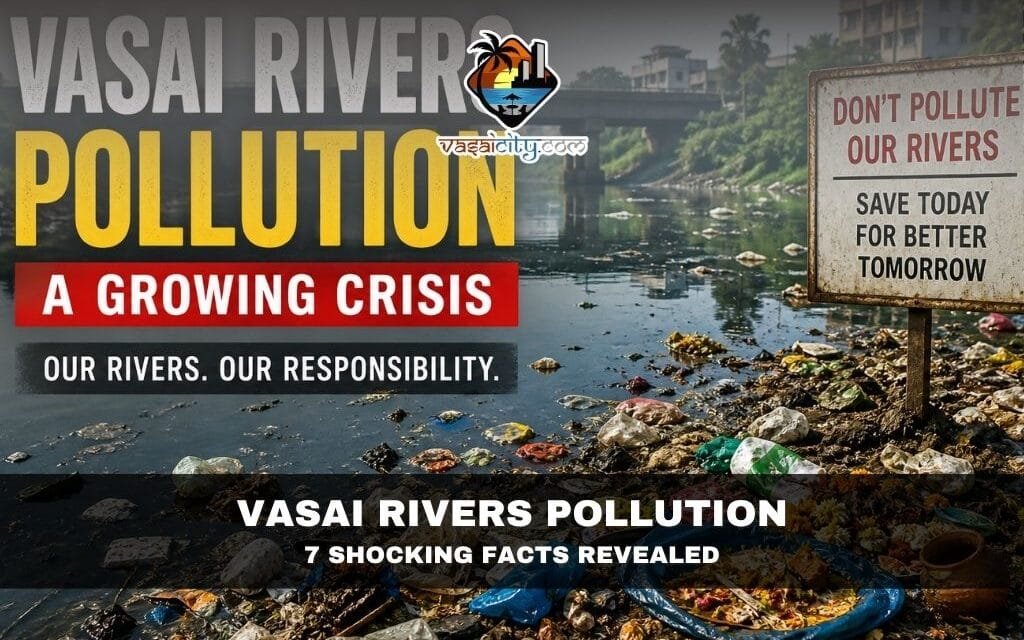
Vasai rivers pollution is becoming an alarming issue as the region’s vital water bodies struggle under increasing environmental pressure.
Table of Contents
The Lifelines of Vasai: Rivers and Creeks
Vasai is naturally surrounded by important water bodies that define its geography and ecosystem. To the south lies the Vasai Creek, a tidal estuary branching from the Ulhas River, while the Vaitarna River forms the northern boundary of the Vasai-Virar region. On the western side, the Arabian Sea completes this coastal landscape.
These interconnected waterways are not just geographical features – they are essential for biodiversity, fishing livelihoods, and natural flood control. Mangrove forests along these rivers play a critical role in maintaining ecological balance and protecting the coastline from erosion.
Vasai Creek: A Vital Yet Vulnerable Estuary
The Vasai Creek, historically known as Bassein Creek, is one of the most significant water channels in the region. Flowing from the Ulhas River and emptying into the Arabian Sea, it separates Vasai from Mira-Bhayandar.
Despite its ecological importance, Vasai rivers pollution has severely impacted this creek. Industrial waste, untreated sewage, and plastic dumping have steadily degraded water quality. What was once a thriving aquatic habitat is now under threat.
Vaitarna River: Northern Boundary Under Stress
The Vaitarna River, forming the northern edge of Vasai-Virar, is another crucial water source. It supports agriculture, drinking water supply, and local ecosystems.
However, growing urbanization and nearby industrial activities have contributed to Vasai rivers pollution here as well. Increasing contamination levels are affecting both water quality and aquatic life, raising concerns among environmentalists.
Hidden Waterways: Streams and Seasonal Flows
Beyond the major rivers, the eastern part of Vasai features the Tungareshwar mountain range, which gives rise to seasonal streams and waterfalls like Chinchoti.
These streams may not flow year-round, but they are essential for groundwater recharge and maintaining the region’s natural balance. Unfortunately, littering and tourist negligence are adding to Vasai rivers pollution even in these fragile zones.
Devkundi River: Beauty Facing Risk
The Devkundi River near Kaman village is known for its scenic beauty, especially during the monsoon season when waterfalls attract trekkers and nature lovers.
However, Vasai rivers pollution is becoming evident here too. Increased tourist activity has led to waste accumulation, while monsoon floods pose safety risks. Without proper management, this natural attraction could lose its charm.
Kaman Creek and Surrounding Areas
Kaman Creek is another important area, known for infrastructure like underwater pipelines and proximity to attractions such as Kamandurg Fort, Pelhar Dam, and Chinchoti Waterfall.
While development has brought economic benefits, it has also contributed to Vasai rivers pollution. Construction waste and unregulated dumping are slowly affecting water quality in this region.
The Growing Problem of Waste Dumping
One of the most disturbing aspects of Vasai rivers pollution is how easily rivers have become dumping grounds. In rapidly developing areas, waste management often fails to keep up with growth.
Industrial units, small businesses, and even residential areas contribute to the problem. Instead of proper disposal systems, waste frequently ends up in nearby water bodies.
A Cultural and Civic Concern
Another dimension of Vasai rivers pollution is the misuse of religious practices. Offerings and materials used during rituals are often discarded into rivers without considering environmental consequences.
While faith is deeply respected, the lack of awareness and responsible behavior is adding to the burden on these already stressed ecosystems.
Environmental Impact and Long-Term Risks
The effects of Vasai rivers pollution go beyond visible dirt. Polluted water harms marine life, reduces oxygen levels, and disrupts the entire food chain.
Mangroves, which act as natural protectors against flooding, are also at risk. Their destruction can lead to increased vulnerability during heavy rains and cyclones.
What Needs to Change?
The current situation raises an important question – how long can these rivers bear the growing burden?
Addressing Vasai rivers pollution requires collective responsibility. Authorities must enforce stricter waste management rules, industries need to adopt sustainable practices, and citizens must change their habits.
Public awareness campaigns, proper waste disposal systems, and eco-friendly alternatives for religious practices can make a significant difference.
A Call for Responsibility
Rivers are not just channels of water- they are lifelines that sustain entire communities. Treating them as dumping grounds reflects a deeper disconnect between people and nature.
Vasai rivers pollution is not just an environmental issue; it is a civic responsibility. Protecting these water bodies is essential for the health, safety, and future of the region.
Inputs by Biju Cherian
This article is based on the author’s research and perspectives. The publisher claims no responsibility for inaccuracies. Views expressed are the contributor’s alone. Institutions mentioned are not endorsed unless specified.