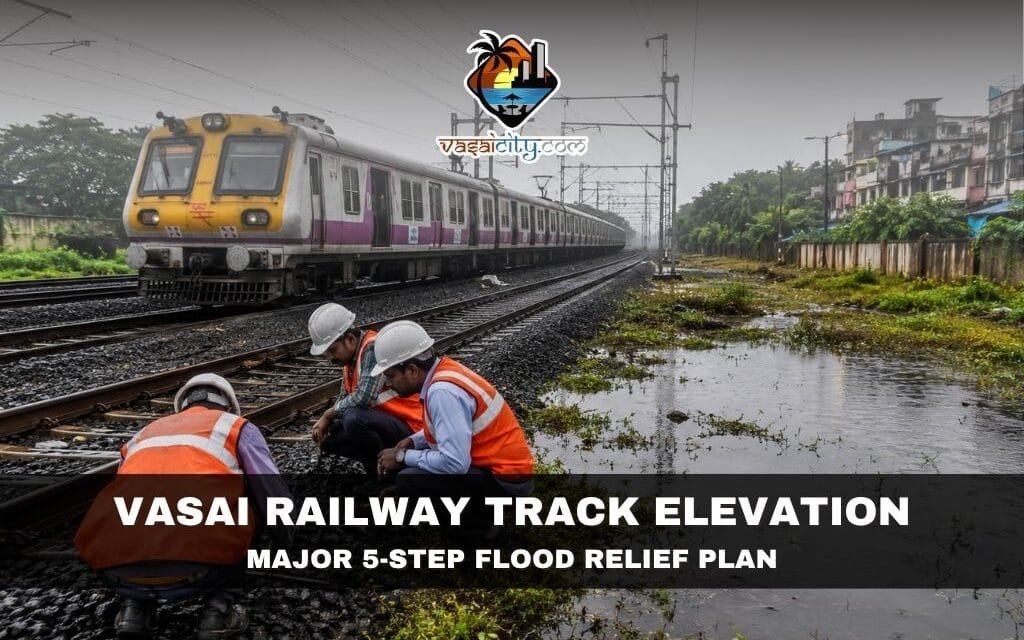
Vasai Railway Track Elevation is set to become one of the most significant infrastructure upgrades for the Vasai-Virar region, as Western Railway (WR) has announced plans to raise the railway track level by 400 mm. The ambitious move is aimed at reducing monsoon-related flooding, improving railway reliability, and ensuring safer travel for thousands of daily commuters.
Every monsoon, residents of Vasai, Virar, Nalasopara, and surrounding suburbs experience severe disruptions due to waterlogged railway tracks. Train delays, cancellations, and overcrowding have become a recurring challenge. With this latest initiative, Western Railway hopes to significantly improve the resilience of its suburban rail network.
Table of Contents
Why the Vasai Railway Track Elevation Is Needed
The Vasai Railway Track Elevation project comes after repeated flooding incidents that have affected train operations over the years. During periods of heavy rainfall, water accumulation around the tracks often forces authorities to slow down or temporarily suspend train services.
As climate patterns become increasingly unpredictable, railway authorities have recognized the need for long-term engineering solutions rather than temporary fixes.
Following a detailed inspection and technical assessment conducted by Western Railway General Manager Ramashray Pandey, officials concluded that raising the track level would help minimize the impact of heavy rainfall on railway operations.
The proposal is considered part of a broader effort to strengthen railway infrastructure across Mumbai’s suburban network.
400 mm Track Raise to Improve Flood Resilience
Under the project, two out of the four existing railway tracks in the Vasai section will be elevated by approximately 400 millimetres.
The increase in height is expected to reduce the likelihood of water accumulating on the tracks during intense rainfall, thereby allowing train services to continue operating more efficiently.
For commuters travelling between Churchgate, Borivali, Vasai Road, Nalasopara, Virar, and beyond, the project promises improved reliability during the monsoon season once completed.
While a 400 mm increase may appear modest, railway engineers believe it can make a substantial difference in drainage efficiency and flood management.
Mumbai Railway Vikas Corporation to Build Higher Railway Lines
The Mumbai Railway Vikas Corporation (MRVC) has also been assigned the responsibility of constructing new railway lines at a higher elevation between Borivli and Virar.
This work aligns with long-term plans to modernize suburban railway infrastructure while preparing the network for increasing passenger demand.
The elevated railway lines will complement the existing flood mitigation measures and support future expansion projects in one of Mumbai Metropolitan Region’s fastest-growing corridors.
The Borivli–Virar stretch serves lakhs of passengers every day, making infrastructure improvements critical for uninterrupted railway operations.
Massive Engineering Work Required
Although work on the Vasai Railway Track Elevation project is expected to begin soon, railway officials have indicated that the initiative involves far more than simply raising the tracks.
Several interconnected railway systems will require extensive modifications, including:
- Overhead electrical equipment
- Railway signalling systems
- Railway platforms
- Railway yards
- Railway car sheds
- Track crossover points
- Drainage infrastructure
Since these components are integrated with the current track level, engineers will need to redesign and rebuild significant portions of the railway network.
Such large-scale infrastructure work requires detailed planning, multiple approvals, and substantial financial investment.
Funding and Execution Challenges
Experts point out that while the announcement is encouraging, completing the Vasai Railway Track Elevation project will require considerable funding.
Infrastructure projects of this scale often involve multiple government agencies, technical consultants, and phased construction schedules.
Railway authorities will also need to ensure that daily train operations continue with minimal disruption while construction progresses.
As a result, commuters should not expect immediate changes, even though preparatory work may begin shortly.
Relief for Daily Commuters
For residents of Vasai-Virar, railway connectivity is the backbone of daily life.
Every day, lakhs of office-goers, students, business owners, and workers depend on Western Railway’s suburban services to reach Mumbai and neighbouring cities.
During heavy rains, even a short suspension of train services can affect the schedules of thousands of families.
If successfully implemented, the Vasai Railway Track Elevation project could significantly reduce these disruptions and improve commuter confidence during the monsoon season.
Better railway infrastructure may also contribute to smoother travel, reduced maintenance requirements, and enhanced passenger safety.
A Long-Term Infrastructure Investment
Infrastructure experts believe that adapting railway systems to changing weather conditions has become increasingly important.
Instead of responding only after flooding occurs, projects like the Vasai Railway Track Elevation represent proactive planning aimed at building a more resilient transport network.
The initiative also complements ongoing railway modernization projects across the Mumbai Metropolitan Region.
Although the project will take time, its long-term benefits could extend well beyond flood prevention by improving operational efficiency and reducing maintenance costs.
What Happens Next?
Western Railway is expected to begin work on raising two existing tracks while coordinating closely with the Mumbai Railway Vikas Corporation on the elevated railway line construction between Borivli and Virar.
As planning progresses, commuters can expect periodic updates regarding construction schedules, traffic management, and operational changes.
The project represents an important step toward creating a stronger and more reliable railway network for one of Maharashtra’s busiest suburban corridors.
For residents who have faced repeated travel disruptions every monsoon, the Vasai Railway Track Elevation project offers hope that future rainy seasons may become considerably less challenging.
Inputs by Biju Cherian
This article is based on the author’s research and perspectives. The publisher claims no responsibility for inaccuracies. Views expressed are the contributor’s alone. Institutions mentioned are not endorsed unless specified.