
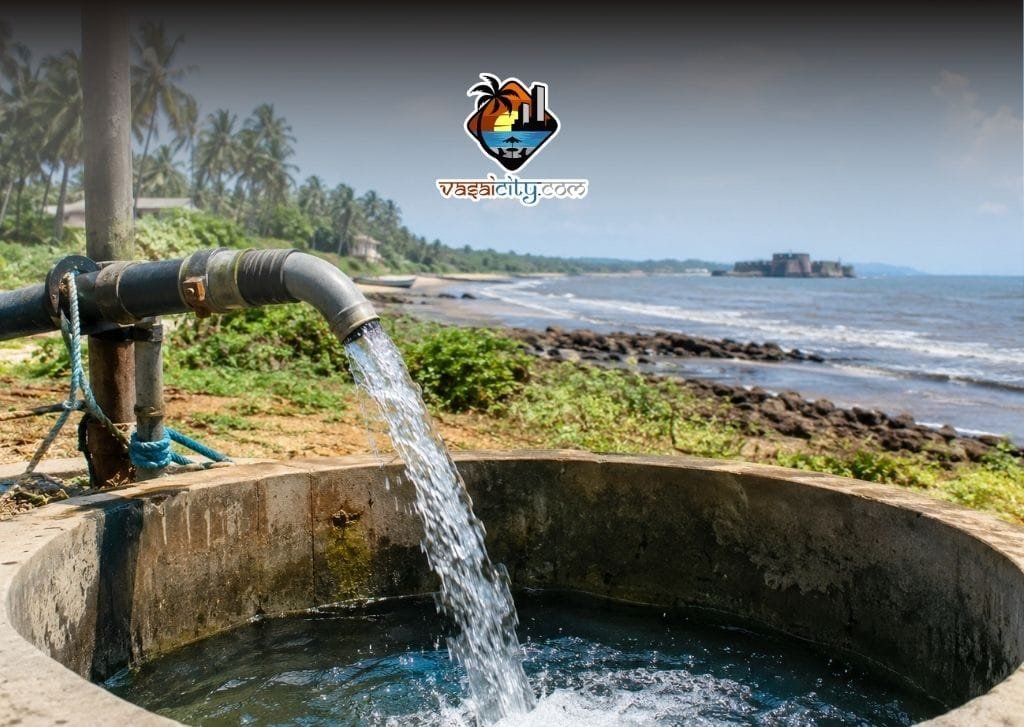
Vasai groundwater could face increasing pressure from excessive pumping, particularly in the city's coastal and creek-side areas, raising concerns about seawater intrusion and the long-term availability of fresh water.
Vasai's geography makes its groundwater resources particularly sensitive. The region is surrounded by the Arabian Sea to the west, Vaitarna Creek to the north and Vasai Creek to the south. Large parts of the taluka also have a long history of dependence on wells, borewells and other local water sources.
The concern over Vasai groundwater is not simply about whether wells may dry up. In coastal aquifers, excessive extraction can also alter the underground movement of water and allow saline or brackish water to move inland.
The Central Ground Water Board (CGWB) has previously identified the possibility of seawater ingress in a small area of the Vasai-Virar region. The Union government has also noted that excessive groundwater exploitation, along with tidal influence in creeks and salt-pan activity, can contribute to salinity problems in coastal groundwater.
Table of Contents
Vasai Groundwater and the Risk of Seawater Intrusion
Groundwater does not remain static beneath the surface. Freshwater stored underground is constantly moving through soil and rock formations, while coastal aquifers interact with seawater and tidal systems.
When groundwater levels fall substantially because of excessive pumping, the natural hydraulic balance can change. During periods when the groundwater level is lower than the surrounding sea level, a reverse hydraulic gradient can develop in coastal areas, allowing saline water to move inland. The Central Ground Water Board describes this mechanism as one of the factors that can contribute to seawater intrusion.
This is particularly important for Vasai groundwater because of the area's extensive coastline and network of creeks.
The potential problem is not limited to locations immediately beside the sea. Depending on local geology, groundwater flow and pumping patterns, saline water can travel through underground formations and affect freshwater sources farther inland.
Claims that seawater could move two or three kilometres inland should therefore be treated as a location-specific risk rather than a fixed distance applicable to the entire Vasai region. The actual extent of saltwater intrusion depends on aquifer conditions, pumping intensity, tidal influence, rainfall and other factors.
1. Excessive Pumping Can Put Vasai Groundwater Under Pressure
One of the biggest concerns for Vasai groundwater is unregulated extraction through borewells and other groundwater sources.
When water is pumped faster than an aquifer can naturally recharge, the underground water level can decline. If this continues for a long period, the freshwater reserve becomes increasingly vulnerable.
This does not mean every borewell in Vasai is automatically harmful. Groundwater extraction has to be assessed according to the local aquifer, recharge rate, depth, seasonal variation and quantity being extracted.
However, uncontrolled pumping across multiple locations can cumulatively put pressure on the groundwater system.
The issue has been recognised in official planning documents for Vasai-Virar. A municipal development plan noted that indiscriminate groundwater extraction, including extraction associated with tankers, had affected groundwater quality and quantity in some village settlements and identified a threat of salinity ingress. The same document emphasised the importance of adequate piped water supply to reduce dependence on groundwater.
2. Coastal Areas Need Special Protection for Vasai Groundwater
The geography of Vasai makes groundwater management especially important.
Areas extending from the Vasai Fort side towards the coastal belt around Arnala, as well as locations influenced by Vasai Creek, Vaitarna Creek and other tidal waterways, require careful monitoring.
The concern is not that seawater will suddenly flood underground freshwater reserves. Instead, a gradual change in the underground freshwater-saltwater balance can occur when groundwater levels are lowered.
For Vasai groundwater, maintaining sufficient freshwater pressure within coastal aquifers is therefore an important part of protecting the resource.
Regular monitoring can help identify changes before they become a major problem. Measurements of groundwater levels and indicators such as electrical conductivity, total dissolved solids and chloride concentration can help identify increasing salinity.
The CGWB operates groundwater monitoring programmes and uses dedicated monitoring infrastructure to track groundwater levels and quality.
3. Rainwater Harvesting Could Help Recharge Vasai Groundwater
Vasai receives substantial rainfall during the southwest monsoon. A significant amount of rainwater, however, can quickly run through roads, drains and other impervious surfaces before reaching the ground.
Capturing a portion of this rainwater and directing it towards suitable recharge structures can help replenish groundwater reserves.
Rainwater harvesting systems can include rooftop collection, recharge pits, recharge trenches and appropriately designed recharge wells. However, such systems must be designed according to local soil and groundwater conditions. Poorly designed recharge systems can create contamination risks rather than solving the problem.
For Vasai groundwater, the objective should be to retain more monsoon water within the local hydrological system instead of allowing all runoff to leave the area.
The Vasai-Virar development plan has previously recognised rainwater harvesting as an important water-conservation measure and noted its role in reducing pressure on piped water supplies and stormwater systems.
The principle is straightforward: capture water when it is abundant during the monsoon and use natural recharge processes to strengthen groundwater availability during the dry months.
4. Stronger Municipal Water Supply Can Reduce Pressure on Vasai Groundwater
Another important part of protecting Vasai groundwater is reducing unnecessary dependence on wells and borewells.
If households, housing societies, commercial establishments and other users have reliable access to treated municipal water, the need to extract groundwater can decline.
Vasai-Virar City Municipal Corporation currently operates a dedicated Water Supply Department, while its Water Department is responsible for planning and managing water resources, public wells and borewells across the corporation's administrative wards.
Municipal documents have also identified the expansion and strengthening of piped water infrastructure as an important requirement.
A recent VVCMC water-supply document states that the distribution network covers a significant portion of developed areas but that further infrastructure is required. It identifies multiple sources supplying the city and highlights the importance of improving the water-distribution system.
This makes municipal water expansion relevant not only to daily household needs but also to the long-term protection of Vasai groundwater.
The city's water-management strategy therefore needs to look beyond simply increasing the quantity of water available. Distribution losses, leakage, illegal connections, network coverage and equitable supply also matter.
5. Protect Wells, Ponds, Talaos and Natural Water Bodies
Protecting Vasai groundwater cannot be separated from protecting the area's surface water.
Traditional wells, ponds, talaos, bawkhals, lakes, streams and other natural water bodies form part of the local water system. When these spaces are filled, polluted, concretised or encroached upon, the ability of rainwater to remain within the local environment can decline.
Water bodies can provide temporary storage during heavy rainfall and, depending on their geological setting, support groundwater recharge.
This is particularly relevant in a rapidly urbanising region such as Vasai-Virar, where construction and paved surfaces are changing how rainwater moves across the landscape.
The municipal Water Department itself lists water bodies, public wells and borewells among the resources under its management responsibilities.
Protecting these assets should therefore be treated as part of long-term water infrastructure rather than simply an environmental issue.
What Should Be Done to Protect Vasai Groundwater?
A sustainable strategy for Vasai groundwater would require several measures to work together rather than relying on one solution.
Monitor Vasai Groundwater Regularly
Groundwater levels should be measured across different parts of Vasai, especially coastal and creek-influenced areas. Water-quality monitoring should also track salinity indicators so that changes can be detected early.
Regulate New Groundwater Extraction
New borewells and high-volume groundwater extraction should be assessed according to local groundwater conditions and applicable regulations.
The objective should not necessarily be to eliminate groundwater use, but to ensure that extraction does not exceed the sustainable capacity of the aquifer.
Expand Rainwater Recharge
Rainwater harvesting should be implemented where technically suitable, with proper maintenance and monitoring. Recharge structures should be designed based on local hydrogeological conditions rather than installed merely as a compliance exercise.
Strengthen Municipal Water Distribution
Expanding reliable piped water supply can reduce dependence on private wells and borewells. At the same time, leakage reduction and better distribution can help ensure that additional water actually reaches areas facing shortages.
Preserve Existing Water Bodies
Ponds, lakes, talaos, bawkhals, wells, wetlands and natural drainage channels should be mapped, protected and regularly maintained.
Once a natural water body disappears beneath construction, recreating its hydrological function can be extremely difficult.
A Long-Term Water Security Issue for Vasai
The debate over Vasai groundwater is ultimately a debate about how the city manages water before a crisis becomes visible.
A dry well is an obvious warning. Salty well water is another. But changes in groundwater levels and salinity can begin underground long before residents notice a serious problem.
That is why groundwater monitoring, regulated extraction, rainwater harvesting, municipal water expansion and protection of natural water bodies need to be treated as connected parts of one strategy.
The government has already acknowledged that coastal groundwater in parts of Maharashtra can be affected by saline-water ingress and that excessive groundwater exploitation can contribute to the problem.
For Vasai, the priority should be to identify vulnerable zones, measure groundwater conditions regularly and act before local freshwater sources are permanently affected.
The monsoon gives the region an important opportunity every year. If more rainwater can be captured and allowed to recharge suitable aquifers, while groundwater extraction is managed responsibly, the pressure on Vasai groundwater can be reduced.
For a city surrounded by the sea and creeks, protecting freshwater underground is not just an environmental responsibility. It is a critical part of securing Vasai's water future.