
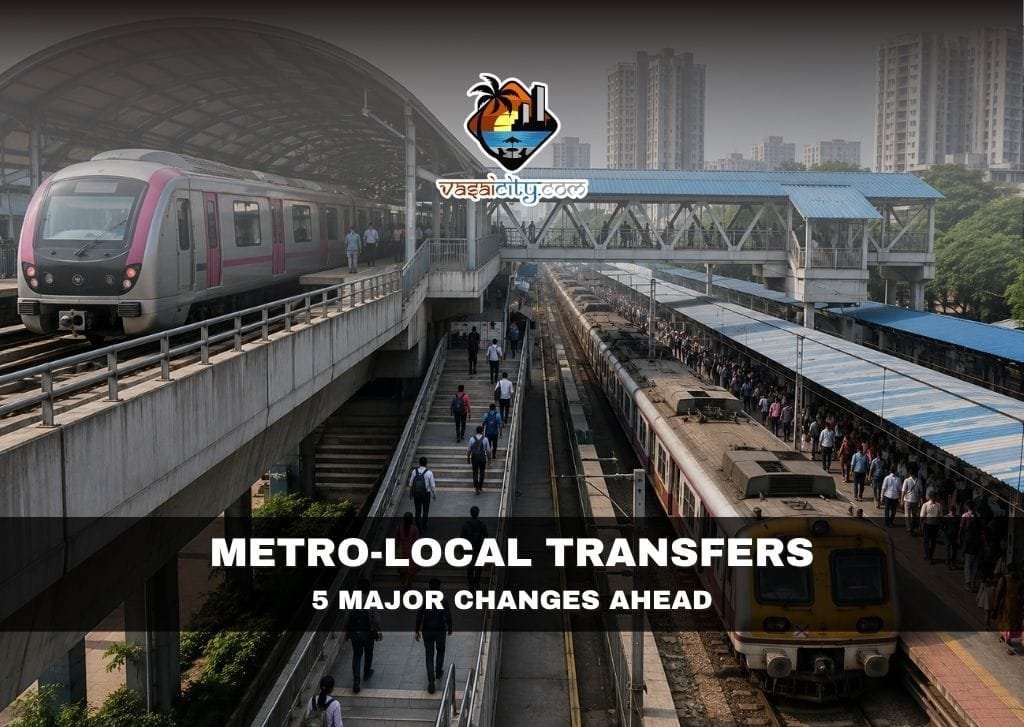
Metro-local transfers across the Mumbai Metropolitan Region (MMR) could soon become faster, safer and more convenient, offering potential relief to thousands of commuters from Vasai and surrounding areas who regularly switch between Metro and suburban local trains.
For many daily passengers, changing trains is not as simple as walking from one platform to another. Long walks, crowded foot overbridges, multiple staircases and unclear signboards can turn a short interchange into a frustrating part of the journey.
Now, the Mumbai Railway Vikas Corporation (MRVC) is studying ways to improve these connections and make metro-local transfers more seamless across the region.
Table of Contents
Metro-Local Transfers to Get a Major Connectivity Study
The proposed study will examine the gaps between Metro stations and suburban railway stations and identify practical infrastructure solutions to improve passenger movement.
The focus will be on creating smoother connections between different modes of public transport instead of treating Metro and suburban railway stations as separate systems.
According to MRVC's stated mission, the organisation is working towards developing efficient, safe and sustainable railway infrastructure for Mumbai's suburban commuters.
The study is expected to take around six to 12 months. Once completed, it will help prepare detailed project reports and a phased plan for implementing infrastructure improvements.
For commuters in Vasai-Virar, better metro-local transfers could become increasingly important as the MMR's public transport network expands.
5 Changes That Could Improve Metro-Local Transfers
1. New Foot Overbridges and Skywalks
One of the biggest challenges during metro-local transfers is the physical distance between stations.
Where Metro and suburban railway stations are located close to each other but do not have a direct pedestrian connection, passengers may have to walk through busy roads or use congested existing structures.
The study will examine options such as new foot overbridges and skywalks to create more direct pedestrian routes.
These facilities could reduce walking distances and make interchanges more convenient, particularly during peak hours.
2. Better Pedestrian Pathways
A seamless interchange is not only about building a bridge.
The study will also examine pedestrian pathways and station entry and exit points to understand how passengers move between different transport systems.
For commuters, this could mean clearer routes, fewer bottlenecks and less confusion while changing trains.
Better-designed pedestrian infrastructure could also improve safety around busy station areas.
3. Travelators and Improved Accessibility
Large stations can require passengers to cover considerable distances before reaching another platform or transport mode.
Travelators could help reduce the physical effort involved in these journeys, particularly at high-footfall interchanges.
The study will also consider accessibility for senior citizens and persons with disabilities. This could include better pedestrian routes and infrastructure designed to make transfers easier for passengers with limited mobility.
Such improvements would make metro-local transfers more inclusive rather than focusing only on speed.
4. Clearer Signage and Wayfinding
Finding the correct exit or interchange can be difficult at crowded railway and Metro stations.
Confusing signs can result in passengers taking longer routes, entering the wrong area or repeatedly stopping to ask for directions.
The proposed study will examine wayfinding systems as part of the effort to improve metro-local transfers.
Better signage could clearly indicate Metro platforms, railway platforms, exits, pedestrian routes and other important facilities.
For first-time passengers and visitors travelling across the MMR, this could make the public transport network considerably easier to navigate.
5. Smarter Ticketing Options
Another important part of seamless metro-local transfers is reducing the need for passengers to deal with separate ticketing systems.
The study will examine smarter ticketing possibilities, including the National Common Mobility Card and QR-based ticketing.
The objective is to make transfers between different transport modes more convenient by reducing friction at ticket counters and entry points.
If implemented effectively, integrated ticketing could eventually make it easier for passengers to move between Metro and suburban railway services during a single journey.
Why This Matters to Vasai Commuters
Vasai is part of a rapidly expanding MMR transport network, and residents regularly travel towards Mumbai, Thane, Navi Mumbai and other parts of the metropolitan region for work, education and other purposes.
The suburban railway remains a critical part of this wider transport system. MRVC documents describe Mumbai's suburban railway as a major mass-transit network serving the metropolitan region and highlight the need for additional capacity and improved passenger infrastructure.
As new Metro corridors and other transport projects develop, the quality of metro-local transfers will become increasingly important.
A passenger may have a fast Metro service available, but if reaching the Metro station from a local train involves a long walk through a crowded interchange, some of the benefit of the faster service can be lost.
This is why station-to-station connectivity is becoming an important part of urban transport planning.
Vasai-Virar is already seeing wider discussions around improved regional connectivity. For example, MRVC's plans have included major suburban railway expansion projects in the wider MMR, including the Panvel-Karjat corridor and the quadrupling of the Virar-Dahanu Road section.
VasaiCity.com has also previously reported on the proposed Panvel-Vasai suburban rail connection, which could further strengthen east-west connectivity across the region.
A Phased Plan Could Follow
The study is not itself a guarantee that every proposed facility will be constructed immediately.
Instead, its purpose will be to identify connectivity gaps, assess possible solutions and prepare detailed project reports. The findings can then help authorities determine which improvements should be implemented first.
A phased approach could allow authorities to prioritise locations with heavy passenger movement or particularly difficult interchange conditions.
Over time, this could result in a network where Metro stations and suburban railway stations function more like interconnected parts of a single public transport system.
What Commuters Can Expect
The biggest potential benefit of improved metro-local transfers is simple: less time and effort spent changing trains.
For daily commuters, even saving a few minutes at every interchange can make a noticeable difference over the course of a week.
More direct pedestrian connections, improved accessibility, clearer signage, travelators and integrated ticketing could collectively make journeys less stressful.
The six-to-12-month study period will therefore be closely watched by commuters and transport observers across the MMR.
If the recommendations are converted into projects and implemented in phases, metro-local transfers could become a much smoother part of everyday travel for residents of Vasai, Virar and other parts of the metropolitan region.