
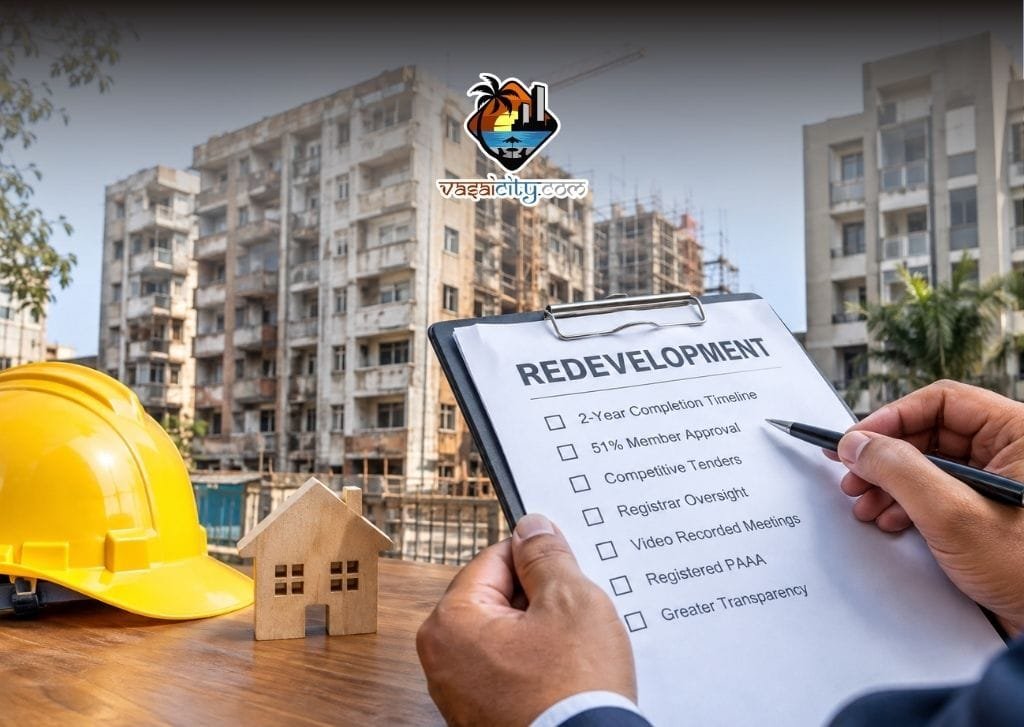
Maharashtra redevelopment rules have undergone a major change after the state government issued a new framework for redevelopment of cooperative housing societies on September 30, 2026.
The new Government Order, issued by the Cooperation Department under Section 79A of the Maharashtra Co-operative Societies Act, 1960, replaces the redevelopment procedure introduced in 2019 and subsequent circulars issued under that framework.
For thousands of housing societies across Maharashtra, including those in Vasai-Virar, the changes could affect how redevelopment proposals are initiated, how developers are selected, how members participate and what documents must be maintained.
One of the most closely watched provisions is the requirement that the redevelopment agreement provide for completion within two years from the date of the plinth or foundation certificate, with an extension in exceptional circumstances not exceeding three years.
But the Maharashtra redevelopment rules go much further than simply introducing a project timeline.
The revised framework puts considerable emphasis on member participation, competitive tenders, professional project reports, documented voting, video recording and registered agreements.
Here are seven important changes that housing society members in Vasai and across Maharashtra should understand.
Table of Contents
1. Maharashtra Redevelopment Rules Now Cover More Redevelopment Models
The revised Maharashtra redevelopment rules are not restricted to the traditional model where a single builder takes up redevelopment of one society.
The framework covers redevelopment undertaken through a private developer, self-redevelopment, redevelopment through contractors, group redevelopment and redevelopment through cooperative housing federations.
This is particularly relevant for older neighbourhoods where several societies are located next to each other and may explore a common redevelopment strategy.
The procedure for selecting a contractor in a self-redevelopment project is also brought within the prescribed framework.
For residents, this means the redevelopment route may change, but the importance of following the prescribed decision-making process remains.
The Government Order also provides a specific framework for cluster or group redevelopment through cooperative housing federations. At federation level, the prescribed quorum and approval requirements apply, while individual affiliated societies also have to follow specified procedures.
This could become particularly significant in densely developed parts of Vasai-Virar where adjoining housing societies are considering larger redevelopment schemes.
2. A Two-Year Completion Timeline Is Now Required in the Agreement
The most widely discussed provision in the Maharashtra redevelopment rules is the completion timeline.
The Development Agreement is required to provide that the redevelopment project should be completed within two years from the date of the plinth or foundation certificate.
The framework allows an extension in exceptional circumstances, but the overall period is not to exceed three years according to the scale of the project.
This distinction is important.
The two-year period is not simply a promise made verbally by a developer. The completion requirement is intended to form part of the formal Development Agreement.
For society members, the Development Agreement therefore becomes a critical document.
Members should carefully examine the commencement date, completion date, extension provisions, consequences of delay, transit arrangements, financial security and other obligations before signing.
Redevelopment delays have historically been one of the biggest concerns for residents who are required to leave their original homes and depend on rent or temporary accommodation during construction.
The new Maharashtra redevelopment rules attempt to bring a defined completion period into the contractual framework.
However, members should still understand that a government-prescribed timeline does not eliminate every possible cause of delay. Statutory approvals, court proceedings, force-majeure situations and other legally relevant circumstances can affect individual projects.
3. The 51% Rule and Two-Thirds Quorum Become Critical
The Maharashtra redevelopment rules introduce a structured voting process for major redevelopment decisions.
For the Special General Body Meeting considering redevelopment, the prescribed quorum is two-thirds of the total membership.
The initial decision to proceed with redevelopment requires approval from at least 51% of the society's total members.
This is different from simply saying that 51% of people attending a meeting must vote in favour.
For example, if a society has 100 members, the required quorum would be 67 after rounding up. The redevelopment proposal would still require approval from at least 51 members.
This makes maintaining an accurate member register extremely important.
The revised process also allows specified members who are abroad, ill, disabled or unable to attend for unavoidable reasons to participate through video conferencing.
However, the order contains important conditions regarding physical participation and the 51% threshold. Society committees should therefore not assume that online participation automatically replaces physical attendance requirements.
For residents, the practical message is clear: redevelopment decisions need to be properly documented and supported by the prescribed level of membership participation.
4. Developers Must Be Selected Through a More Transparent Tender Process
Another important part of the Maharashtra redevelopment rules concerns developer selection.
The society is expected to follow a structured tender process rather than simply appointing a developer through an informal discussion.
At least three competitive bids should ordinarily be obtained.
If fewer than three bids are received, the tender period is extended through prescribed additional periods. If the number remains below three even after those extensions, the available bids can proceed to the next stage under the prescribed process.
The appointed Architect or Project Management Consultant is required to prepare a comparative assessment of the bids.
The evaluation is not supposed to be based purely on the highest financial offer.
Factors such as the developer's experience, reputation, quality, financial capacity, technical capability and competitive terms are part of the evaluation process.
This is an important point for societies negotiating redevelopment.
A developer offering the highest additional carpet area or corpus may not necessarily be the only proposal worth examining.
Members also need to consider the developer's previous projects, financial strength, construction capability, delivery record and proposed contractual protections.
The revised framework is designed to make this comparison more structured.
5. A Registrar-Authorised Officer Must Be Present for Developer Selection
The developer-selection meeting receives additional oversight under the Maharashtra redevelopment rules.
The Special General Body Meeting at which the developer is selected must be conducted in the presence of an authorised officer or representative appointed through the Registrar's office.
Before the meeting, the society is required to submit relevant redevelopment records, including the member list, earlier meeting minutes, Project Report, tender information and comparative statement.
The Registrar is required to decide on appointment of the authorised officer within the prescribed period.
The developer-selection meeting must also follow specified notice, quorum and voting procedures.
The meeting is required to be video recorded, creating an additional record of the proceedings.
Members who wish to raise objections or record their views should have an opportunity to do so.
The voting process is also structured. Ordinarily, voting may take place by show of hands, while a secret ballot can be required when the prescribed proportion of members makes a written request.
For societies, this means developer selection should no longer be treated simply as a meeting between the managing committee and shortlisted builders.
It becomes a documented institutional process involving the members, professional consultant and Registrar's oversight mechanism.
6. PAAA Registration Becomes an Important Protection Before Members Vacate
For individual flat owners, one of the most significant provisions concerns the Permanent Alternative Accommodation Agreement, commonly known as the PAAA.
Under the Maharashtra redevelopment rules, the Development Agreement and individual Permanent Alternative Accommodation Agreements are required to be registered.
The individual PAAA is to be executed within the prescribed period after registration of the Development Agreement. The framework also states that members should vacate only after the required legal approvals have been obtained and the individual PAAA has been registered.
This is particularly important because redevelopment involves a major change in the member's living arrangements and property rights.
The PAAA should clearly identify the member's entitlement in the new building.
Issues such as carpet area, flat identification, transit arrangements and other agreed obligations should be examined carefully before a member hands over possession.
The Development Agreement must also clearly state the carpet area payable under the Real Estate (Regulation and Development) Act, 2016.
For residents, the lesson is simple: a developer appointment alone should not be treated as sufficient reason to immediately vacate a flat.
The contractual and statutory conditions governing possession must first be examined.
7. Members Get Greater Access to Redevelopment Documents
Transparency is one of the central themes of the new Maharashtra redevelopment rules.
Members are expected to have access to important redevelopment documents, including notices, meeting minutes, Project Management Consultant reports, tender documents, bids, comparative statements, draft Development Agreements and prescribed video recordings.
These documents are to be available for inspection free of cost, while copies can be supplied on payment of the applicable prescribed charges.
This provision could prove particularly useful when disagreements arise within a society.
For example, a member questioning why one developer was preferred over another can examine the comparative statement and tender documents rather than relying solely on verbal explanations.
Similarly, members can examine the Project Report to understand how the redevelopment potential, FSI, TDR, residential area, commercial area, parking, open spaces and other requirements were assessed.
The revised process therefore places greater importance on maintaining a proper documentary trail.
The PMC Report Will Play a Bigger Role
The Maharashtra redevelopment rules also give the Architect or Project Management Consultant an important role before tenders are invited.
The society is expected to obtain quotations from qualified professionals and select the consultant through the prescribed process.
The consultant must examine the existing building and land, ownership and title-related information, applicable development regulations, available FSI and TDR, parking, open spaces, residential and commercial requirements and construction specifications.
The Project Report is expected to be prepared within the prescribed period after appointment of the consultant.
Where different development options are available under applicable DCPR or UDCPR provisions, comparative project reports may also be required.
For a society in Vasai, this can be especially important because the development potential of an old building depends on factors beyond simply measuring the existing structure.
Land title, plot dimensions, road width, reservations, applicable planning regulations, FSI/TDR availability and municipal requirements can all affect the final redevelopment potential.
What About Cluster Redevelopment?
The Maharashtra redevelopment rules also provide a formal mechanism for group redevelopment through cooperative housing federations.
At federation level, the prescribed quorum is two-thirds of affiliated societies and the initial decision requires at least 51% approval of the total affiliated societies.
Individual societies also have to pass their own resolutions through their prescribed Special General Body Meeting process.
The Government Order additionally provides an alternative mechanism involving 60% of the combined membership of affiliated societies, subject to the conditions specified in the order.
This could be relevant to large layouts in Vasai-Virar where several older societies occupy adjoining or strategically connected parcels.
Cluster redevelopment can potentially allow infrastructure, open spaces, access roads and other planning elements to be considered at a larger scale.
However, residents should carefully distinguish between a proposal presented by developers and rights that are actually recorded in approved plans and legally binding agreements.
For local context, VasaiCity has previously reported on the proposed Anand Nagar redevelopment in Vasai West, where cluster-style redevelopment and the treatment of existing residents' entitlements are among the issues being examined.
What Happens If the Redevelopment Rules Are Violated?
The Government Order provides for action where its directions are violated or where conduct such as collusion, misappropriation or actions harmful to members' interests are found.
The order refers to proceedings under Sections 79A(3) and 78A of the Maharashtra Co-operative Societies Act, 1960.
Importantly, these provisions should not be described as an automatic penalty imposed simply because a procedural mistake occurs.
Action under the relevant sections involves the statutory authorities and prescribed procedures, including applicable opportunities for hearing.
Section 79A(3) provides for consequences in specified circumstances where directions issued under the Act are not complied with.
Section 78A separately deals with circumstances in which action may be taken against a committee or member, including conduct prejudicial to the interests of the society or its members.
Therefore, managing committee members should maintain proper records and obtain professional advice whenever there is uncertainty about the redevelopment procedure.
What Vasai Housing Societies Should Do Now
For older housing societies in Vasai and Vasai-Virar, the new Maharashtra redevelopment rules make documentation more important than ever.
Before selecting a developer, members should ask several basic questions.
Has the society followed the prescribed procedure?
Was the required quorum achieved?
Does the redevelopment proposal have the required 51% support?
Was the Architect or PMC properly appointed?
Has a detailed Project Report been prepared?
Were multiple developers invited to bid?
Were the competing proposals compared objectively?
Has the Registrar's authorised officer been arranged for the developer-selection meeting?
Will the meeting be video recorded?
Does the Development Agreement clearly specify carpet area, transit arrangements, financial security and completion obligations?
Has the PAAA been properly drafted and registered before members are required to vacate?
These questions can be particularly important when the redevelopment involves significant increases in carpet area, corpus payments, transit rent or other financial benefits.
A society should not judge a proposal only by the headline offer.
The legal structure, financial strength of the developer, project feasibility, approvals, timelines and protections in the agreements can be equally important.
A New Phase for Redevelopment in Maharashtra
The September 30, 2026 Government Order represents a substantial procedural overhaul of cooperative housing society redevelopment in Maharashtra.
The most visible changes include the two-year completion provision from the plinth or foundation certificate, the 2/3 quorum, the 51% membership approval requirement, competitive tendering, professional project reports, Registrar oversight, video-recorded proceedings and registered PAAA arrangements.
For residents of Vasai, the changes come at a time when redevelopment is rapidly reshaping older neighbourhoods.
Ageing buildings are being replaced by larger residential projects, while cluster redevelopment is increasingly being discussed in established localities.
The new framework does not guarantee that every redevelopment project will be completed without delays or disputes.
What it does is establish a more detailed procedure for how societies are expected to make major redevelopment decisions.
For members, that makes participation important.
For managing committees, record-keeping and procedural compliance become more significant.
For developers, the process places greater emphasis on experience, financial capacity, competitive offers and contractual commitments.
And for housing societies across Vasai-Virar, the message is straightforward: before signing away possession or committing to a redevelopment proposal, understand the process, examine the documents and ensure that the promises made to members are properly recorded in enforceable agreements.
Source: Government of Maharashtra, Cooperation Department, Government Order dated September 30, 2026, issued under Section 79A of the Maharashtra Co-operative Societies Act, 1960. Government reference code reported for the order: 202609301657141847. The original Government Order should be consulted for the exact legal wording and application to an individual society.
Disclaimer: This article is a general news and public-information report and is not legal advice. Housing societies, members, managing committees and developers should obtain professional legal, architectural and financial advice before taking redevelopment decisions.
