
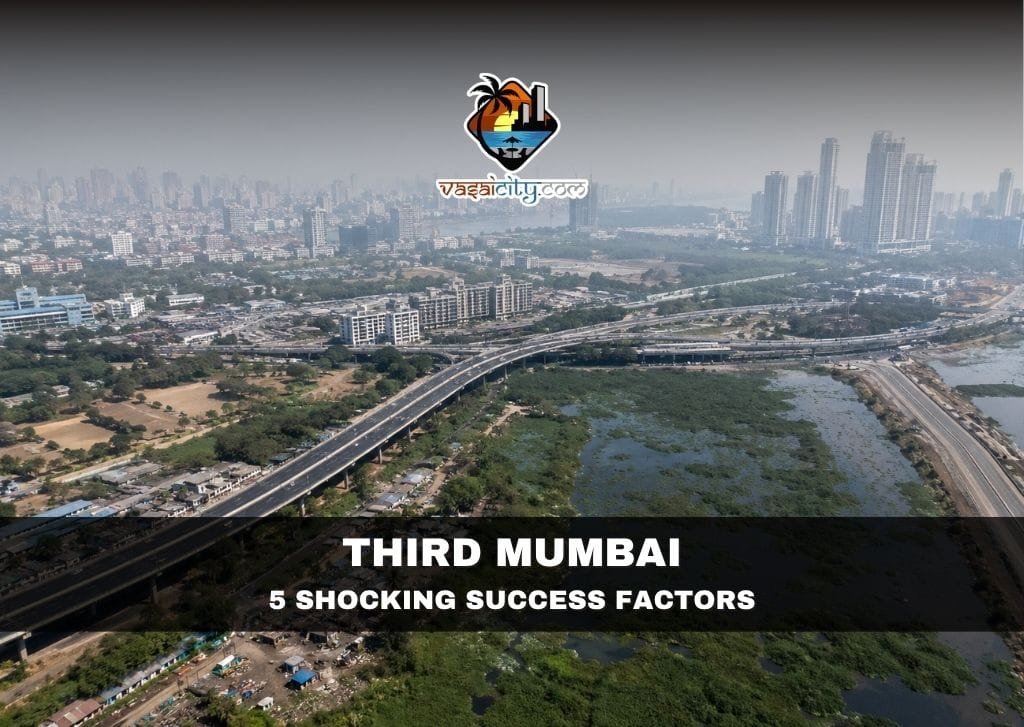
Third Mumbai is emerging as one of Maharashtra’s most ambitious urban development projects, while a proposed new urban growth belt in the Vasai-Palghar-Dahanu region is increasingly being discussed as a possible “Fourth Mumbai”. But one question matters more than the size of either project: will these new urban centres actually create places where people can live and work, or will they simply become larger commuter suburbs of Mumbai?
The question is particularly important for residents of Vasai, Virar, Palghar and the wider Mumbai Metropolitan Region (MMR), where long-distance commuting, traffic congestion and pressure on public infrastructure have already become part of everyday life.
The idea behind Third Mumbai is to create a new planned urban centre in Raigad, taking advantage of major infrastructure such as the Atal Setu and Navi Mumbai International Airport. The officially notified Karnala-Sai-Chirner New Town covers about 323.44 sq km and 124 villages across Uran, Panvel and Pen talukas. MMRDA is the New Town Development Authority.
At the same time, the wider Palghar side of the MMR is also undergoing major planning and infrastructure changes. MMRDA's extended notified area includes the remaining villages of Vasai taluka and the entire Palghar taluka, while growth centres have been approved around Virar and Boisar.
Table of Contents
Third Mumbai Has a Big Opportunity — But Also a Big Test
The development of Third Mumbai is being driven by infrastructure that could fundamentally change the geography of the region.
The Atal Setu has created a faster connection between Mumbai and Navi Mumbai, while the Navi Mumbai International Airport is expected to strengthen the economic potential of areas around Raigad.
MMRDA has already taken steps towards implementation. In April 2026, the authority announced that 216 acres had been secured for the Raigad-Pen Growth Centre through its participatory land policy.
In August 2026, MMRDA also appointed Singapore-based Surbana Jurong to prepare the vision document and master plan for the 323.44-sq-km KSC New Town.
These are important developments. But infrastructure alone cannot create a successful city.
A city needs employers, schools, hospitals, entertainment, public transport, government institutions and commercial districts. Most importantly, people must have a reason to work there, rather than merely live there.
Third Mumbai Needs Jobs, Not Just Housing
This could become the biggest deciding factor for Third Mumbai.
Mumbai's historic problem has been the concentration of employment in a relatively small number of business districts. Residential development has spread much farther, creating enormous daily commuter flows.
Navi Mumbai was originally conceived as a planned counter-magnet to Mumbai. It eventually developed major commercial and employment centres, but its evolution took decades.
The lesson is clear.
If Third Mumbai primarily produces residential towers while employment continues to remain concentrated in Mumbai, the new city could eventually face the same problem it is supposed to solve.
People may live in Raigad, but continue travelling towards Mumbai, BKC, Thane or other established employment centres every morning.
That would shift congestion geographically rather than eliminate it.
The same warning applies to the proposed “Fourth Mumbai” concept in the Vasai-Palghar-Dahanu belt.
Fourth Mumbai Could Be Crucial for Vasai and Palghar
For residents of Vasai and Virar, the proposed western growth corridor is particularly significant.
The wider Palghar region is already seeing major infrastructure and planning initiatives. MMRDA's official planning documents show that its jurisdiction was expanded to include large parts of Vasai and Palghar, and 224 villages in Palghar were later brought into the MMR's Extended Notified Area.
MMRDA has also approved growth centres near Virar in Vasai taluka and Boisar in Palghar taluka, including areas around the proposed Mumbai-Ahmedabad High-Speed Railway corridor.
This gives the western side of the MMR an opportunity that should not be missed.
Rather than allowing Vasai-Virar and Palghar to grow primarily as residential areas for Mumbai workers, planning authorities could aim to create genuine employment centres within the region.
That would be the real test of the so-called Fourth Mumbai.
The Navi Mumbai Lesson Cannot Be Ignored
The experience of Navi Mumbai offers perhaps the most important lesson for both Third Mumbai and the proposed Fourth Mumbai.
Simply creating roads, bridges and residential buildings does not automatically create a self-sufficient city.
Navi Mumbai has become a major urban centre, but the original objective of completely shifting Mumbai's administrative and employment pressure was never fully achieved.
That raises an uncomfortable question: if Navi Mumbai could not completely decongest Mumbai, what will be different this time?
The answer must be economic decentralisation.
New cities need their own business districts, corporate offices, government departments, educational institutions, healthcare facilities and service-sector employment.
Without that ecosystem, even the best transport network can become a mechanism for moving more commuters over longer distances.
Government Offices Could Change the Equation
One of the strongest ways to create immediate economic activity in new urban centres would be to move government offices and public institutions outside Mumbai.
Mumbai has accumulated government departments, courts, corporate offices and other institutions over decades. Their concentration creates significant daily commuter movement towards the traditional city centre.
If selected government offices were shifted to Third Mumbai, Raigad, Thane or Palghar, thousands of employees and related businesses could gradually move closer to these emerging centres.
That could create a chain reaction.
Restaurants, housing, retail, professional services, schools, healthcare facilities and other businesses would follow employment.
The same principle could work for the proposed Fourth Mumbai region.
Instead of waiting for private companies to independently create employment clusters, the government could use its own institutions as anchor tenants for emerging urban centres.
Third Mumbai Needs Strong Public Transport
Another crucial factor will be public transportation.
A new city cannot depend entirely on private cars and highways. That would simply reproduce Mumbai's traffic problem on a larger geographical scale.
Third Mumbai will need an integrated network connecting residential neighbourhoods with business districts, railway stations, airports, ports and neighbouring cities.
The same applies to the Vasai-Palghar-Dahanu belt.
For western MMR residents, projects such as regional rail connectivity, road corridors and multimodal transport links could become particularly important. VasaiCity has previously examined how major connectivity projects could reshape the region's future. Vasai Virar Connectivity Growth: 5 Major Changes Ahead
The objective should not simply be to make it easier to travel to Mumbai.
The objective should be to make it easier to travel within the new economic region.
That distinction could determine whether these projects succeed.
Third Mumbai Must Balance Development and Environment
There is another major challenge: land.
The KSC New Town covers a large area and includes numerous villages. Land aggregation, compensation, environmental protection and the interests of existing communities will therefore remain critical issues.
MMRDA's recent participatory land policy indicates an attempt to involve landowners rather than relying exclusively on conventional acquisition. The authority has described the model as based on participation and landowner involvement.
That approach will need to remain transparent and credible as development expands.
The same principle should guide development in Palghar.
The western belt contains environmentally sensitive areas, agricultural land, forests, wetlands and coastal ecosystems. Urban expansion that ignores these constraints could create serious problems in the future.
A successful new city must therefore be economically productive and environmentally sustainable.
Will Third Mumbai and Fourth Mumbai Become Commuter Cities?
This is ultimately the biggest question.
Imagine a resident living in a new township near Pen or Virar.
If that person wakes up every morning, travels for two hours to Mumbai for work and returns home at night, the new city has not truly become an independent economic centre.
It has become a dormitory.
That is precisely the outcome that planners must avoid.
Third Mumbai has the advantage of being planned around major new infrastructure. The proposed western growth belt also has the advantage of being part of an expanding MMR.
But connectivity should be used to create local economic activity, not simply faster commuting.
Five Things That Could Decide Third Mumbai's Success
The success of Third Mumbai and the proposed Fourth Mumbai could ultimately depend on five factors:
1. Local employment: Major companies, government offices and institutions must be encouraged to establish themselves in the new centres.
2. Public transport: Rail, metro, buses and other mass-transit systems must be planned before population density becomes excessive.
3. Planned housing: Residential development should grow alongside schools, hospitals, markets, recreation and civic infrastructure.
4. Land and environmental management: Development must protect existing communities and environmentally sensitive areas.
5. Economic decentralisation: Mumbai's employment and institutional concentration must gradually spread towards Raigad, Thane and Palghar.
The Real Goal Should Be Self-Sufficient Cities
The success of Third Mumbai should not be measured by how many buildings are constructed or how much land is developed.
It should be measured by how many people can live, work and access essential services within the new urban region.
The same standard should apply to the proposed Fourth Mumbai.
Maharashtra now has an opportunity to learn from decades of urbanisation across Mumbai, Navi Mumbai, Thane, Vasai-Virar and other parts of the MMR.
Building another city is relatively straightforward.
Building a city where people actually want to live, work and spend their daily lives is much harder.
For Third Mumbai, the planning process is now moving into an important phase, with MMRDA working on the broader master plan.
For Vasai, Virar and Palghar, the next few years could be equally important.
If jobs follow infrastructure, Third Mumbai and Fourth Mumbai could become genuine economic centres and reduce pressure on Mumbai.
If jobs do not follow, Maharashtra could simply end up creating two more enormous commuter belts.
The question, therefore, is not whether these new Mumbais will be bigger.
The real question is whether they will be better.