
Palghar District Air Travelers flying to West Asia and Southeast Asia face significantly longer road journeys, higher taxi fares, and complex transit hurdles following plans to relocate 14 international flight routes from Mumbai’s Chhatrapati Shivaji Maharaj International Airport (CSMIA) to the Navi Mumbai International Airport (NMIA) starting March 2027.
The proposed shift is linked to the planned redevelopment of Mumbai Airport’s Terminal 1, where partial demolition is scheduled to begin in January 2027. To manage passenger flow during construction, airport operator Mumbai International Airport Limited (MIAL) and Adani Airports have been working on an arrangement with airlines to move select short- and medium-haul international routes out of Mumbai’s Terminal 2. However, Maharashtra Chief Minister Devendra Fadnavis has formally opposed shifting international operations out of Mumbai and has written to the Union Civil Aviation Minister proposing an alternative redevelopment approach.
In This Article
Why International Flights Are Moving From Mumbai to Navi Mumbai
The planned relocation stems from capacity constraints triggered by the upcoming overhaul of Terminal 1 at CSMIA in Santacruz. With partial demolition of Terminal 1 slated for January 2027, domestic flights currently operating from that terminal will need to be absorbed into Terminal 2 (T2) in Sahar.
To create space for these displaced domestic passengers, airport authorities have proposed temporarily freeing up roughly one-third of T2’s international handling capacity. Under this destination-based relocation plan, 14 international sectors would shift across the harbour to NMIA in the Kopra-Panvel area from March 2027.
According to the proposed arrangement, major carriers operating these sectors—including Air India, IndiGo, Qatar Airways, Saudia, and Air Arabia—would transition their operations for the designated routes to Navi Mumbai.
The 14 International Routes Targeted for Relocation
The destination-based shift focuses heavily on high-frequency Gulf, West Asian, and South/Southeast Asian corridors. Among the key destinations identified for relocation are:
- United Arab Emirates: Dubai and Sharjah
- Saudi Arabia: Riyadh and Jeddah
- Qatar: Doha
- Kuwait: Kuwait City
- Oman: Muscat
- Nepal: Kathmandu
- Other West Asian and Southeast Asian destinations forming part of the 14-route cluster
These routes represent the primary international travel lifelines for residents across the northern Mumbai Metropolitan Region (MMR), particularly in Vasai, Virar, Nalasopara, Palghar, and Dahanu.
Impact on Vasai, Virar, and Palghar Residents
Located along the far northwestern edge of the Mumbai Metropolitan Region, Palghar district relies heavily on direct north–south road and rail connectivity into Mumbai’s western suburbs. Moving international departures and arrivals from Santacruz/Sahar to Panvel dramatically alters travel logistics for local flyers.
1. Travel Distance Nearly Doubles
Currently, residents traveling from Vasai, Palghar, or Dahanu to CSMIA cover roughly 60 km to 120 km depending on their starting point. Relocating flights to NMIA increases the one-way road distance to approximately 140 km to 200 km.
2. Severe Highway Bottlenecks and Extended Travel Time
To reach Navi Mumbai by road, passengers from Vasai-Virar and northern Palghar must bypass Mumbai entirely and navigate several notorious traffic choke points:
- Ghodbunder Road and Fountain Hotel Junction: A major freight corridor frequently choked by heavy container trucks moving between the Mumbai–Ahmedabad National Highway (NH-48) and Thane.
- Western Express Highway (WEH) and Eastern Suburbs: Depending on the chosen route, travelers must cross congested stretches before connecting to Thane–Belapur Road or Palm Beach Road in Navi Mumbai.
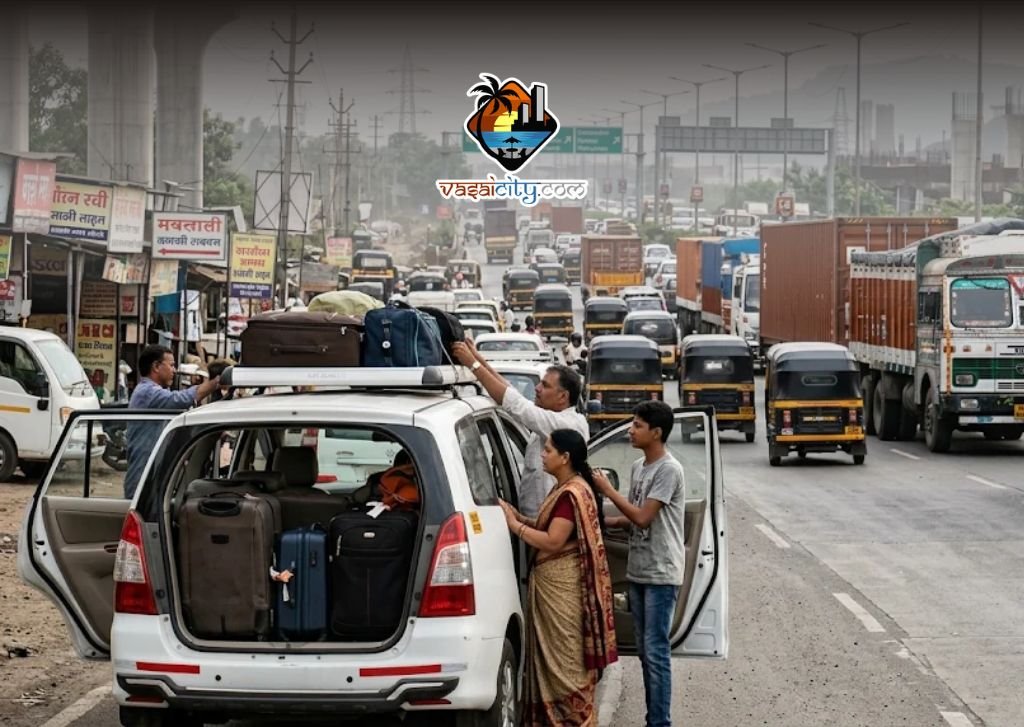
Under normal traffic conditions, the journey from Palghar district to Panvel can take 3 to 4 hours. During peak hours, monsoon waterlogging, or highway breakdowns, travel time can stretch to 6 to 8 hours. For early-morning or late-night international departures, families may be forced to leave home half a day—or even a full day—in advance, adding hotel accommodation costs near Panvel to their travel budgets.
3. Steep Rise in Taxi and Cab Fares
Higher mileage directly translates into steeper ground transportation expenses. App-based aggregators such as Ola and Uber, along with local tourist vehicle operators in Vasai, Virar, and Palghar, will charge significantly more due to:
- Longer point-to-point distances exceeding 140 km
- Multiple highway and bridge toll plazas along the route
- Return-fare billing structures typically applied by outstation and freelance tourist taxis for trips crossing into Navi Mumbai
For budget-conscious migrant workers and families traveling with multiple suitcases, ground transport costs could rival a substantial portion of a one-way economy airfare to the Gulf.
4. Impractical Suburban Rail Connections for International Flyers
While Vasai, Virar, and Nalasopara enjoy direct suburban rail connectivity to Mumbai’s Western Line, reaching Panvel by train is cumbersome for international passengers. Travelers must either:
- Board a Western Line local train and switch to the Central or Harbour Line at crowded interchanges such as Dadar, Bandra, Andheri, or Kurla; or
- Use the Vasai Road–Diva–Panvel rail corridor, which offers limited direct MEMU/passenger services and lacks the frequency and luggage-friendly infrastructure required for time-sensitive international flights.
Navigating packed suburban platforms and foot overbridges with heavy check-in baggage is impractical for elderly passengers, families with young children, and returning overseas workers.
Why the Shift Hits Vasai Taluka and Palghar Particularly Hard
Palghar district—and Vasai taluka in particular—is home to a large diaspora of Non-Resident Indians (NRIs), white-collar professionals, and blue-collar workers employed across the United Arab Emirates, Saudi Arabia, Qatar, Oman, and Kuwait.
For decades, proximity to Mumbai’s Sahar airport allowed Gulf-based workers from Vasai, Nalasopara, Virar, Manor, and Dahanu to return home quickly for annual leave or family emergencies. Shifting these exact Gulf sectors to Navi Mumbai introduces longer transit times, potential missed connections, and exhausting last-mile commutes for thousands of households across the district.
Chief Minister Devendra Fadnavis Opposes International Flight Shift
Amid growing concern from passengers and aviation stakeholders over the disruption caused by splitting international operations between two airports, Maharashtra Chief Minister Devendra Fadnavis has stepped in to oppose the move.
The Chief Minister has stated that international flights should not be shifted out of Mumbai. He has formally written to the Union Civil Aviation Minister outlining an alternative plan to carry out the redevelopment of Mumbai Airport’s Terminal 1 without forcing international routes to relocate to Navi Mumbai.
What Travelers Should Watch For Next
As of November 2026, the proposed January 2027 Terminal 1 demolition timeline and the March 2027 route-shifting schedule remain subject to final coordination between the Ministry of Civil Aviation, MIAL, airlines, and the Maharashtra state government.
Travelers from Vasai, Virar, and Palghar planning international trips to West Asia or Southeast Asia in early to mid-2027 should monitor official airline schedules closely before booking non-refundable ground transport or connecting flights.
Frequently Asked Questions
Why are international flights shifting from Mumbai Airport to Navi Mumbai in 2027?
The proposed relocation is linked to the partial demolition and redevelopment of Terminal 1 at Mumbai’s Chhatrapati Shivaji Maharaj International Airport starting in January 2027. To accommodate domestic passengers shifted from Terminal 1 into Terminal 2, airport operators plan to temporarily move 14 international routes to Navi Mumbai International Airport from March 2027.
How will the flight relocation affect Palghar District Air Travelers?
Palghar District Air Travelers will face nearly double the road travel distance, higher cab fares, and longer transit times. Instead of traveling 60 to 120 km to Santacruz/Sahar, flyers from Vasai, Virar, Palghar, and Dahanu will have to travel 140 to 200 km across congested corridors to reach Panvel in Navi Mumbai.
Which international destinations are planned to move to Navi Mumbai?
The relocation plan targets 14 international routes primarily serving West Asia and Southeast Asia. Key destinations include Dubai, Sharjah, Doha, Riyadh, Jeddah, Kuwait, Muscat, and Kathmandu, which are heavily used by workers and families from Vasai-Virar and Palghar.
Which airlines are expected to shift these routes to Navi Mumbai?
Under the proposed destination-based arrangement between the airport operator and carriers, airlines operating these 14 specific sectors—including Air India, IndiGo, Qatar Airways, Saudia, and Air Arabia—would move those routes to Navi Mumbai International Airport.
How much longer will it take to reach Navi Mumbai Airport from Vasai and Palghar?
While a road trip from Palghar district to Navi Mumbai may take 3 to 4 hours under light traffic, bottlenecks along Ghodbunder Road, Fountain Junction, and highway corridors can push travel time to 6 to 8 hours, forcing flyers to leave home half a day or a full day early.
Can travelers from Vasai-Virar use local trains to reach Navi Mumbai Airport with luggage?
Using suburban trains is difficult for international flyers. While Vasai, Nalasopara, and Virar are on the Western Line, reaching Panvel requires changing lines at crowded hubs like Dadar, Andheri, or Kurla, or relying on infrequent Vasai Road–Panvel trains, making heavy luggage handling impractical.
Why will taxi fares increase for flyers from Vasai and Palghar?
App-based cabs like Ola and Uber as well as local tourist taxis will cost significantly more due to the extra 80 km of travel distance, multiple highway toll charges, and return-fare pricing typically levied by local tourist cab operators for trips to Navi Mumbai.
What is Chief Minister Devendra Fadnavis’s stand on shifting international flights?
Maharashtra Chief Minister Devendra Fadnavis has opposed moving international flights out of Mumbai. He has written to the Union Civil Aviation Minister proposing an alternative redevelopment plan for Mumbai Airport’s Terminal 1 so international routes can remain in Mumbai.