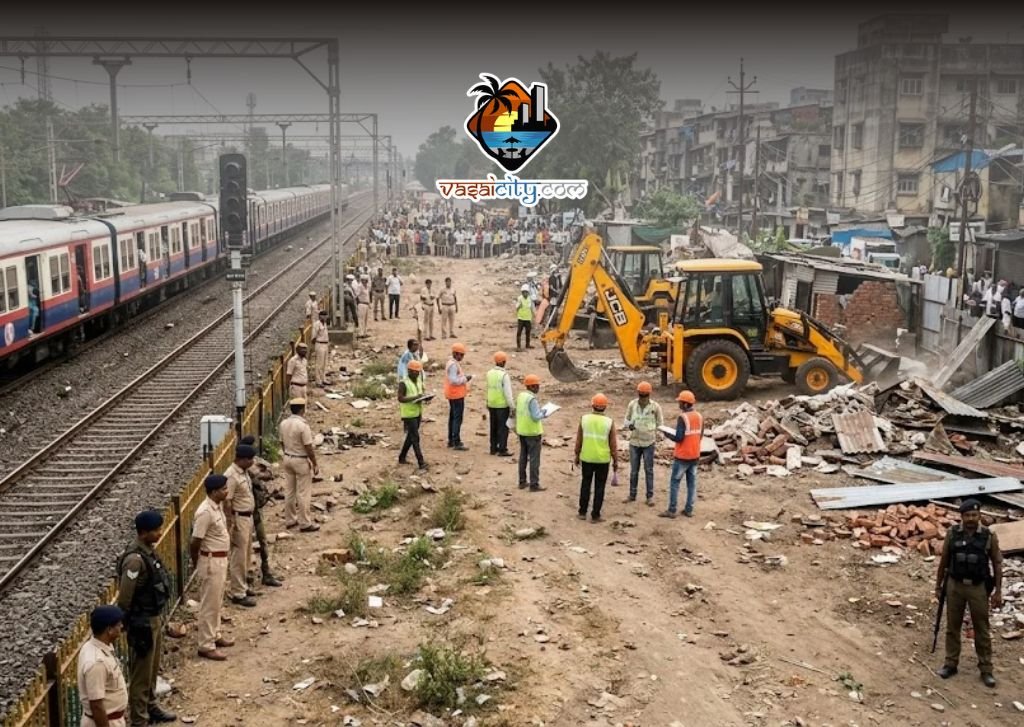

The Western Railway corridor has made critical progress toward expanding suburban capacity after railway authorities executed a focused anti-encroachment drive near Ram Mandir station, clearing 28 illegal structures to pave the way for additional tracks running north toward Virar.
The operation involved a coordinated team of 43 Railway Protection Force (RPF) personnel, officers from the Mumbai City Police, and engineering personnel from Western Railway. The targeted demolition reclaimed vital land required for the laying of the long-planned fifth and sixth lines between Mahim and Virar, a corridor that forms the backbone of northern Mumbai’s suburban transit system.
Authorities have indicated that similar demolition and clearance operations will soon commence along the northern belt, specifically targeting structures occupying railway land near Dahisar and Borivali stations.
Table of Contents
Accelerating the 5th and 6th Lines Toward Virar
The suburban segment from Churchgate through to Virar handles over 3 million passengers daily. A fundamental constraint on Western Railway’s suburban operations has been track sharing between fast suburban locals, outstation express trains, and freight traffic.
The expansion plan aims to segregate suburban local trains from long-distance mail and express trains. Once the fifth and sixth lines become fully operational across the entire suburban stretch:
- Outstation passenger trains and freight will operate largely on separate tracks.
- Western Railway can introduce additional fast and slow suburban services during morning and evening rush hours.
- Punctuality across the suburban network will improve significantly due to fewer signal stops and track crossovers.
The recent operation near Ram Mandir cleared long-standing ground impediments directly sitting on the designated alignment for these additional tracks.
Coordinated Demolition Operation Near Ram Mandir
The removal of the 28 encroachments was executed following extensive planning between civil engineering divisions and security agencies:
- Security Deployment: A contingent of 43 RPF personnel worked alongside local police personnel to secure the trackside boundary and manage perimeter safety during the demolition.
- Structural Clearance: Railway engineering teams deployed heavy machinery to pull down unauthorised residential and commercial shanties built within the safety zone of the tracks.
- Debris Removal and Securing the Perimeter: Cleared parcels are being surveyed and barricaded to prevent fresh occupations from taking root before track laying commences.
Unauthorised settlements along track margins pose severe operational hazards, including trespassing risks, poor track drainage caused by waste dumping, and restricted speed limits for suburban trains navigating narrow right-of-ways.
Future Demolitions Slated for Dahisar and Borivali
With the Ram Mandir pocket cleared, Western Railway authorities are preparing to address major bottlenecks situated further north. The stretches between Borivali and Dahisar represent some of the most congested land parcels on the network.
Upcoming operations will systematically reclaim identified plots in these areas. Officials have noted that clearing the northern suburban bottleneck is mandatory if the expanded corridor is to deliver direct operational benefits to commuters travelling to and from Mira Road, Bhayander, Naigaon, Vasai Road, Nalasopara, and Virar.
For commuters in the Palghar and Vasai-Virar district, ongoing tracking of suburban line upgrades is essential. Readers can explore our related coverage on Vasai-Virar transport and rail infrastructure projects for detailed ground updates on local mobility improvements.
Direct Benefits for Vasai, Nalasopara, and Virar Commuters
Commuters travelling from Vasai, Nalasopara, and Virar bear the brunt of suburban overcrowding. Peak-hour trains departing Virar routinely run beyond carrying capacity, leading to severe passenger distress.
The clearance of land along the Western Railway corridor directly impacts northern suburban commuters in several ways:
- Increased Train Frequency: Creating dedicated corridors for long-distance services will open up path slots for more local trains originating from Virar and Vasai Road.
- Reduction in Delays: Currently, express trains entering or departing terminals such as Bandra Terminus and Mumbai Central often delay suburban fast locals. Segregated tracks remove these route conflicts.
- Smoother Upgrades: Unencumbered track margins allow the railways to install modern overhead electrical (OHE) infrastructure, improve stormwater drains, and modernise signalling systems.
The ongoing anti-encroachment drive highlights Western Railway’s commitment to addressing complex right-of-way hurdles that have historically slowed urban infrastructure projects. By clearing the corridor systematically from Ram Mandir through Dahisar and Borivali, railway authorities are laying the tangible groundwork needed to bring much-needed relief to millions of daily suburban commuters.
What is the purpose of the recent demolition drive along the Western Railway corridor?
The demolition drive cleared 28 unauthorised structures near Ram Mandir station to free up railway land needed for constructing the fifth and sixth railway tracks between Mahim and Virar. This expansion will segregate long-distance trains from suburban locals, increasing overall corridor capacity and reducing delays for local commuters.
How many personnel were involved in the Ram Mandir station operation?
The operation was carried out jointly by 43 Railway Protection Force (RPF) personnel, officers from the Mumbai City Police, and the Western Railway engineering and administrative staff to ensure safety and prevent disruption to running train services.
Which areas will Western Railway target next for encroachment removal?
Western Railway has identified railway land near Borivali and Dahisar stations for upcoming clearance operations. These sections contain critical bottlenecks that must be removed to continue laying new tracks northward toward Mira Road, Bhayander, and Virar.
How will the 5th and 6th railway lines benefit Vasai-Virar commuters?
Once the extra lines are built, long-distance mail, express, and freight trains will run on dedicated tracks rather than sharing lines with suburban services. This change frees up track capacity, allowing Western Railway to operate more frequent local trains from stations like Virar, Nalasopara, and Vasai Road during rush hours.
Why do encroachments along railway tracks cause train delays?
Encroachments restrict the physical space required for track maintenance, proper drainage, and new line installation. They also raise safety concerns regarding track trespassing and waste disposal on tracks, forcing suburban trains to operate under cautious speed restrictions in congested zones.
Does the project between Mahim and Virar cover the entire western suburban route?
The initiative focuses on adding two dedicated tracks between Mahim and Virar. When combined with previously developed corridors between Churchgate and Mahim, the project aims to establish a fully segregated quad-track or six-track system spanning the busiest sections of the Western line.
Has Western Railway announced a specific completion date for track laying?
Western Railway has not released a single completion date for the full Mahim-Virar expansion, as construction proceeds in phases alongside ongoing land acquisition, utility shifting, and encroachment clearance drives across different municipal jurisdictions.