
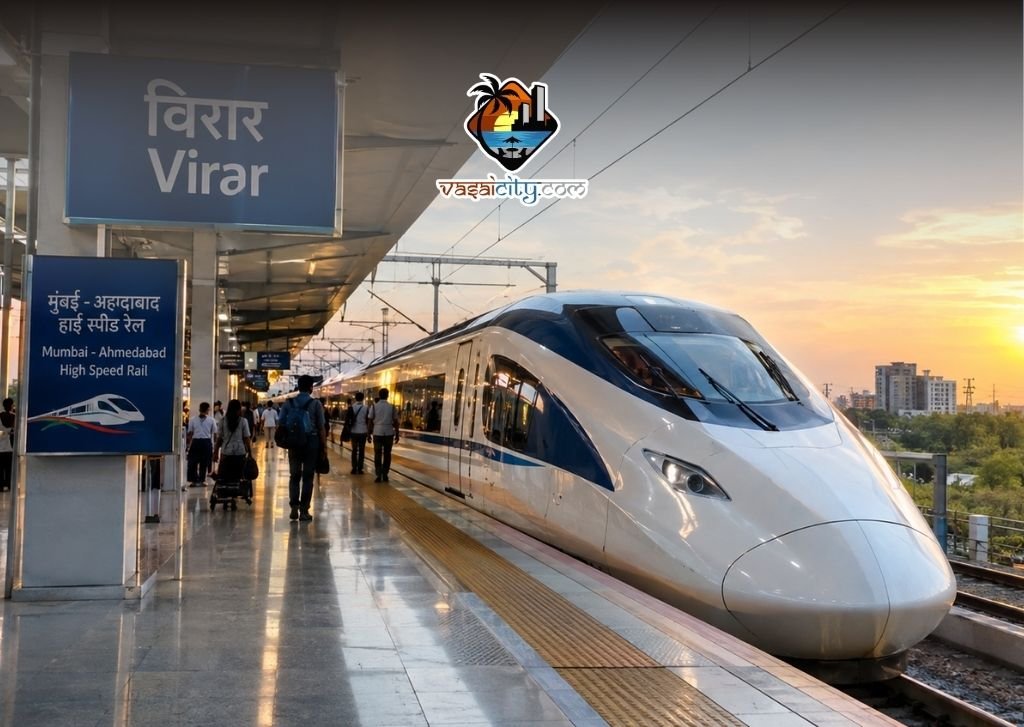
The Virar High-Speed Rail Station is emerging as one of the most significant planned infrastructure developments in the Vasai-Virar region, with the station and its surrounding area being considered for a much larger urban transformation under Project-SMART.
For decades, Vasai-Virar has largely functioned as a residential extension of Mumbai. Every weekday, large numbers of residents travel south on the Western Railway towards Andheri, Dadar, Churchgate, BKC and other employment centres.
That pattern has earned the region the familiar description of a "bedroom community" — a place where people live, while much of their employment and business activity happens elsewhere.
The proposed Virar High-Speed Rail Station could gradually change that equation.
The station is part of the Mumbai–Ahmedabad High-Speed Rail (MAHSR) corridor, India's first high-speed rail project. The 508-km corridor will have 12 stations, including Mumbai, Thane, Virar and Boisar in Maharashtra. According to NHSRCL, the trains are designed for a maximum operating speed of 320 kmph.
But for local residents, the bigger story may not be the train's speed.
It is what authorities are planning around the station.
Table of Contents
Virar High-Speed Rail Station and Project-SMART
In February 2026, the Mumbai Metropolitan Region Development Authority (MMRDA) announced that Thane and Virar had been selected for focused station-area development planning under Project-SMART.
Project-SMART stands for Station Area Development along the Mumbai–Ahmedabad High-Speed Rail Corridor.
The initiative is being pursued by MMRDA in coordination with the Ministry of Housing and Urban Affairs (MoHUA) and the Japan International Cooperation Agency (JICA). The objective is to ensure that high-speed rail infrastructure becomes a catalyst for structured and sustainable urban growth.
JICA's involvement is particularly important because the planning exercise draws on Japanese experience in areas such as transit-oriented development, integrated mobility, land-value capture, environmental sustainability and stakeholder participation.
The intention is therefore not simply to construct a railway station.
The broader vision is to create a well-connected urban district around the station.
1. Virar Could Become More Than a Residential Suburb
The first major potential change is economic.
Vasai-Virar has experienced substantial residential growth, but employment opportunities have not always expanded at the same pace. As a result, many residents continue to travel outside the region for work.
A properly planned station area could begin to change that pattern.
The Virar High-Speed Rail Station is expected to serve as an anchor for development around the surrounding area. Commercial activity, offices, public facilities, retail and other supporting services could emerge around the station as the area develops.
MMRDA's Project-SMART framework specifically talks about using high-speed rail stations as catalysts for major growth centres within the Mumbai Metropolitan Region.
For Virar, that could eventually mean more employment opportunities closer to home.
It could also create opportunities for local businesses. Restaurants, hotels, retail outlets, professional services, healthcare providers, transport operators and other businesses could benefit from increased movement of workers and passengers.
However, these are development possibilities rather than guaranteed outcomes.
The actual economic impact will depend on how the station-area plan is implemented and whether commercial and civic infrastructure develops alongside the transport network.
2. A Large Station-Area Development Is Being Planned
The scale of the proposed development is one of the most important aspects of the story.
The planned Virar High-Speed Rail Station is located at Walaipada in the Nalasopara East area, according to local reporting. The surrounding station area is being considered for a Local Area Plan covering roughly 463 hectares, while subsequent reporting has referred to approximately 465 hectares as the broader planning area.
That is considerably larger than the footprint of a railway station itself.
The planning exercise is intended to determine how roads, land uses, public facilities, commercial areas and other infrastructure can be integrated around the high-speed rail station.
Local reporting has also indicated that six villages — including More, Tulinj, Gokhivre, Bilalpada, Dhaniv and Virar — are included in the special planning exercise.
This makes the development relevant well beyond passengers using the high-speed railway.
It could affect the wider pattern of urban growth in the northern part of the Vasai-Virar region.
3. Japanese Planning Principles Could Influence the New Urban District
One of the distinctive features of Project-SMART is the involvement of JICA.
Japan has extensive experience in developing cities around railway stations. In many Japanese urban centres, railway stations function as integrated hubs surrounded by offices, retail, housing, public facilities and efficient local transport.
Project-SMART is drawing on similar principles.
MMRDA says JICA experts have shared international best practices covering transit-oriented development, land-value capture, integrated mobility planning, environmental sustainability, stakeholder engagement and private-sector participation.
The idea is to make the railway station the centre of a connected urban system rather than an isolated piece of infrastructure.
For Virar, that could eventually mean better organised commercial districts, improved pedestrian movement, public transport connections, parking and other facilities around the station.
Local reports have also described plans involving commercial centres, residential development and public amenities in the wider station area.
The final form, however, will depend on the approved planning framework and subsequent implementation.
4. Multimodal Connectivity Could Be the Biggest Local Benefit
For ordinary residents, the success of the Virar High-Speed Rail Station will depend heavily on what happens outside the station.
A high-speed railway is useful only when passengers can reach it conveniently.
This is why multimodal integration is central to Project-SMART.
MMRDA's February 2026 announcement specifically highlighted seamless multimodal integration as one of the principles for station-area development.
The Virar station will need effective connections with local roads, buses, autos, taxis and other first- and last-mile transport services.
The Western Railway network will remain important as well, because suburban rail is the primary mass-transit system serving the region.
Local reporting on the Project-SMART plans has mentioned facilities such as parking, auto and taxi stands and bus stops as part of the station-area development approach.
If these systems are properly integrated, the station could become an important transport interchange for the northern MMR.
That could ultimately prove more valuable to residents than the headline speed of the high-speed train itself.
5. Land Use and Local Residents Will Be Central to the Story
Large-scale urban planning inevitably raises questions about land ownership, development rights and the future use of existing properties.
This is particularly important around Walaipada and the surrounding areas, where the proposed station-area planning covers a substantial amount of land.
Local reports in April 2026 said the proposed 463-hectare planning exercise was intended to be undertaken while taking local residents into confidence, and reported municipal assurances concerning protection of local interests.
That should not, however, be interpreted as a blanket legal guarantee that every existing property will be unaffected.
The final implications for individual landowners will depend on the approved Local Area Plan, development regulations, land-use changes, individual property status and any applicable agreements or statutory procedures.
This distinction is important.
Residents should rely on official notifications and approved planning documents rather than property advertisements or social-media claims when assessing what the project could mean for a particular plot or property.
What Does the High-Speed Rail Project Actually Connect?
The Virar High-Speed Rail Station will be one of 12 stations on the Mumbai–Ahmedabad High-Speed Rail corridor.
The planned stations are:
- Mumbai
- Thane
- Virar
- Boisar
- Vapi
- Bilimora
- Surat
- Bharuch
- Vadodara
- Anand
- Ahmedabad
- Sabarmati
NHSRCL says the complete corridor is approximately 508 km long. The maximum operating speed is planned at 320 kmph.
NHSRCL's current FAQ gives an indicative journey time of approximately 2 hours 7 minutes between Mumbai and Ahmedabad with limited stops, and around 2 hours 58 minutes with all stops.
This is important because some claims circulating locally suggest extremely short travel times between Virar and BKC or other Mumbai destinations.
Those claims should be treated carefully.
The high-speed railway's journey time is not the same as a passenger's total door-to-door journey.
A resident still needs to travel from home to the station, enter the station, board the train and then travel from the destination station to the final workplace.
Therefore, the real benefit will depend on the entire transport chain — not just the speed of the high-speed train.
Could Virar Develop Its Own Employment Hub?
This may ultimately be the most significant question.
If the Virar High-Speed Rail Station succeeds in attracting offices, commercial establishments, institutions and supporting businesses, the region could gradually become less dependent on Mumbai for employment.
That would represent a major shift.
Instead of thousands of residents travelling south every day simply because the region lacks comparable employment opportunities, more people could potentially work closer to where they live.
Such a change would also support secondary economic activity.
A growing employment centre creates demand for restaurants, cafés, retail stores, accommodation, professional services, healthcare, transport and other businesses.
This could create a more balanced local economy.
But transport infrastructure alone cannot create that ecosystem.
It requires suitable land-use planning, reliable utilities, roads, public transport, drainage, water supply, civic services and investment from businesses and developers.
What It Could Mean for Property and Development
The Virar High-Speed Rail Station is also likely to attract considerable attention from the property market.
Major transport infrastructure often increases interest in areas surrounding stations.
However, residents and investors should be cautious about assuming that every property near the proposed station will automatically appreciate.
Property performance will depend on factors such as exact accessibility, permitted land use, road connectivity, infrastructure capacity, development permissions and the actual pace of construction.
The more immediate opportunity could be the creation of new commercial and service clusters.
A successful station-area development could support offices, hotels, restaurants, retail centres, healthcare facilities and other businesses.
That would potentially change the character of the surrounding area from predominantly residential development to a more mixed-use urban district.
Virar's Future Will Depend on More Than One Project
The Virar High-Speed Rail Station should not be viewed in isolation.
The future of Vasai-Virar will be shaped by several infrastructure and urban-development initiatives working together.
High-speed rail can improve regional connectivity.
Western Railway will continue to provide suburban connectivity.
Roads will connect neighbourhoods to major transport hubs.
Buses, autos and taxis will provide local and last-mile mobility.
Commercial development can create employment.
And civic infrastructure — including water, drainage, roads, waste management and public spaces — will determine whether the resulting urban growth is actually sustainable.
This is why Project-SMART is potentially more significant than the station itself.
It attempts to address the relationship between transportation and the city that grows around it.
A Potential Turning Point for Virar
The Virar High-Speed Rail Station is still part of a larger project and planning process. The station-area development itself also has several stages ahead, including planning, approvals, coordination and implementation.
The latest MMRDA material shows that integrated Station Area Development Plans for Virar and Thane are being taken forward with MMRDA, JICA, MoHUA, NHSRCL and local authorities involved in the process.
Local reporting in October 2026 has also indicated that discussions around the Virar station-area development plan continue at the government level, with the roughly 463-hectare planning area remaining central to the proposed transformation.
That means the story is no longer simply about a future railway station.
It is about how a large part of northern Vasai-Virar could potentially be reorganised around a major transport hub.
For a region that has traditionally sent a large share of its workforce towards Mumbai every morning, the possibility of creating a stronger local employment and commercial centre could be transformative.
