
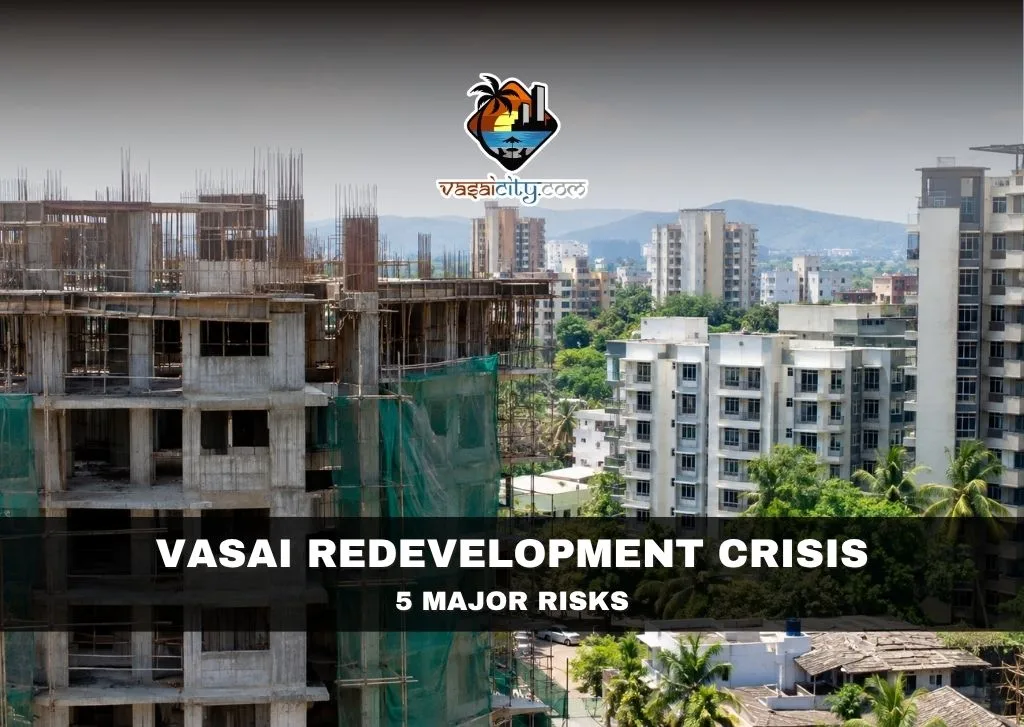
The Vasai redevelopment crisis has put around 95 redevelopment projects across the Vasai-Virar region under scrutiny after the Vasai-Virar City Municipal Corporation (VVCMC) raised concerns over approvals involving additional Floor Space Index (FSI).
The civic action has created uncertainty for original residents, homebuyers, investors, developers and financial institutions linked to the affected projects.
According to recent reports, the VVCMC has put restrictions on further construction, Occupation Certificates (OCs) and property-document registrations in projects where additional construction area is alleged to have been sanctioned contrary to applicable planning regulations.
The Vasai redevelopment crisis is particularly significant because many of the projects were already under construction or had progressed substantially after receiving permissions from the civic authorities.
Table of Contents
Vasai Redevelopment Crisis: What Triggered the Action?
The issue centres on additional FSI granted in redevelopment projects approved during the 2020–2025 period.
FSI, or Floor Space Index, determines how much construction can be carried out on a particular plot in relation to its area. Additional construction potential can be available through various provisions, including premium FSI and Transferable Development Rights (TDR), subject to applicable rules.
The Maharashtra government's UDCPR framework contains specific provisions governing redevelopment and the use of FSI and TDR.
The present dispute, however, concerns whether additional FSI in the affected projects was sanctioned and utilised in accordance with the applicable regulations and approval procedures.
The VVCMC's review has therefore created a difficult situation: projects that had previously received permissions are now being examined again for compliance.
95 Redevelopment Projects Facing Uncertainty
Recent reporting puts the number of affected projects at around 95, although some reports refer to more than 80 projects because the review and hearing process has been progressing project by project.
The VVCMC has conducted hearings with developers associated with the affected projects.
At these hearings, developers have reportedly argued that they constructed their projects on the basis of permissions granted by the municipal corporation and have disputed the allegations of unauthorised construction or regulatory violations.
This is an important aspect of the Vasai redevelopment crisis.
The issue is not simply about construction already carried out by private developers. It also involves questions about the approvals, scrutiny and permissions issued by the planning authority itself.
Reports indicate that some developers have sought additional time to submit documents and explanations, while the civic administration continues its review.
Occupation Certificates Put on Hold
One of the biggest concerns in the Vasai redevelopment crisis is the reported hold on Occupation Certificates.
An Occupation Certificate is an important document because it confirms that a completed building has complied with applicable development and construction requirements to the extent certified by the competent authority.
Without an OC, residents can face difficulties in completing the formal process associated with occupation and property transactions.
For redevelopment projects, the issue becomes even more serious because original residents may already have vacated their old buildings and shifted to temporary accommodation while waiting for their new homes.
A delay at the OC stage can therefore extend the redevelopment process considerably.
Property Registrations Also Under Scrutiny
The crisis has also moved beyond construction permissions.
The civic administration has reportedly written to the District Registrar regarding registration of sale documents involving flats and shops in the affected developments.
This could affect buyers who have entered into transactions based on project approvals and the expectation that the redevelopment would proceed normally.
For a homebuyer, registration is not a minor administrative step. It is part of the legal and financial process of acquiring property.
Any restriction or uncertainty surrounding registration can consequently affect buyers, sellers, developers and lenders.
Original Residents Are Among Those Most Affected
The Vasai redevelopment crisis has a particularly direct impact on original residents who handed over possession of their old homes for redevelopment.
Many such residents may have vacated their original flats after developers obtained municipal permissions, commencement certificates and other project approvals.
Some projects were also registered under Maharashtra's MahaRERA framework, while financing was reportedly obtained from nationalised and cooperative banks.
This means that residents and purchasers may have proceeded on the understanding that the projects had passed the necessary approval stages.
If the project later encounters questions regarding FSI or planning permissions, residents can be left caught between the developer and the authorities.
Their immediate concern is usually straightforward: When will they receive their permanent homes?
Homebuyers and Investors Face Financial Exposure
The financial implications could be substantial.
Reports have estimated that more than ₹1,000 crore could be connected to the affected projects through investments involving homebuyers, original residents and bank financing.
The precise financial exposure will depend on the individual project, the number of affected flats and shops, the stage of construction, outstanding loans and the eventual decision of the authorities.
For homebuyers, however, uncertainty can have several consequences.
A buyer may have already paid a substantial portion of the purchase price while also servicing a home loan. At the same time, possession may be delayed because the project cannot obtain its required approvals.
Original residents may also continue to incur rent or temporary accommodation expenses while waiting for rehabilitation homes.
Banks and other lenders could face their own exposure where loans have been sanctioned against properties in projects whose approvals are now being examined.
What Are the Main Technical Issues?
The Vasai redevelopment crisis revolves around several technical and planning-related questions.
These reportedly include:
- Excess or improperly sanctioned FSI
- Questions regarding additional construction area
- Alleged violations of UDCPR provisions
- Incorrect or disputed building plans
- Open-space requirements
- Approval procedures followed for additional development potential
- Whether earlier permissions can remain valid
- Whether technical deficiencies can be corrected through revised approvals
The exact issue may differ from one project to another.
That distinction is important because a technical deficiency in one project may not necessarily mean that every affected redevelopment project has the same violation.
The VVCMC's ongoing project-wise review is therefore significant.
Developers Challenge the Notices
Developers have also raised objections to the action taken by the municipal corporation.
During hearings before the VVCMC Town Planning Department, developers reportedly argued that the notices issued against them were not legally sustainable.
Their position, as reported, is that the projects were developed on the basis of permissions granted by the civic authority and that they had not independently violated the regulations.
This creates a central question in the Vasai redevelopment crisis:
If construction permissions were granted by the planning authority, how should responsibility be determined when those permissions are subsequently found to be inconsistent with the applicable regulations?
That question could become important in determining the next steps for individual projects.
Why the 2020–2025 Period Matters
The projects under scrutiny largely relate to approvals issued during the period when the Unified Development Control and Promotion Regulations were being implemented and applied across Maharashtra.
The UDCPR contains provisions dealing with redevelopment, FSI and TDR. For example, the regulations provide specific treatment for existing authorised buildings and redevelopment of older structures.
However, applying FSI provisions to a particular redevelopment project involves examining the plot, existing authorised construction, applicable development regulations, TDR or premium FSI, sanctioned plans and other project-specific factors.
Therefore, simply comparing the number of floors or total construction area between two projects may not establish whether a project is compliant.
The official approval documents remain critical.
Government Review Could Decide the Next Step
The administration now faces the difficult task of determining what should happen to projects where irregularities are established.
One option being discussed publicly is project-wise review rather than treating all projects identically.
There have also been calls for technical deficiencies to be considered for regularisation through mechanisms such as premium payments or TDR adjustments where legally permissible.
At the same time, there are demands for responsibility to be fixed separately if officials, architects or developers are found to have acted improperly.
These are two different questions.
The first concerns the future of the building and the residents living in or awaiting it.
The second concerns accountability for how an alleged irregular approval came about.
Keeping these issues separate could be important for protecting the interests of residents and legitimate purchasers.
What Could Happen to the Affected Projects?
The eventual outcome may differ between projects depending on the findings of the scrutiny.
Projects with no substantive violation could potentially move forward once the review is completed.
Projects with documentation or technical deficiencies may require revised approvals or other corrective measures, subject to the competent authority and applicable law.
Where serious violations are established, the authorities may have to determine what legal and administrative action is appropriate.
Recent reporting indicates that the VVCMC has completed hearings for a large number of the projects, with some developers being given additional time to provide documents or clarifications. The final decisions are therefore still important to watch.
What Should Homebuyers Do Now?
For people considering purchasing a flat in a redevelopment project affected by the Vasai redevelopment crisis, caution is important until the status of the particular project becomes clear.
Potential buyers should not rely solely on statements made by a developer, broker or salesperson.
They should independently verify the project's approval status and relevant documents with the competent authorities.
The VVCMC Town Planning Department provides information and resources relating to development permissions, commencement certificates and Occupancy Certificates on its official website.
Buyers should particularly check:
- Sanctioned building plans and revised plans, if any.
- Commencement Certificate and its validity.
- FSI calculations and the basis for additional FSI.
- TDR or premium FSI documents, where applicable.
- MahaRERA project details and updates.
- Current construction status.
- Occupation Certificate status, if construction is complete.
- Any notices or restrictions issued by the civic authority.
- Registration status of the flat or commercial unit.
- Pending litigation or disputes, where disclosed.
Buyers should also have property documents reviewed by an independent property lawyer before making significant financial commitments.
Existing Residents Should Keep Their Documents Ready
People already involved in an affected redevelopment should maintain copies of all documents connected with the project.
This includes the original agreement, redevelopment agreement, permanent alternate accommodation agreement, registered documents, rent receipts, possession records, payment receipts, correspondence with the developer and copies of approved plans or permissions available to them.
Residents should also record any additional rent or accommodation expenses caused by delays.
Housing societies may benefit from obtaining an independent legal and technical assessment of their project's approval position rather than relying entirely on the developer's explanation.
A Larger Question for Vasai-Virar's Redevelopment Future
The Vasai redevelopment crisis has exposed a broader challenge for a rapidly urbanising region.
Vasai-Virar has a large stock of older residential buildings, many of which require redevelopment to improve structural safety, parking, infrastructure and living conditions.
VVCMC's own Town Planning portal publishes information relating to development planning, commencement certificates, revised development plans and Occupancy Certificates.
The current controversy shows why redevelopment approvals need to be transparent, consistent and properly documented from the beginning.
For residents, a redevelopment project is not simply a construction proposal. It often involves their lifetime savings, temporary relocation, rent, home loans and expectations of receiving a safer and better home.
For developers, clarity in planning regulations and approvals is equally important because projects involve substantial financial commitments.
And for the civic administration, the challenge is to ensure that planning rules are followed while also preventing residents who acted in good faith from being caught indefinitely in an approval dispute.
What Happens Next?
The immediate focus is now on the VVCMC's project-wise examination and the decisions that follow the hearings.
The administration will need to determine which projects comply with the applicable rules, which require corrections and whether any approvals need to be revised or otherwise dealt with under the law.
At the same time, residents and homebuyers will be watching for clarity on Occupation Certificates and property registrations.
The Vasai redevelopment crisis is therefore far from being only a dispute between the municipal corporation and developers.
It has become a wider issue involving housing security, property transactions, bank finance, urban planning and public accountability.
Until the authorities issue project-specific decisions, people connected with the affected developments should treat the situation carefully and verify the current legal and approval status of their individual project.
The Maharashtra government's Urban Development Department provides the state's official regulatory framework and updated documents relating to UDCPR, which can be referred to alongside project-specific approvals.
For Vasai-Virar, the eventual resolution will be important not only for the approximately 95 projects currently under scrutiny, but also for the credibility and future of redevelopment across the rapidly growing city.
This report is based on publicly reported information available as of September 19, 2026. Allegations of regulatory violations remain subject to project-wise scrutiny and official decisions. Developers' positions have been included where reported, and individual projects may have different facts and approval histories.