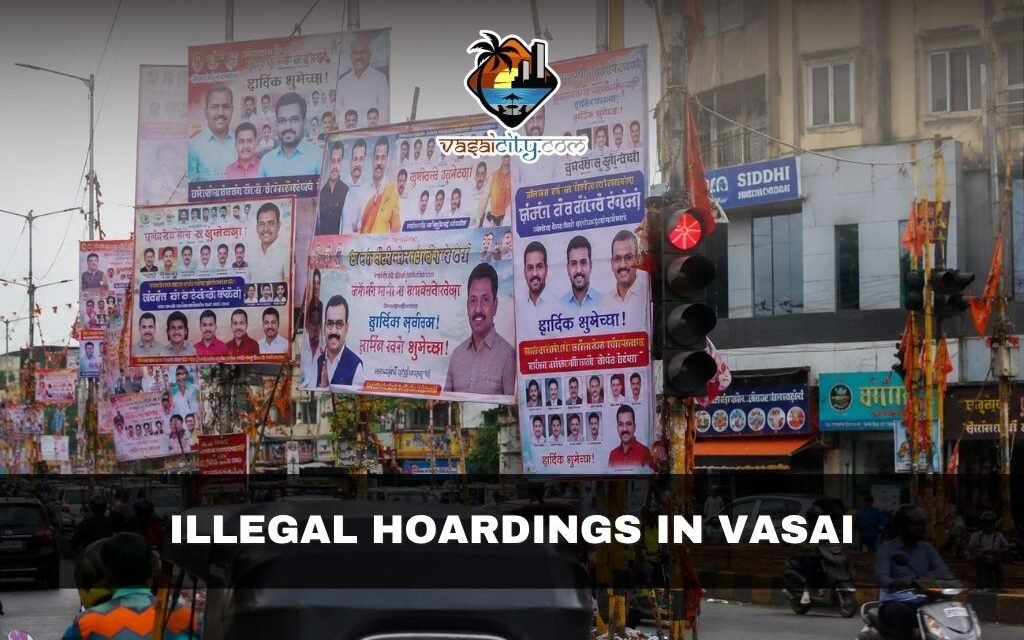
Illegal hoardings in Vasai have become an increasingly visible concern for residents who want their city to remain clean, safe and well managed. From busy junctions and roads to footpaths, bridges and public spaces, unauthorised banners, posters, flags and advertising displays can be seen in several parts of the city.
For Vasaikars, these are not simply matters of aesthetics. When public infrastructure is covered with unauthorised displays, it can affect visibility, movement and the overall experience of navigating through the city.
Vasai is home to thousands of families, businesses and communities. Its roads, gardens, junctions, skywalks, bridges and open spaces are shared civic assets. They should therefore be maintained in a manner that serves the public rather than becoming uncontrolled spaces for advertising, publicity or political messaging.
Table of Contents
Illegal Hoardings in Vasai Raise Road Safety Concerns
One of the most important concerns surrounding illegal hoardings in Vasai is road safety.
Large banners and hoardings placed near intersections can potentially obstruct the visibility of traffic signals, road signs and approaching vehicles. Even when a display does not completely block a signal, its size, position or bright design can become a distraction for motorists.
For pedestrians, clutter around footpaths and junctions can also make already busy areas more difficult to navigate.
The issue becomes particularly important on roads that experience heavy traffic during peak hours. When drivers have to deal with congested roads, pedestrians, vehicles entering from side lanes and frequent honking, unnecessary visual distractions can make the situation worse.
Illegal Hoardings in Vasai Add to Urban Clutter
A city is judged not only by its buildings and roads but also by how its public spaces are maintained.
The unchecked spread of illegal hoardings in Vasai, along with banners, posters and flags, can create a cluttered appearance. Walls, railings, dividers, poles and other civic infrastructure can quickly become covered with promotional or political material.
What begins as one banner can eventually turn into several competing displays in the same location.
The result is a cityscape where important civic infrastructure is visually hidden behind advertisements and publicity material.
This is especially noticeable at prominent junctions and locations that should otherwise provide residents and visitors with a clear view of the surrounding urban environment.
Illegal Hoardings in Vasai and the Question of Public Space
Public spaces belong to the community.
Roads, footpaths, bridges, gardens, junctions and other civic facilities are created and maintained for public use. Their use for commercial advertising, political publicity or private messaging should therefore be subject to appropriate permissions and rules.
The concern is not about whether businesses, organisations or political groups should be allowed to communicate with the public. The issue is whether such displays are properly authorised, safely installed and removed when their permitted period ends.
A clear and consistently enforced system can allow legitimate publicity while preventing public spaces from becoming advertising zones without accountability.
Who Is Responsible for Controlling Illegal Hoardings in Vasai?
The Vasai Virar City Municipal Corporation (VVCMC) has an important role to play in regulating the use of municipal spaces and addressing unauthorised displays within its jurisdiction.
Residents should expect authorities to have clear rules regarding permissions, placement, size, duration and removal of hoardings and other public displays.
More importantly, enforcement needs to be consistent.
If an unauthorised banner is removed from one location but similar displays continue appearing elsewhere, residents are unlikely to feel that the problem is being addressed comprehensively.
Illegal Hoardings in Vasai Need Citizen Participation Too
Government authorities cannot maintain every public space without public cooperation.
Residents can play a constructive role by reporting unauthorised displays, avoiding damage to civic infrastructure and raising concerns through appropriate official channels rather than allowing the problem to become normalised.
Citizen participation can also encourage greater accountability.
If residents regularly point out unsafe or unauthorised displays, authorities have more information about locations requiring attention. Responsible reporting can therefore become an important part of improving civic management.
A Cleaner Vasai Is Possible
The debate over illegal hoardings in Vasai should ultimately be about more than removing banners.
It should be about deciding what kind of city Vasai wants to become.
A modern city requires good roads, reliable infrastructure and efficient public services. But it also needs clean streets, uncluttered public spaces, safe junctions and respect for civic property.
Development should not mean simply adding more infrastructure. The quality of the urban environment matters just as much.
A cleaner visual environment can make roads easier to navigate, public spaces more welcoming and the city more attractive to residents, businesses and visitors.
What Vasaikars Can Expect
Residents have a legitimate interest in seeing municipal authorities take a systematic approach to unauthorised hoardings, banners, posters and flags.
That could include regular inspections, transparent permission systems, timely removal of unauthorised displays and action against repeat violations.
There should also be clarity about where advertising and public displays are permitted and where they are not.
Most importantly, enforcement should apply consistently, regardless of who has put up a display.
The objective should not be to target a particular individual, organisation, business or political group. It should be to protect public spaces and ensure that civic rules are followed equally.
Illegal Hoardings in Vasai: A Call to Reclaim Public Spaces
Illegal hoardings in Vasai may appear to be a small civic issue when viewed individually. But when banners, posters, flags and hoardings accumulate across roads and public infrastructure, they collectively affect the appearance and functionality of the city.
Vasai belongs to its residents. Its public spaces should reflect the needs and aspirations of the people who live here.
The VVCMC has a responsibility to enforce the applicable rules, while citizens have a role in demanding accountability and reporting problems responsibly.
A cleaner, safer and more organised Vasai will not happen through infrastructure projects alone. It will require authorities and residents to work together to protect the city’s shared spaces.
The question is therefore straightforward: Do Vasaikars want their city’s public spaces to remain cluttered with unauthorised displays, or do they want to reclaim them for the community?
The choice – and the civic responsibility – belongs to everyone.