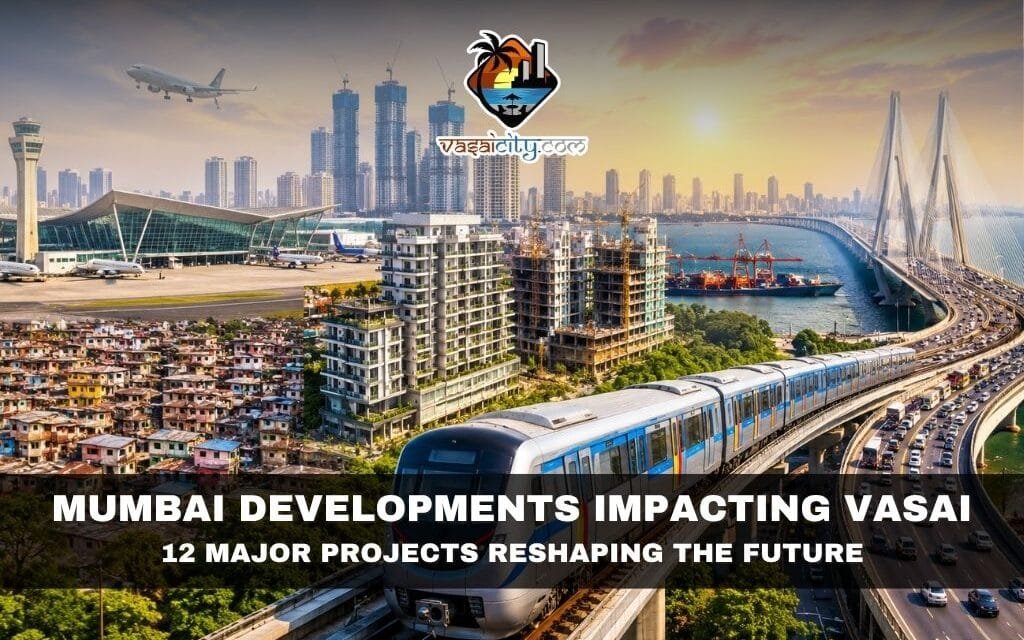
Mumbai Developments Impacting Vasai are becoming one of the biggest talking points among residents, investors, commuters, and businesses across the Vasai-Virar region. While Vasai has a rich history of being an independent and prosperous city long before Mumbai emerged as India’s financial capital, today’s reality is very different. Every major infrastructure project, redevelopment initiative, and transport upgrade taking place in Mumbai has a direct or indirect impact on the growth of Vasai.
Over the next decade, Mumbai is undergoing an unprecedented transformation worth nearly $60 billion (approximately ₹5 lakh crore). From modern transport systems and urban redevelopment to new airports and sea bridges, these ambitious projects are expected to redefine not only Mumbai but also neighbouring regions like Vasai.
For thousands of daily commuters travelling between Vasai and Mumbai, these developments could significantly improve travel times, employment opportunities, business growth, and property values.
Table of Contents
Mumbai Developments Impacting Vasai Through Better Connectivity
One of the biggest reasons Mumbai Developments Impacting Vasai matter is improved connectivity.
Every day, lakhs of residents from Vasai, Nalasopara and Virar travel to Mumbai for work, education and business. New roads, metro lines and railway upgrades will reduce congestion and make commuting faster.
Projects like the Mumbai Metro Expansion, Mumbai Coastal Road, Atal Setu, Goregaon-Mulund Link Road, and the upcoming Mumbai-Ahmedabad Bullet Train are expected to create an integrated transport network that benefits the entire Mumbai Metropolitan Region (MMR).
Although many of these projects are located within Mumbai, their long-term impact extends to Vasai by making travel smoother and improving regional connectivity.
Mumbai Metro Expansion: A Massive Transport Revolution
Among all Mumbai Developments Impacting Vasai, the Mumbai Metro Expansion is one of the most significant.
The metro network is being expanded to nearly 337 kilometres across 13 corridors, making it one of India’s largest urban transit systems.
The expanded metro will:
- Reduce dependency on overcrowded local trains.
- Improve last-mile connectivity.
- Lower travel times across Mumbai.
- Enhance access to commercial districts.
For Vasai residents who travel daily to Mumbai, better integration between suburban rail and metro services can make commuting far more convenient.
Dharavi Redevelopment: Transforming India’s Largest Slum
The Dharavi Redevelopment Project, valued at nearly $36 billion, is considered one of the world’s largest urban renewal initiatives.
The project aims to redevelop one of Asia’s largest informal settlements into a modern urban township with improved housing, infrastructure, healthcare, commercial spaces and public amenities.
Besides transforming central Mumbai, this redevelopment is expected to create thousands of employment opportunities across construction, engineering, logistics and support services.
Many skilled workers from Vasai may benefit from these opportunities.
Navi Mumbai International Airport Will Create New Opportunities
Another major milestone among Mumbai Developments Impacting Vasai is the upcoming Navi Mumbai International Airport.
Designed as India’s first large-scale multi-modal airport, it is expected to reduce pressure on Mumbai’s existing airport while improving regional connectivity.
The airport will:
- Generate thousands of direct and indirect jobs.
- Boost tourism.
- Improve logistics and cargo movement.
- Encourage commercial investments.
Businesses in Vasai involved in hospitality, transport, logistics and real estate could witness long-term benefits.
Mumbai Coastal Road and Atal Setu Will Improve Road Connectivity
Mumbai’s road infrastructure is also witnessing historic upgrades.
The Mumbai Coastal Road Project, stretching over 10.5 kilometres, aims to significantly reduce travel time along the city’s western coastline.
Similarly, the Atal Setu, India’s longest sea bridge, has already improved connectivity between Mumbai and Navi Mumbai.
Although Vasai is geographically separate, these projects reduce overall traffic congestion across the metropolitan region, improving mobility for residents travelling towards South Mumbai and Navi Mumbai.
Mumbai Port and Eastern Waterfront Redevelopment
The redevelopment of Mumbai Port’s 966-hectare Eastern Waterfront is another ambitious initiative.
The project proposes:
- Public waterfront spaces
- Commercial developments
- Tourism infrastructure
- Recreational zones
- Improved transport access
This transformation could create fresh business opportunities for entrepreneurs and investors across the Mumbai Metropolitan Region, including Vasai.
BDD Chawl Redevelopment: Preserving Heritage While Modernising Housing
Mumbai’s historic BDD Chawls are being redeveloped into modern residential complexes while preserving their cultural significance.
The redevelopment includes:
- Better housing
- Improved civic infrastructure
- Modern amenities
- Enhanced public spaces
Large-scale housing projects like these often stimulate demand across nearby suburban regions, including Vasai’s real estate market.
Mumbai-Ahmedabad Bullet Train Will Change Regional Mobility
India’s first high-speed rail corridor between Mumbai and Ahmedabad represents a major leap in transportation.
Although the project primarily serves intercity travel, its supporting infrastructure is expected to improve overall connectivity across western India.
For Vasai residents, better regional transport networks could enhance business travel and future employment opportunities.
Mumbai Water Metro and Sustainable Transport
Mumbai is also planning an ambitious 250-kilometre Water Metro Network.
This project aims to introduce water-based urban transport that complements roads, railways and metro systems.
Combined with electric buses, pedestrian-friendly streets and smart parking systems, Mumbai is moving toward cleaner and more sustainable urban mobility.
Such initiatives contribute to better environmental planning across the wider metropolitan region.
Flood Control, Water Supply and Smart Infrastructure
Infrastructure isn’t limited to transport alone.
Mumbai is investing nearly ₹26,000 crore in:
- Water supply upgrades
- Sewage treatment systems
- Flood mitigation projects
- Stormwater drainage improvements
As climate resilience becomes increasingly important, these investments can serve as models for surrounding urban areas, including Vasai-Virar.
Why Mumbai Developments Impacting Vasai Matter
The relationship between Mumbai and Vasai has evolved significantly over the past three centuries.
Historically, Vasai was an important trading and administrative centre. Today, it forms an integral part of the Mumbai Metropolitan Region, with thousands depending on Mumbai for employment and economic opportunities.
As Mumbai continues its transformation into a global financial and infrastructure hub, Vasai stands to benefit through:
- Improved connectivity
- Increased employment opportunities
- Better business prospects
- Rising demand for housing
- Growth in commercial investments
- Enhanced regional infrastructure
These benefits may not be immediate, but over the next decade, they are expected to influence the pace and direction of Vasai’s development.
Conclusion
The ongoing Mumbai Developments Impacting Vasai are far more than isolated infrastructure projects. Together, they represent one of the largest urban transformation programmes ever undertaken in India.
From metro rail expansion and airport development to redevelopment projects, sea bridges and smart infrastructure, Mumbai’s evolution into a global city will inevitably shape the future of neighbouring regions like Vasai.
For residents, businesses, investors and commuters, staying informed about these developments is essential, as they are likely to redefine how people live, work and travel across the Mumbai Metropolitan Region in the coming years.
Inputs by Biju Cherian
This article is based on the author’s research and perspectives. The publisher claims no responsibility for inaccuracies. Views expressed are the contributor’s alone. Institutions mentioned are not endorsed unless specified.