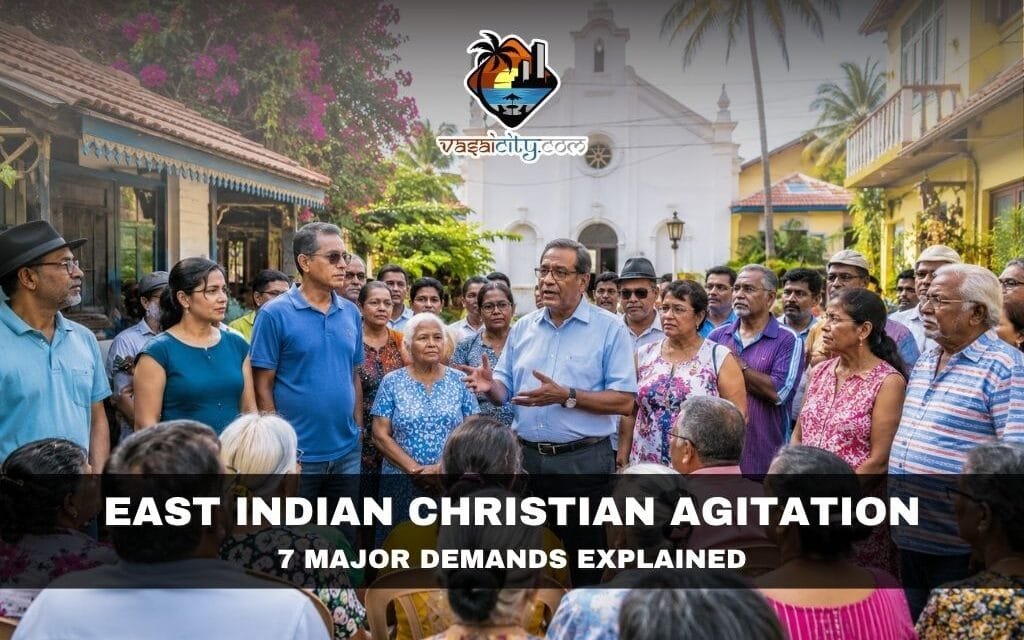
The East Indian Christian Agitation has become a significant issue across the Mumbai Metropolitan Region (MMR), including Vasai, as members of the indigenous East Indian Christian community demand stronger protection for their land, heritage, and future. Community leaders say that despite their historic contribution to the region’s development, they now face increasing challenges related to housing, education, healthcare, and the preservation of their identity.
For generations, East Indian Christians have been recognised as one of the original inhabitants of the Mumbai Metropolitan Region. Their ancestors contributed land for the construction of schools, hospitals, churches, financial institutions, and other public infrastructure that continue to benefit society today.
However, many within the community believe that while these institutions have flourished, the people who made them possible have been left behind.
Table of Contents
Why the East Indian Christian Agitation Has Intensified
The East Indian Christian Agitation is driven by a growing sense of insecurity about the community’s future. Residents across Vasai, Mumbai, Mira-Bhayandar, and neighbouring areas say rapid urbanisation and changing demographics have significantly altered the social fabric of their traditional villages.
Many East Indian families who once formed the majority in these settlements now find themselves becoming minorities in their own ancestral areas. Community representatives argue that unchecked development has reduced their presence, making it increasingly difficult to preserve their customs, traditions, and heritage.
Several long-standing gaothans, which are traditional village settlements, are under increasing pressure due to redevelopment, infrastructure projects, and changing land ownership patterns.
As a result, the East Indian Christian Agitation has become a movement focused on safeguarding both cultural identity and the rights of indigenous residents.
The Historical Contribution of the East Indian Community
The East Indian Christian community has played a vital role in shaping the Mumbai Metropolitan Region.
Over the decades, families donated large portions of their ancestral lands for:
- Schools and educational institutions
- Hospitals and healthcare centres
- Churches and spiritual institutions
- Community welfare facilities
- Financial and cooperative institutions
These contributions have benefited people from all communities and backgrounds.
Community members now argue that while development has continued, adequate support for the original land-owning families has not kept pace with modern challenges.
Housing Remains a Major Concern
One of the biggest issues highlighted during the East Indian Christian Agitation is the lack of adequate housing.
Many families continue to live in ancestral homes that require repairs or redevelopment. Others face legal and planning challenges within gaothan areas, making it difficult to construct or renovate houses.
Community members are demanding policies that specifically recognise the housing needs of the indigenous East Indian Christian population.
They believe that government authorities should introduce special housing schemes and planning regulations that protect traditional settlements while allowing residents to improve their living conditions.
Protecting Gaothan Lands
Another major demand of the East Indian Christian Agitation is the protection of gaothan lands.
Gaothans are more than just residential areas. They represent centuries of history, social traditions, family connections, and cultural identity.
Community leaders argue that these villages should receive greater legal protection against unplanned development and land-related disputes.
According to the community, preserving gaothans is essential not only for the East Indian Christians but also for protecting the cultural heritage of the Mumbai Metropolitan Region.
Demand for Transparency in Church Land Matters
The East Indian Christian Agitation has also brought attention to issues concerning church-owned properties.
Community representatives are seeking greater transparency and accountability in matters related to church lands.
They believe that decisions involving community properties should involve open communication and ensure that the long-term interests of the East Indian Christian community remain protected.
Supporters of the movement say greater transparency would help build trust while safeguarding assets that hold historical and cultural significance.
Education and Healthcare Challenges
Although educational and healthcare institutions were established on lands donated by earlier generations, many community members feel they are not receiving sufficient benefits today.
The East Indian Christian Agitation highlights the need for better access to:
- Educational support
- Scholarships
- Affordable healthcare
- Employment opportunities
- Financial assistance for community development
Leaders say targeted welfare measures could help younger generations remain connected to their ancestral villages while improving their quality of life.
Declining Political Representation
Another concern raised during the East Indian Christian Agitation is the reduction in political representation.
Community members believe their voice in public decision-making has weakened over the years due to demographic changes.
They argue that stronger representation at local and regional levels would help ensure that issues affecting indigenous communities receive greater attention during policy discussions.
According to community representatives, preserving their identity requires not only cultural recognition but also meaningful participation in governance.
Preserving Language, Culture and Heritage
Beyond land and housing, the East Indian Christian Agitation is also about preserving a unique way of life.
The East Indian community has its own language, traditions, festivals, music, architecture, cuisine, and cultural practices that have evolved over centuries.
Many residents fear that these traditions could gradually disappear if younger generations migrate away or if traditional settlements lose their original character.
Community organisations continue to encourage cultural programmes, language preservation initiatives, and heritage events aimed at keeping these traditions alive.
Recognition as Bhumiputra Community
A central demand of the East Indian Christian Agitation is greater recognition of the East Indian Christians as the indigenous or Bhumiputra community of the region.
Community leaders say such recognition would help strengthen policies related to land protection, heritage conservation, housing, and social welfare.
They believe acknowledging their historical contribution would also ensure that future development takes into account the interests of the region’s original inhabitants.
Community Appeals for Constructive Dialogue
Supporters of the movement emphasise that the East Indian Christian Agitation is aimed at protecting constitutional rights and preserving cultural heritage through peaceful and democratic means.
They are urging government authorities, local representatives, and other stakeholders to engage in constructive dialogue to address long-standing concerns.
Community members hope that meaningful discussions will lead to practical solutions that balance urban development with the protection of indigenous communities and their heritage.
Looking Ahead
As urbanisation continues across Vasai and the wider Mumbai Metropolitan Region, the concerns raised through the East Indian Christian Agitation reflect broader questions about sustainable development, cultural preservation, and social inclusion.
The community maintains that protecting gaothans, improving housing opportunities, ensuring transparency, and recognising the historical contribution of East Indian Christians are essential steps towards securing their future.
With increasing public attention on these issues, many hope that policymakers will work together with community representatives to find balanced solutions that preserve both development and heritage for future generations.
Inputs by Biju Cherian
This article is based on the author’s research and perspectives. The publisher claims no responsibility for inaccuracies. Views expressed are the contributor’s alone. Institutions mentioned are not endorsed unless specified.