
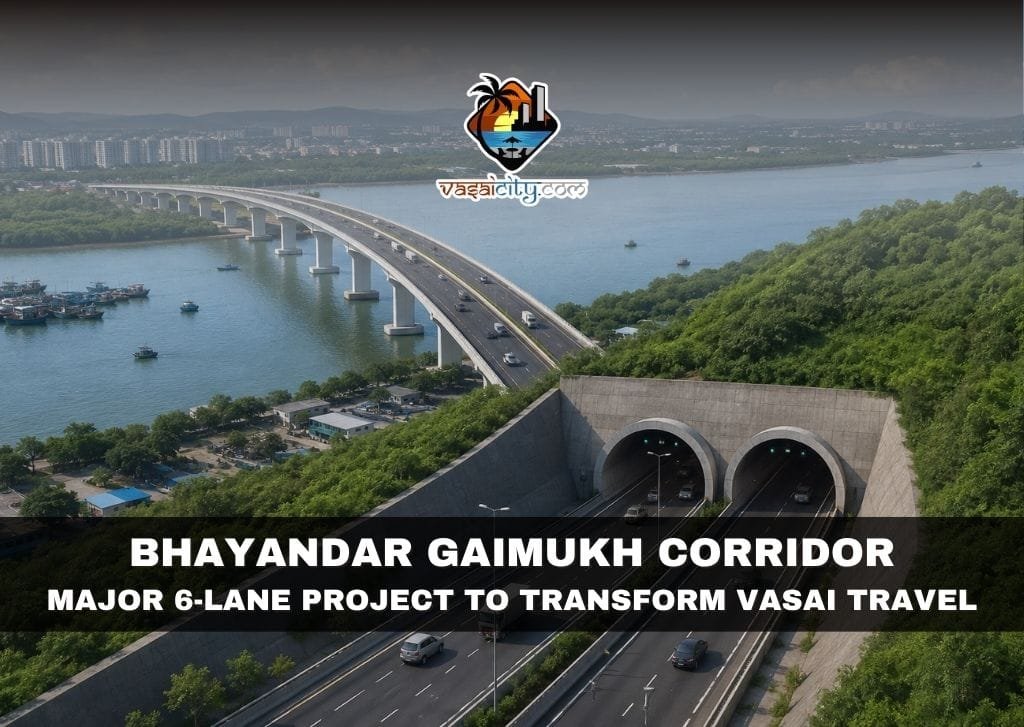
The Bhayandar Gaimukh Corridor is emerging as one of Maharashtra's biggest infrastructure projects and is expected to significantly improve travel for thousands of commuters from Vasai, Mira-Bhayandar, Thane and Mumbai. Once completed, the ambitious six-lane corridor will provide an alternative route to the heavily congested Ghodbunder Road and Western Express Highway, reducing travel delays and improving regional connectivity.
For residents of Vasai, who currently depend heavily on a single southern highway connection, this project could become a major relief by offering an additional route towards Mumbai and Thane.
Table of Contents
Why the Bhayandar Gaimukh Corridor Matters to Vasai
Every day, thousands of vehicles from Vasai and nearby areas cross the Vasai Creek Bridge before joining Ghodbunder Road. Traffic congestion on this stretch has become a routine challenge, especially during office hours and weekends.
The Bhayandar Gaimukh Corridor has been planned to ease this pressure by creating a faster and more efficient transport corridor connecting Bhayandar directly with Gaimukh in Thane.
With increasing urban development across the Mumbai Metropolitan Region (MMR), the demand for improved road infrastructure has become more urgent than ever.
₹17,000 Crore Infrastructure Investment
The Maharashtra Government has approved the proposed project with an estimated investment of ₹17,000 crore.
The new corridor is designed as a combination of elevated roads and underground tunnels, making it one of the region's most technically advanced highway projects.
Officials expect the project to support future traffic growth while reducing dependency on existing road networks.
Bhayandar Gaimukh Corridor: Project Highlights
The Bhayandar Gaimukh Corridor will stretch approximately 15.44 kilometres and will consist of two major sections.
Elevated Creek Bridge
The first section begins at Bhayandar and extends to the Fountain Hotel Junction.
Key features include:
- Length: 9.58 km
- Six lanes (3+3 configuration)
- Elevated bridge across the creek
- Direct connection towards Thane
This elevated bridge is expected to improve vehicle movement while bypassing several existing bottlenecks.
Twin Underground Tunnels
The second section starts from Fountain Hotel Junction and continues towards Gaimukh.
Highlights include:
- Length: 5.86 km
- Twin underground tunnels
- Six lanes (3+3 configuration)
- Faster access to Ghodbunder Road and surrounding areas
These tunnels are expected to provide uninterrupted traffic movement while reducing surface-level congestion.
Expected Benefits of the Bhayandar Gaimukh Corridor
The Bhayandar Gaimukh Corridor is expected to bring several advantages for commuters across the Mumbai Metropolitan Region.
Some of the anticipated benefits include:
- Reduced congestion on Ghodbunder Road.
- Alternative access to Mumbai from Vasai.
- Improved travel reliability during peak hours.
- Better connectivity between Mira-Bhayandar and Thane.
- Enhanced movement for commercial vehicles.
- Support for future urban development in the MMR region.
For daily commuters, even a modest reduction in travel time could significantly improve the overall commuting experience.
Impact on Vasai Residents
For many residents, travelling towards Mumbai involves navigating the crowded Ghodbunder Road corridor after crossing the Vasai Creek Bridge.
The Bhayandar Gaimukh Corridor is expected to reduce dependence on this single route by creating another high-capacity option.
Improved road connectivity may also benefit businesses, logistics operators and emergency services by providing greater route flexibility.
As development continues across Vasai-Virar, better regional infrastructure is likely to play an important role in supporting economic growth and reducing travel stress.
A Key Project for the Mumbai Metropolitan Region
The corridor aligns with the broader vision of improving transportation infrastructure across the Mumbai Metropolitan Region.
As suburban populations continue to grow, projects like the Bhayandar Gaimukh Corridor are expected to improve mobility between residential hubs and employment centres.
Transport experts believe that additional road capacity, combined with metro and railway expansion, will help create a more balanced transport network for the region.
Current Status
The Maharashtra Government has approved the project, and it is expected to be implemented in phases after completion of detailed planning, clearances and construction processes.
Once operational, the corridor is expected to become an important alternative route connecting Bhayandar with Gaimukh while easing pressure on existing highways.
Residents and commuters will be watching closely as this landmark infrastructure project progresses in the coming years.
Inputs by Biju Cherian
This article is based on the author’s research and perspectives. The publisher claims no responsibility for inaccuracies. Views expressed are the contributor’s alone. Institutions mentioned are not endorsed unless specified.