
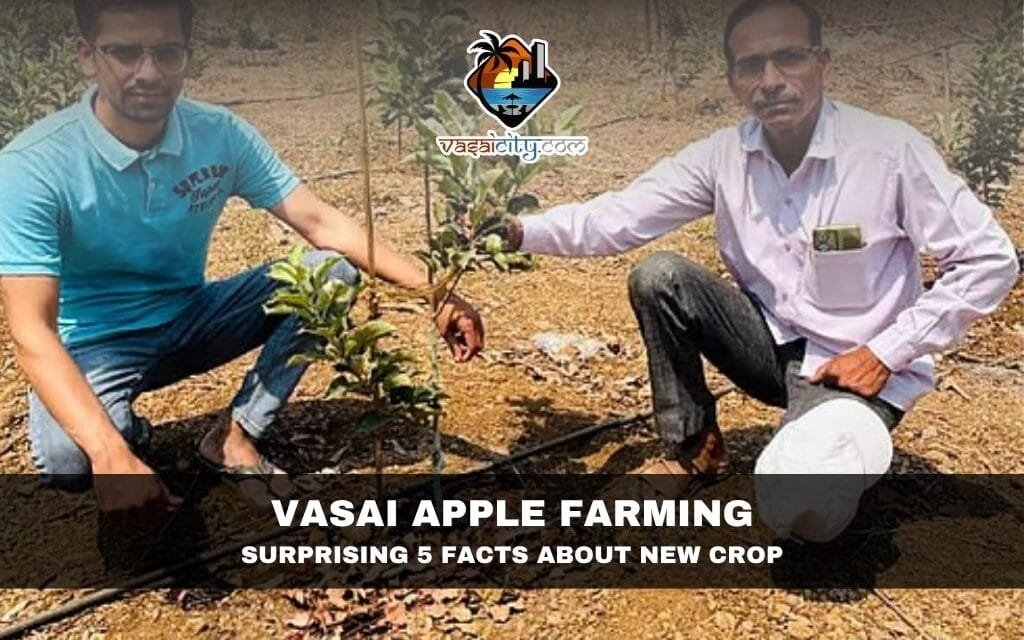
Vasai Apple Farming is creating a surprising buzz in the region as a local farmer successfully grows apples in an area traditionally known for tropical crops. This development is opening new doors for farmers looking to diversify their income and adapt to changing agricultural conditions.
Vasai taluka has long been known for its natural richness. Surrounded by a scenic coastline on one side and hills on the other, the region has built its identity around farming vegetables, bananas, flowers like jasmine and mogra, and its thriving fishing industry. However, Vasai Apple Farming is now emerging as an unexpected yet promising addition to this list.
Table of Contents
A Farmer’s Unique Experiment in Vasai Apple Farming
In Ambode village, located in the eastern belt of Vasai, farmer Manohar Bhoir has taken a bold step by cultivating apples on his eight-guntha land. Traditionally, apples are grown in colder climates such as Himachal Pradesh and Kashmir. But this experiment in Vasai Apple Farming proves that innovation can challenge geographical limitations.
Bhoir planted around 50 apple saplings sourced from Shrirampur. These include the ‘Anna’ and ‘Hariman 99’ varieties, which are known to adapt better to warmer climates. Remarkably, these plants have already started bearing fruit within just four months of planting.
How the Apple Crop Was Achieved
The process behind this success in Vasai Apple Farming involved careful planning and the use of organic methods. The saplings were planted in pits measuring approximately 2.5 by 2.5 feet on January 3. Bhoir used a combination of cow dung manure, organic fertilizers, vermicompost, and balanced nutrients to support plant growth.
Although the trees have already produced fruit, Bhoir plans to remove the first batch. This is a common agricultural practice that helps strengthen the plants and ensures better yield in the future.
The total investment for this project was around ₹25,000. According to Bhoir, each tree is expected to produce approximately 15 to 20 kilograms of apples within two years, making Vasai Apple Farming a potentially profitable venture.
Family Support and Future Plans
Bhoir’s farming efforts are supported by his family. His two daughters, who have an agricultural background, along with his son, actively assist him in managing the farm. Their combined knowledge and effort have played a crucial role in the success of this initiative.
In addition to apples, Bhoir plans to maximize land use by introducing intercropping. He intends to grow marigold flowers and vegetables between the apple trees. This approach not only increases productivity but also ensures a steady income throughout the year.
He has also planted around 25 Kesar mango saplings on the same land, further diversifying his agricultural output. If Vasai Apple Farming continues to show positive results over the next two years, Bhoir aims to expand apple cultivation on a larger scale.
A Growing Trend of Crop Innovation
The success of Vasai Apple Farming is part of a larger trend where local farmers are experimenting with unconventional crops. In recent years, Vasai has seen the cultivation of fruits like litchi, strawberry, and dragon fruit. Apples now join this list, highlighting the region’s evolving agricultural landscape.
Despite a decline in traditional farming due to urbanization, innovative farmers are making the most of limited land. These experiments are not just about profits—they also demonstrate resilience and adaptability in changing times.
Why This Matters for Local Farmers
The rise of Vasai Apple Farming could be a game-changer for small-scale farmers. With climate patterns shifting and land availability shrinking, alternative crops like apples provide new income opportunities.
Moreover, government agricultural bodies continue to promote crop diversification. Farmers can explore schemes and guidance through official resources like the Ministry of Agriculture:
If successful on a larger scale, Vasai Apple Farming could position the region as a hub for innovative agriculture, inspiring more farmers to experiment with high-value crops.
Conclusion
The success story of Manohar Bhoir is a powerful example of how innovation and determination can transform traditional farming practices. Vasai Apple Farming is not just a unique experiment it represents a shift in mindset among local farmers.
As more farmers observe these results, apple cultivation could soon become a viable alternative crop in Vasai. What once seemed impossible—growing apples in a humid coastal region – is now turning into a reality, one farm at a time.