
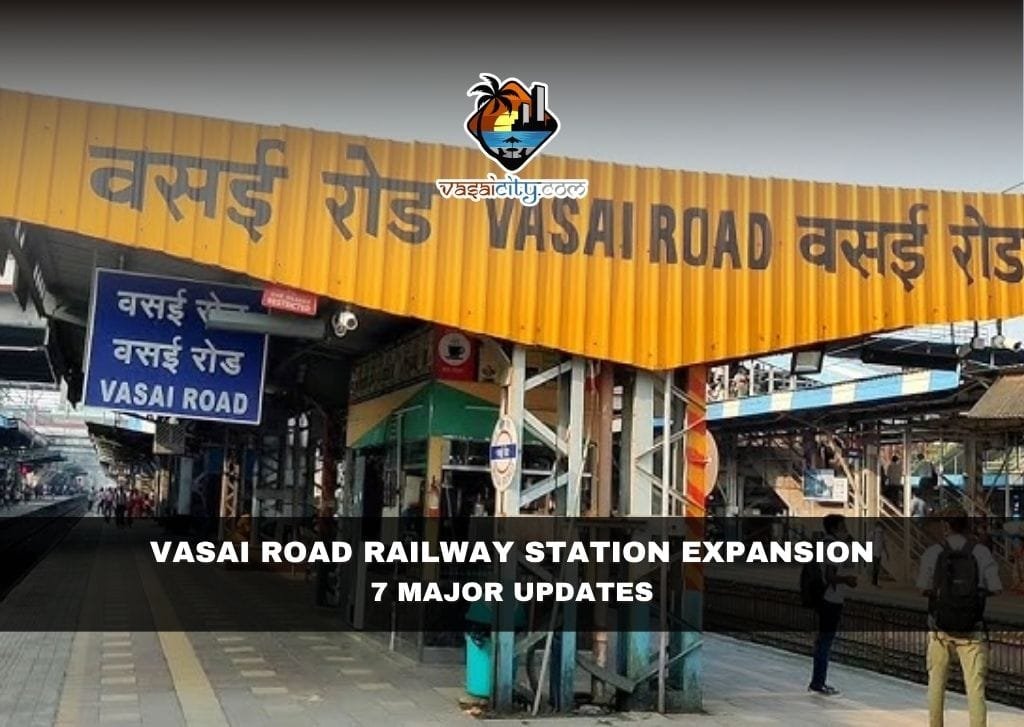
Vasai Road Railway Station Expansion is now officially underway, marking a major infrastructure boost for commuters across the western suburbs and beyond. The Western Railway has initiated construction of a new coaching terminal at Vasai Road, a project that promises to significantly enhance passenger train operations in the region.
The ambitious development, approved in March 2025, is being constructed on the eastern side of the Vasai Road railway yard. Spread across 4.5 hectares of railway land, the new facility is designed exclusively for passenger use, with no freight handling planned at this location.
Table of Contents
What the Vasai Road Railway Station Expansion Includes
The Vasai Road Railway Station Expansion project will be developed in phases, with the first phase focusing on essential infrastructure. This includes three railway lines and an island platform setup featuring two platforms.
Officials say that once completed, the terminal will be capable of handling approximately 12 passenger trains in each direction daily. This will significantly improve train frequency and reduce congestion at existing railway hubs across the Mumbai Metropolitan Region (MMR).
Boost to Train Connectivity and Operations
One of the biggest advantages of the Vasai Road Railway Station Expansion is its role in improving connectivity. The terminal is expected to serve as a key originating and terminating point for both northern-bound and southern-bound trains.
In addition, the project will support MEMU (Mainline Electric Multiple Unit) services between Dahanu Road and Panvel, offering better connectivity for daily commuters. This is particularly important for passengers traveling across long suburban distances.
A Strategic Backup During Disruptions
The Vasai Road Railway Station Expansion is also being planned as a strategic backup terminal for Mumbai’s busy railway network. During disruptions - especially in the monsoon season - train services can be rerouted to Vasai to minimize delays and maintain smoother operations.
This added flexibility will play a crucial role in improving overall railway reliability in the region, which often faces weather-related challenges.
Project Cost and Financial Breakdown
The total cost of the Vasai Road Railway Station Expansion stands at ₹162.27 crore, out of which ₹150.26 crore has already been sanctioned. A significant portion of the budget - ₹108.54 crore - has been allocated to civil construction work.
Other key expenditures include:
- ₹15.14 crore for electrical systems
- ₹23.21 crore for signalling infrastructure
- ₹3.34 crore for mechanical components
According to railway officials, the project has a financial internal rate of return (FIRR) of 16.38%, indicating strong economic viability.
Scale and Technical Details
The Vasai Road Railway Station Expansion spans a route length of approximately 1.8 kilometers, with a total track length of 5.1 kilometers. The maximum operational speed within the terminal will be limited to 30 km/h to ensure safety and efficiency in train handling.
Despite the moderate speed, the terminal’s design focuses on optimizing train turnaround time and improving scheduling flexibility.
Relief for Overcrowded Railway Hubs
A major benefit of the Vasai Road Railway Station Expansion is the expected decongestion of overcrowded railway stations in Mumbai. By shifting some train operations to Vasai, pressure on major termini will be reduced.
Commuters traveling between Borivali and Dahanu, as well as those commuting from Vasai to Panvel, are expected to benefit the most from this project.
Timeline and Completion
While initial groundwork and preparatory activities have already begun, the full completion of the Vasai Road Railway Station Expansion is expected by June 2027.
Once operational, the terminal is set to transform Vasai into a key railway hub, improving connectivity, reducing travel time, and offering a more reliable commuting experience for thousands of passengers daily.
Inputs by Biju Cherian
This article is based on the author’s research and perspectives. The publisher claims no responsibility for inaccuracies. Views expressed are the contributor’s alone. Institutions mentioned are not endorsed unless specified.
